


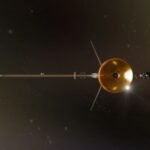






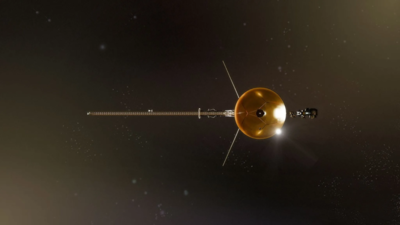
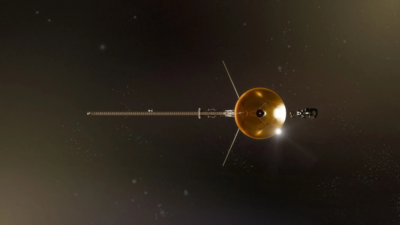
Once upon a time, nearly 50 years ago, a little spacecraft left Earth on a journey into the unknown. It carried cameras, scientific instruments and something rather unusual: a golden record containing sounds, pictures and greetings from the people of Earth.Nobody knew how long it would survive. Nobody knew how far it would travel. And nobody knew whether anyone, anywhere in the universe, would ever find the message it carried.That spacecraft was Voyager 1. Launched by Nasa on Sept 5, 1977, it was originally sent to explore the giant planets of our solar system. It was supposed to fly past Jupiter and Saturn, take pictures and send information home.But Voyager had other adventures waiting for it. Today, it’s the most distant human-made object in space. It has travelled beyond the planets, crossed the boundary of the Sun’s protective bubble and entered the space between stars. And it is still sending messages to Earth.On Nov 18, 2026, at about 3.46 pm IST, Voyager 1 is expected to become the first human-made object to reach a distance of one light-day from Earth. That means it will be about 25.9 billion km away. A message sent from Earth will take 24 hours to reach it. A reply will take another 24 hours to return. So, how did this little traveller get so far? And what is it doing out there?It began with a rare opportunityTo understand Voyager’s journey, we must go back to the 1960s, when scientists realised that the giant planets of our solar system were going to be positioned in a way that offered a rare opportunity. A spacecraft could visit several of them in one journey, using their gravity to travel from one to another. Such an alignment happens only about once every 176 years.Nasa decided not to let the opportunity pass. It built two spacecraft, Voyager 1 and Voyager 2. Both were designed to study Jupiter and Saturn, their moons and their rings. Voyager 2 was launched first, on Aug 20, 1977. Voyager 1 followed on Sept 5.Despite leaving later, Voyager 1 travelled along a faster route and overtook its twin. The secret behind their journeys was a clever trick called a gravity assist. When a spacecraft passes close to a moving planet, the planet’s gravity can change its direction and increase its speed. It is a little like swinging a ball around a moving object and letting it gain speed from the movement.This allowed Voyager to travel enormous distances without carrying enough fuel to power its entire journey.A world of surprisesVoyager 1 reached Jupiter in March 1979. What it saw surprised scientists. Jupiter was not just a huge ball of gas with swirling clouds. Its moon Io had active volcanoes. Voyager spotted enormous plumes rising from the moon’s surface. It was the first time scientists had seen active volcanoes on a world beyond Earth.
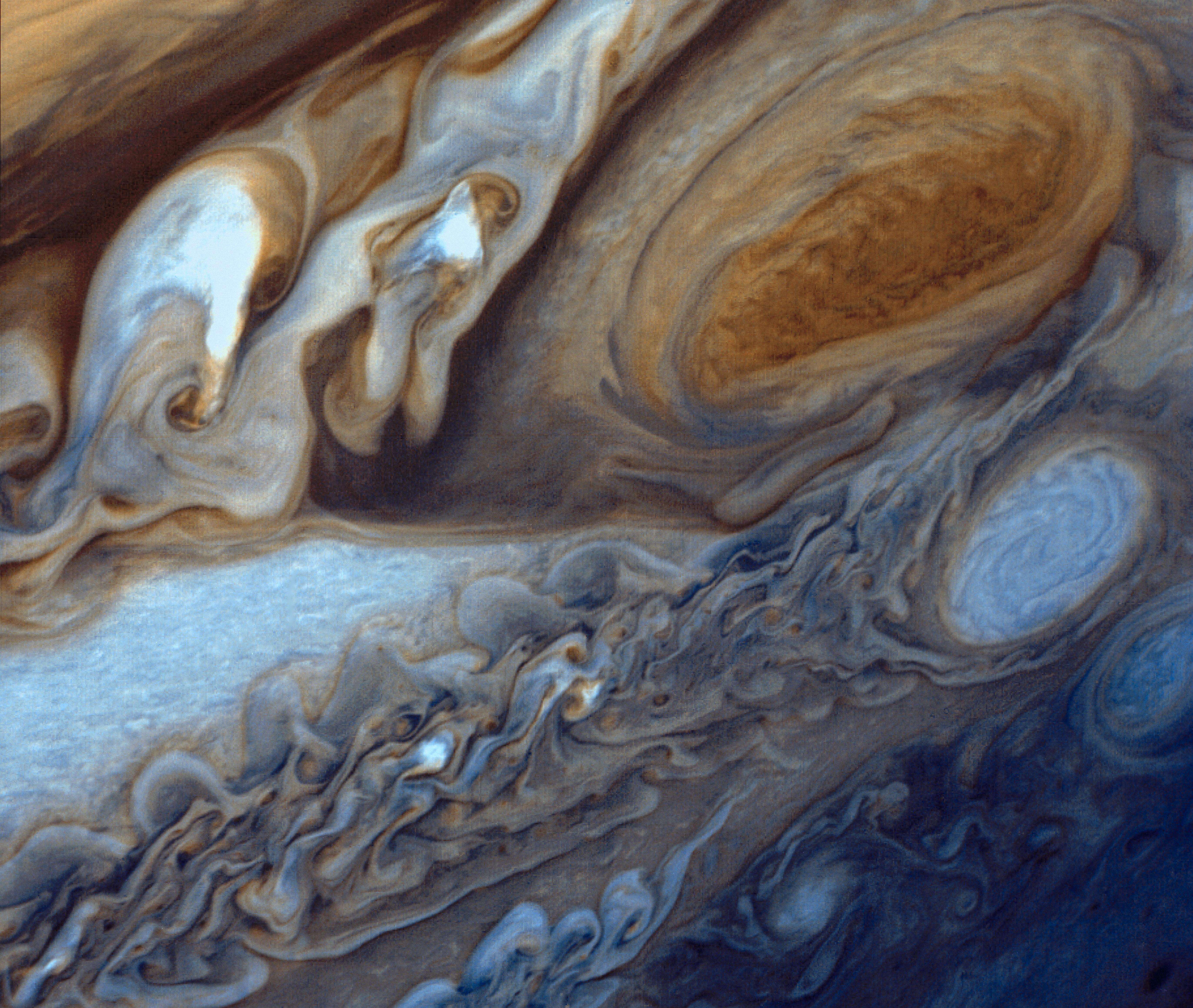
View of Jupiter taken by Voyager 1 (Image Credit: NASA/JPL-Caltech).
The spacecraft also discovered two previously unknown moons, Thebe and Metis, and photographed a faint ring around Jupiter.Then came Saturn. In Nov 1980, Voyager 1 flew past the ringed planet. Nasa says it found five new moons and a new ring, later named the G ring. Its photographs showed that Saturn’s rings were far more complicated than they appeared from Earth.One of its most important targets was Titan, Saturn’s largest moon. Voyager found that Titan had a thick atmosphere, made largely of nitrogen, with methane and other gases. The atmosphere was so thick that the spacecraft could not see the surface clearly.These discoveries changed what scientists knew about the outer planets. But Voyager 1’s planetary adventure was about to end. Its journey into the space beyond them was just beginning.A last look at homeIn Feb 1990, Voyager 1 did something that would give the world one of its most memorable photographs. By then, it was about 6 billion km from Earth. Its cameras had completed their main work, and Nasa was preparing to switch them off to save electricity.
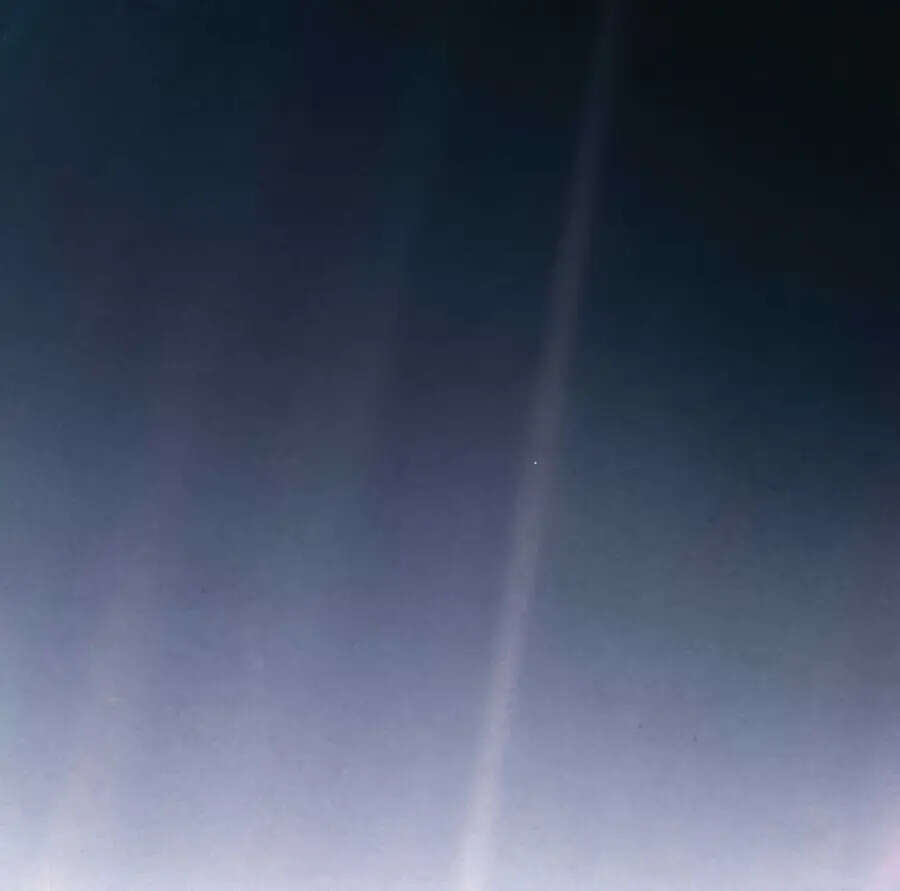
This narrow-angle color image of Earth, dubbed “Pale Blue Dot,” is part of the first ever “family portrait” of the solar system, taken by Voyager 1. (Photo: NASA/JPL-Caltech).
But astronomer Carl Sagan had an idea. Before the cameras were shut down, why not turn the spacecraft around and ask it to photograph the planets, including Earth, one last time?Voyager did. The photograph showed Earth as a tiny speck of light, caught in a ray of sunlight. It became known as the “Pale Blue Dot”.Think about that for a moment. Every person who has ever lived, every city, every ocean, every war, every celebration and every ordinary day of human life was happening on that tiny speck.Sagan later wrote about what the picture meant. It reminded us that Earth is our only home, and that everything we have ever known exists on this small planet.The cameras were switched off after the photograph was taken. Voyager would never take another picture of Earth or the planets. But its other instruments continued working.When Voyager entered the space between starsThere’s something important to understand about the phrase ‘leaving the solar system’. The Sun constantly sends out a stream of tiny charged particles called the solar wind. These particles travel outwards and create a huge bubble around the Sun. Scientists call this the heliosphere.Imagine it as a protective neighbourhood around our star. At the outer edge of this bubble is a boundary called the heliopause. Beyond it lies the space between stars, known as interstellar space.
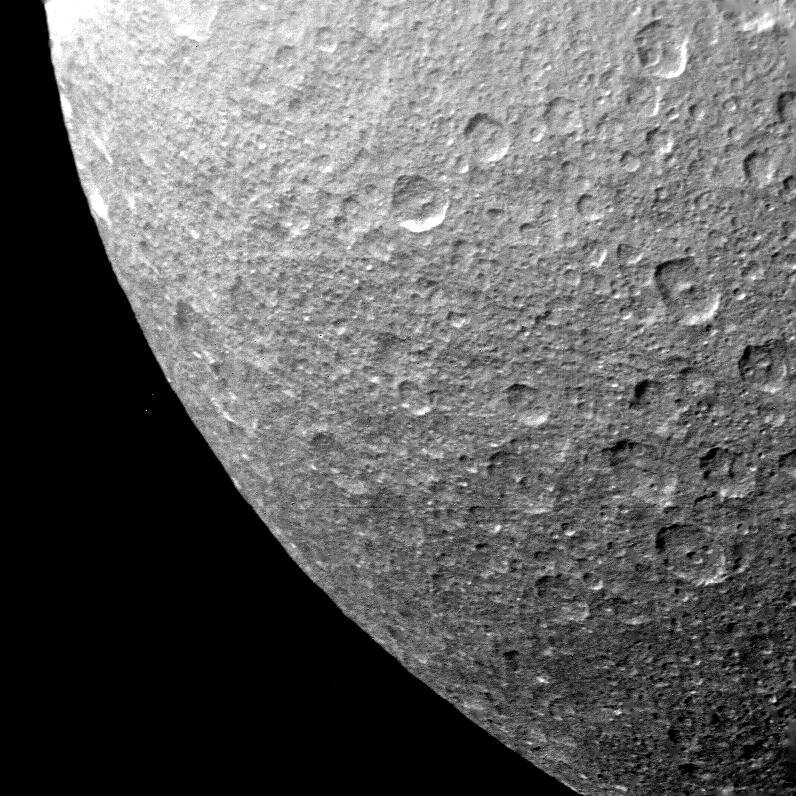
Multiple impact craters are seen on the ancient surface of Saturn’s moon Rhea in this picture taken by Voyager 1 (Photo: Nasa).
On Aug 25, 2012, Voyager 1 crossed this boundary. It became the first human-made spacecraft to enter interstellar space.Scientists knew it had crossed because the spacecraft began detecting changes in the particles around it. Particles coming from within the Sun’s bubble became much less common, while high-energy particles from outside increased. The crossing was formally confirmed only in 2013, after measurements of the surrounding plasma.But there is a small catch. Voyager has crossed the Sun’s protective bubble, not the full extent of its gravitational influence. The Sun’s gravity reaches much farther, towards a distant region called the Oort Cloud, which is believed to contain countless icy objects.So, although Voyager has entered the space between stars, it has not crossed every possible boundary of the solar system. Voyager 2 followed its twin into interstellar space in Nov 2018. It took a different route, past Uranus and Neptune, and will reach its own one-light-day mark only in Nov 2035.What’s out there?The space between stars is not completely empty. It contains gas, dust, charged particles and magnetic fields. Voyager 1 is now studying this region. Its instruments measure magnetic fields, waves travelling through electrically charged gas and tiny particles arriving from distant parts of the galaxy.
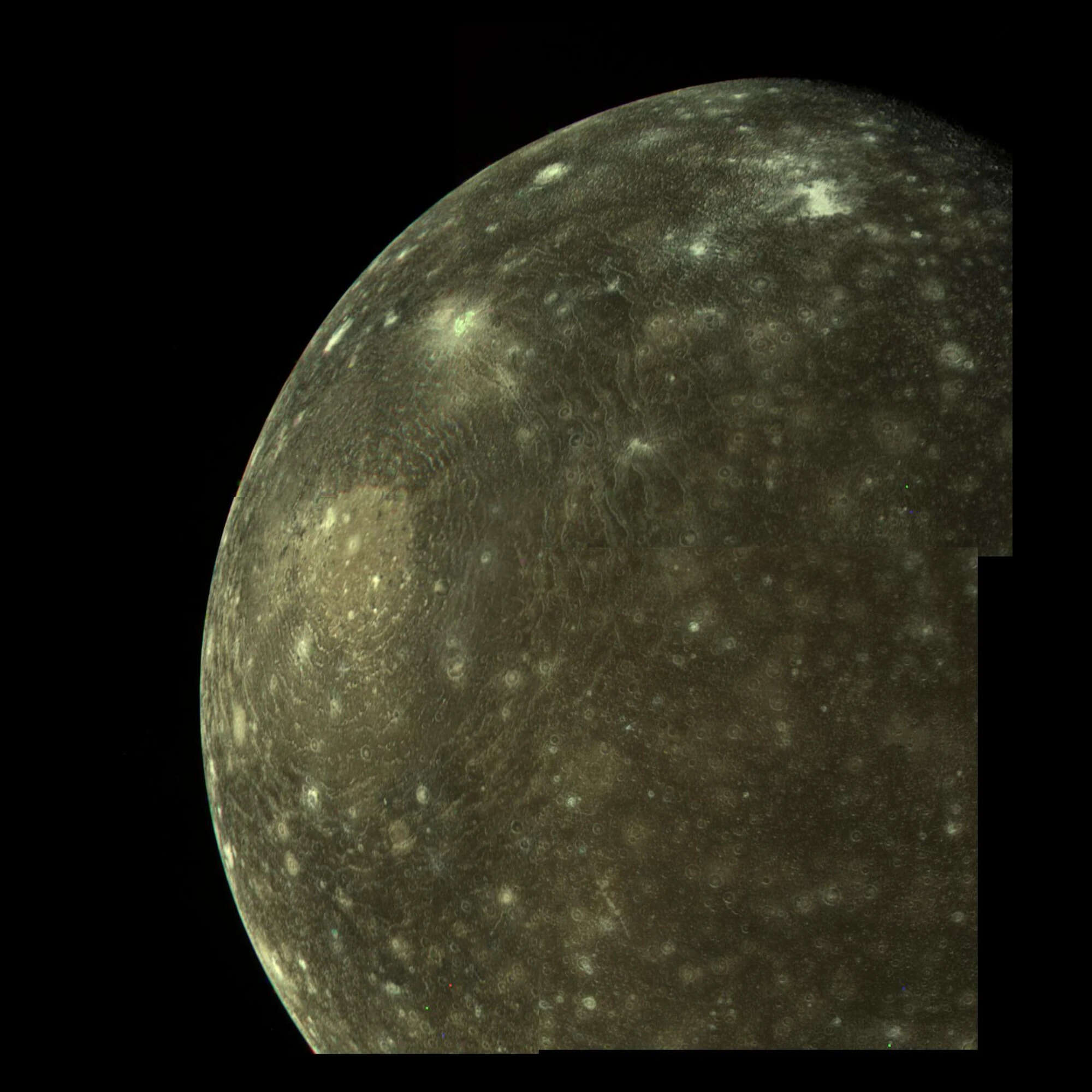
Jupiter’s moon Callisto was revealed by the Voyager cameras to be a heavily cratered and hence geologically inactive world (Photo: Nasa).
Why does this matter? Scientists can use telescopes to look at distant stars and galaxies. But Voyager is doing something different. It is actually measuring the material in the space between stars.Its observations are helping researchers understand what lies beyond the Sun’s influence and how our solar system meets the wider galaxy. It is a little like travelling to the edge of a forest to find out what lies beyond it, rather than simply looking at the forest from a distance.Message from earth, for whoever finds itThere is something else aboard Voyager 1 that makes its journey special. Attached to the spacecraft is a 12-inch gold-plated copper disc called the Golden Record.It is a message from Earth, prepared in case Voyager is ever found by an intelligent civilisation elsewhere in the universe. The idea came from astronomer Carl Sagan and a team of scientists and experts who wanted to put together a small collection that would tell the story of our planet and the people who live on it.The record carries 115 images, greetings in 55 languages, music from different parts of the world and sounds from everyday life on Earth.There are sounds of thunder, wind, birds, animals, footsteps and laughter. The music includes works by Bach and Beethoven, as well as Chuck Berry. There are also greetings from then US President Jimmy Carter and UN Secretary-General Kurt Waldheim.The cover carries instructions on how to play the record and information that could help anyone finding it locate Earth. There is no guarantee that anyone will ever find it though. Space is so vast that the chances are extremely small.And Voyager is not actively looking for extraterrestrial life or trying to establish contact with other civilisations. It is simply carrying the message as it travels.Perhaps that is what makes the Golden Record so special. It is a greeting sent without knowing who might receive it, or when. It tells whoever might find it that a small planet around an ordinary star was once home to people who wanted to say hello.How does it keep going?By now, you might wonder how a spacecraft built in 1977 is still working. The answer lies in a special power source. Voyager 1 does not use solar panels because sunlight is too weak at such enormous distances from the Sun.Instead, it has three devices called radioisotope thermoelectric generators. They use heat produced by the natural decay of a radioactive material called plutonium-238 and convert it into electricity.But the power they produce slowly declines with time. So Nasa engineers have had to make some difficult choices. They have switched off instruments and heaters that are no longer essential, saving electricity for the systems that matter most.The cameras were switched off in 1990. Several scientific instruments have also been shut down over the years. As of Nov 2026, two scientific instruments remain operational: one that measures magnetic fields and another that detects waves in the electrically charged gas around the spacecraft.Voyager also needs to communicate with Earth. Nasa uses a network of large radio antennas around the world to listen for its faint signals.The spacecraft has suffered communication problems in recent years, but engineers have managed to restore contact and keep it going. Most recently, Nasa’s antennas detected no signal on Oct 18 and 19, before contact returned on its own on Oct 20. Its ageing computers and limited power supply make every additional year of operation a challenge.In Sept, engineers completed a power-saving operation, nicknamed the “Big Bang”, that swapped three power-hungry devices for lower-power ones. Nasa expects its scientific mission to end sometime in the 2030s, although nobody knows the exact date.The journey has no real endingVoyager 1 is travelling at about 61,000 km per hour. That is incredibly fast by everyday standards. But space is so vast that even at this speed, reaching another star would take tens of thousands of years.In about 40,000 years, it is expected to pass relatively close to a star called Gliese 445. Even then, it will remain about 1.7 light-years away.Long before that, Voyager will run out of electricity to operate its instruments and send messages home. Its scientific mission will end. Its radio will fall silent.But the spacecraft itself will not stop travelling. It will continue moving through the galaxy, carrying its Golden Record, long after the last signal from Earth has reached it.And that brings us back to Nov 18, 2026, when Voyager 1 is expected to reach a distance of one light-day from home. Imagine that. A little spacecraft that left Earth when the world was very different has travelled so far that a message from its home planet needs an entire day to find it.One day, it will stop talking to us. But it will keep going. And somewhere in the great darkness between the stars, a little piece of Earth will continue its journey, carrying our music, our greetings, our pictures and our hope that someone, somewhere, might one day find it.
Which musical piece do you think represents Earth best for the Golden Record?
3k+ users shared opinion today
5k+ users already voted today
3k+ users shared opinion today