







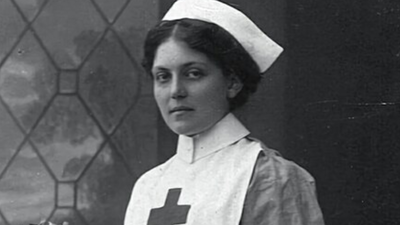
Violet Jessop survived three maritime disasters involving the Olympic-class ships, a record that earned her the nickname “Miss Unsinkable.” According to Wikipedia, All That’s Interesting and Sky History, she was aboard the RMS Olympic when it collided with HMS Hawke in 1911, escaped the Titanic’s sinking in 1912, and survived the sinking of the HMHS Britannic in 1916.Her story is remarkable not only because she lived through so much, but because she kept returning to sea afterward. Jessop worked as a stewardess and later as a nurse during World War I, and she continued serving on ocean liners long after the disasters that should have been enough to end any maritime career.
A difficult early life
Violet Constance Jessop was born on October 2, 1887, near Bahía Blanca, Argentina, to Irish immigrant parents. She was the eldest of nine children, six of whom survived infancy, and she spent much of her childhood helping care for her younger siblings.As a child, Jessop contracted tuberculosis, an illness doctors predicted would be fatal. She survived, though the experience left a lasting impression on her sense of resilience.When she was 16, her father died after complications from surgery, and the family moved to England. Jessop attended a convent school before leaving to help support the family when her mother became ill.Following in her mother’s footsteps, she applied for work as a stewardess. At 21, she joined the Royal Mail Line aboard the Orinoco in 1908, beginning a career at sea that would become one of the most extraordinary in maritime history.
The Olympic collision
In 1911, Jessop joined the White Star Line and was assigned to the RMS Olympic, the largest civilian liner of its time. The ship was the first of three Olympic-class vessels built in Belfast, alongside the Titanic and the Britannic.On September 20, 1911, the Olympic left Southampton and collided with the British warship HMS Hawke in the Solent. The impact caused significant damage to the Olympic, but no one died and the ship managed to return to port without assistance.The collision was costly for White Star, which had to pay for extensive repairs and lost revenue while the Olympic was out of service. An inquiry also found the company responsible for the incident.Jessop did not mention the collision in her memoirs, but she remained with the Olympic until April 1912, when she was transferred to the Titanic. That move would place her at the center of one of the most famous maritime disasters in history.
Surviving the Titanic
Jessop boarded the Titanic on April 10, 1912, at the age of 24. Four days later, on April 14, the ship struck an iceberg in the North Atlantic and sank about two hours and forty minutes later.In her memoirs, Jessop described being ordered onto deck to serve as an example for non-English-speaking passengers who could not follow the crew’s instructions. She watched as lifeboats were loaded, then was ordered into lifeboat 16.As the boat was lowered, Titanic’s sixth officer, James Paul Moody, handed her a baby to look after. Jessop and the other survivors were rescued the next morning by the RMS Carpathia and taken to New York.According to Jessop, while aboard the Carpathia, a woman, presumably the baby’s mother, grabbed the child from her arms and ran off crying without saying a word. The moment became one of the most haunting details of her account.Nearly 1,500 people died in the Titanic disaster, but Jessop survived. Instead of leaving the sea behind, she returned to work, a decision that would soon place her in danger again.
The Britannic disaster
During World War I, Jessop became a nurse with the Voluntary Aid Detachment and served aboard the HMHS Britannic, the youngest of the Olympic-class ships. The vessel had been converted into a hospital ship and was carrying wounded troops from the Gallipoli campaign.On November 21, 1916, the Britannic struck a German naval mine in the Aegean Sea and sank within 55 minutes. Thirty of the 1,066 people aboard died, but Jessop survived, though not without injury.As the ship listed, lifeboats were pulled toward one of Britannic’s giant spinning propellers, which had lifted partly out of the water. The boats were smashed, and Jessop had to jump into the sea to avoid being pulled under.She suffered a traumatic head injury in the process. Years later, a doctor discovered she had sustained a skull fracture, a detail she only learned long after the event.Jessop later described watching the Britannic go down, saying the ship “dipped her head a little, then a little lower and still lower” before taking a final plunge into the depths. Her words captured the horror of seeing another White Star liner disappear beneath the waves.
A life after disaster
After the war, Jessop returned to work for White Star Line in 1920. She later joined the Red Star Line and then the Royal Mail Line again, completing two around-the-world cruises aboard the Belgenland.At 36, she married John James Lewis, a fellow White Star steward, though the marriage ended in divorce after about a year. She eventually retired to Great Ashfield in Suffolk, where she lived until her death in 1971 at the age of 83.Her story has been retold in books, films and documentaries, including the 1958 film A Night to Remember and James Cameron’s 1997 Titanic. In the 1979 television movie S.O.S. Titanic, Jessop was portrayed by Madge Ryan.Jessop’s life remains a reminder that survival is not always about luck. Sometimes it is about persistence, courage and the willingness to keep moving forward, even when the sea has already taken so much.