







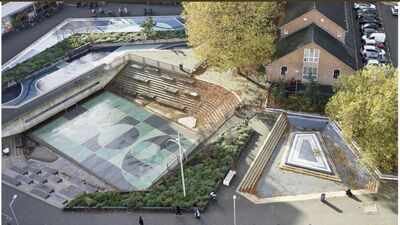
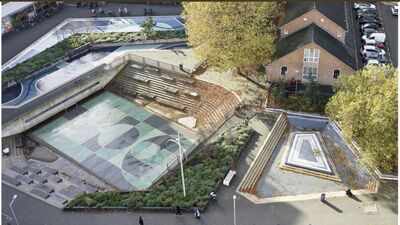
Rotterdam has found a unique way to deal with heavy rainfall by turning a public square into a temporary water storage space that also serves as a recreational area. The Water Square Benthemplein, designed by Dutch architecture firm De Urbanisten, collects rainwater during downpours and holds it in specially designed basins. During the dry season, the same area becomes a place for residents to play basketball, volleyball and other sports, demonstrating how urban infrastructure can serve more than one purpose.
How Rotterdam’s water square stores rainwater during heavy downpours
The Water Square Benthemplein was created to address a problem that Rotterdam has faced during intense rainfall. When large amounts of rain fall within a short period, parts of the city can flood because the existing water system cannot always process the additional water quickly enough.The Climate Adaptation Platform Netherlands says that the concept of water squares is to give residential areas places where rainwater can be collected and released in a controlled way. Instead of letting too much water overwhelm the drainage system, specially designed public spaces temporarily hold the water until the city’s water infrastructure can handle it.Benthemplein is one of the most prominent examples of this approach. The square has a storage capacity of 1,800 cubic metres, making it a significant part of Rotterdam’s efforts to manage heavy rainfall. Its design also ensures that the space remains useful to residents when there is no immediate need to store water.The project was designed by De Urbanisten and officially opened on 4 December 2013, according to Landezine’s project profile.
Three basins manage different levels of rainfall
One of the most important features of Benthemplein is its 3 separate water basins. According to the Dutch Architects, 2 shallow basins collect rainwater from the immediate surroundings whenever it rains. A third, deeper basin is designed to receive water when rainfall continues for longer and larger quantities need to be stored.The water reaches these basins through large stainless-steel gutters that run across the square. The design also includes a water wall and a rain well, which make the movement of rainwater visible to people visiting the space. The water wall directs rainfall towards the deeper basin, while the rain well brings water from a neighbouring building into the gutter system.De Urbanisten explains that the water is gradually channelled into the square rather than being allowed to collect unpredictably. The design also accounts for what happens after the rain stops. According to Dutch Architects, water collected in the shallow basins moves into an underground infiltration system, allowing it to gradually seep into the groundwater. This helps maintain groundwater levels and supports nearby trees and plants, particularly during dry periods.Water from the deeper basin is returned to Rotterdam’s open-water system within a maximum of 36 hours. This arrangement also prevents all the collected rainwater from immediately entering the city’s combined sewage system.
The square is also useful when there is no rain
The water square was never intended to function only as a flood-control facility. Its designers wanted to create a lively neighbourhood destination that residents could enjoy throughout the year.When the basins are dry, the deeper section becomes a sports area where visitors can play basketball, football and volleyball. The stepped edges around the basin also provide seating, allowing spectators to watch games or simply spend time with others.The shallower sections have different recreational uses. One is designed for skating and other activities on wheels, while another includes a smooth surface intended for dancing and informal gatherings. The surrounding areas feature trees, ornamental grasses and flowers, creating quieter places for people who prefer to sit and relax.Landezine’s project description highlights how the square combines sports facilities, greenery and water management without making the recreational areas feel like secondary additions. The design uses different shades of blue on surfaces that can hold water, while stainless steel marks the structures that transport it. This makes the square’s water-management purpose visible even during dry weather.
Local residents helped shape the design
According to Dutch Architects, students and teachers from Zadkine College and the Graphic Lyceum, members of a nearby church, a youth theatre, a gym and local residents participated in the planning process.Three workshops were organised to discuss how the square should look, what activities it should accommodate and how rainwater could become part of the experience. Participants wanted a place that offered plenty of room for young people while also providing green and quieter areas for relaxation.The German Development Institute’s 2021 paper explains that the consultation process took place over 6 months and focused on activities, design choices and refining the ideas proposed by participants. The paper notes that the workshops shaped features such as the basketball area, skating facilities and seating arrangements.
Rotterdam has expanded the water square concept
Benthemplein is not the only public space of its kind in Rotterdam. The city has developed smaller water squares in other neighbourhoods as part of its wider approach to managing rainfall.According to the Climate Adaptation Platform Netherlands, Bellamy Square in Spangen includes a water-storage section with a capacity of 250 cubic metres. Another example is Kleinpolder Square in Overschie, where an underground basin collects overflow water from nearby surface water. The space also accommodates public sculptures placed on raised platforms to protect them from flooding.Benthemplein’s large storage capacity also made the construction more expensive. Piling work was required during construction, while funding included support from the Dutch government’s Beautiful Netherlands Innovation Programme and an INTERREG subsidy from the European Union.De Urbanisten’s research into water squares began in 2006-2007, and the concept became part of Rotterdam’s official urban policy through Rotterdam Waterplan 2 in 2007.