







In a historic first, the International Court of Justice (ICJ) recently held Myanmar responsible for committing genocide against its Rohingya minority during the military’s brutal 2017 crackdown. The November 19 judgment marked an extraordinary moment in international law as the world’s highest court had never before held a state responsible for carrying out a genocide.The ruling moved the Rohingya’s suffering beyond allegations and condemnation to a formal finding of state responsibility for one of the gravest crimes known to humanity. The verdict also struck a major blow to the military establishment that has ruled Myanmar with impunity, adding to the international pressure on its leadership, already isolated and facing sanctions since the 2021 coup that ousted Aung San Suu Kyi’s civilian government.But the significance of this judgment extends far beyond its legal precedent.Can a landmark verdict translate into justice on the ground? For the Rohingya, that means accountability for those responsible, recognition of the atrocities they endured and, above all, the possibility of returning home safely after hundreds of thousands were driven into exile. For Myanmar, it could become a defining test of whether a state held guilty of genocide can ever be compelled to confront its crimes and change course.
The ICJ ruling
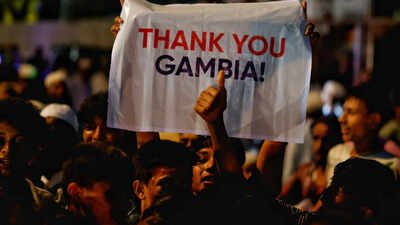
The case dates back to 2019, when the Muslim-majority West African nation of The Gambia, approached the ICJ, accusing Myanmar of violating the 1948 Genocide Convention.Under the convention, the court had to determine whether Naypyidaw had acted with the specific intent to “destroy, in whole or in part”, the Rohingya as a group — the legal threshold for establishing genocide.
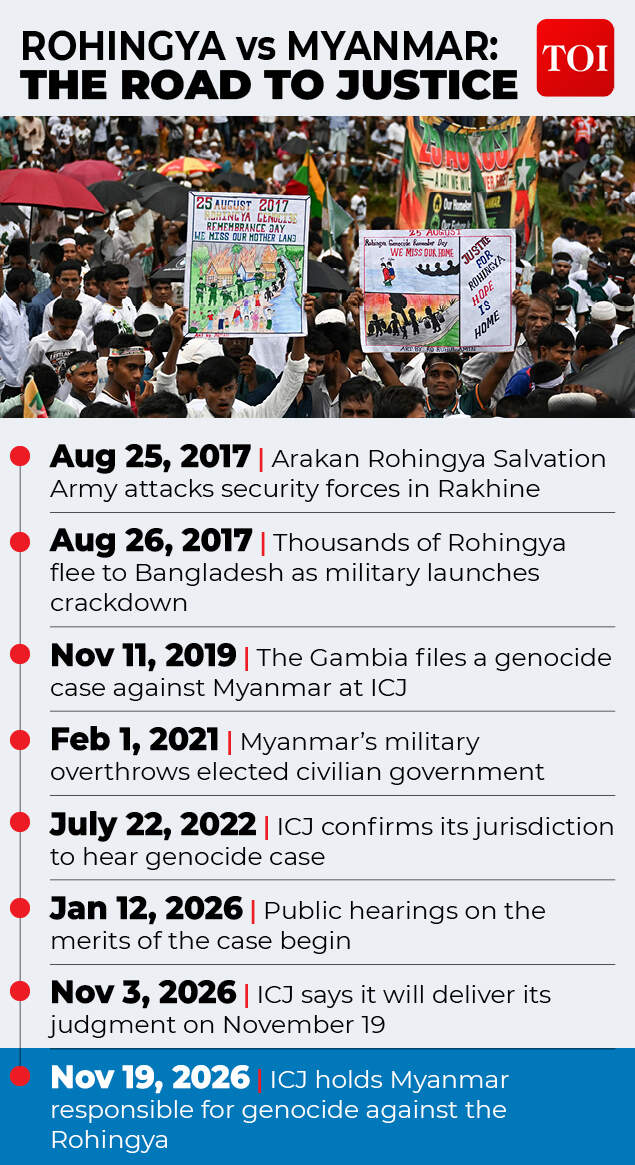
Rohingya’s nine-year road to justice
In its November 19 judgment, the 15-member ICJ bench ruled by a 9-6 majority that Myanmar was responsible for committing genocide against the Rohingya, rejecting Naypyidaw’s defence that the 2017 military campaign was a legitimate operation against insurgents.The court also found that Myanmar’s security forces had perpetrated widespread sexual violence, committed acts of extreme violence against children and attacked Rohingya fleeing across the border into Bangladesh.Sreeparna Banerjee, a Myanmar expert at the Observer Research Foundation, described the verdict as a significant legal and political setback for the state.“The ruling reinforces the state’s obligation to prevent genocide, protect the Rohingya and ensure accountability. It also strengthens the international recognition of the Rohingya’s suffering and places Myanmar under greater legal and diplomatic scrutiny,” she told The Times of India.Yet, while the judgment is final and legally binding, with no right of appeal, the ICJ has no direct enforcement mechanism. This leaves its implementation uncertain, particularly as Naypyidaw has, unsurprisingly, rejected the ruling.
What it means for Myanmar’s military junta
For years, Myanmar maintained that the 2017 military operations were a response to attacks by the Arakan Rohingya Salvation Army, a Rohingya insurgent group operating in Rakhine state, where the crisis unfolded. With the state now formally held responsible for genocide, that justification has been fundamentally undermined, marking a major challenge to Naypyidaw’s long-standing account of the military crackdown.
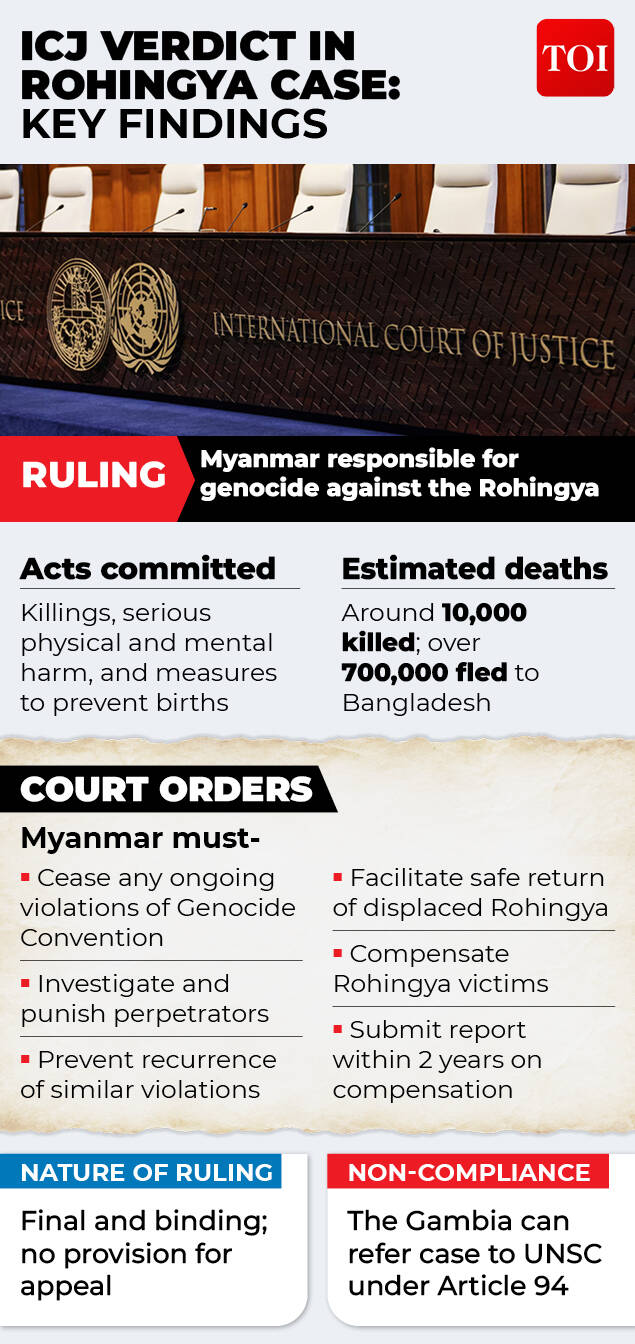
What ICJ ruled in Rohingya genocide case
However, the ICJ’s finding of state responsibility does not establish the individual criminal liability of military commanders or political leaders. Determining who within the military chain of command should face prosecution remains a separate legal process.This distinction is particularly significant for President Min Aung Hlaing, who was Myanmar’s military chief during the 2017 Rohingya crackdown and later led the coup that ousted the civilian government.
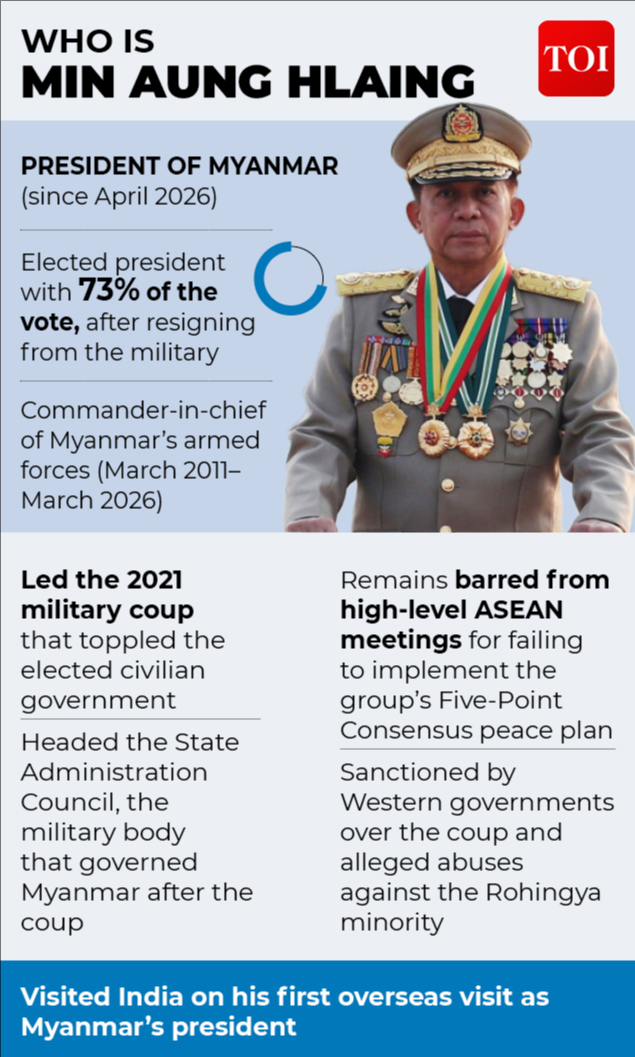
All about Myanmar’s President Min Aung Hlaing
The judgment could nevertheless have far-reaching implications for Myanmar’s military leadership.“The ruling increases international scrutiny of the military leadership and weakens its attempts to normalise its international standing. It could reinforce broader efforts to pursue accountability and further constrain the junta’s diplomatic legitimacy,” Banerjee said.The ICJ has also directed Naypyidaw to investigate those suspected of committing acts of genocide and prosecute and punish them where warranted. This places the military establishment in a difficult position as it is now under a legal obligation to pursue accountability for atrocities committed by its own security forces, raising serious questions about whether it would be willing to investigate and prosecute those within its own ranks.
The challenge of ensuring accountability
With the ICJ lacking an enforcement mechanism and Myanmar’s military leadership unlikely to hold its own ranks accountable, the challenge of establishing individual responsibility remains.One possible route to enforcing the judgment lies in Article 94 of the UN Charter, should The Gambia, which brought the case before the ICJ, choose to invoke the provision.Under Article 94(1), UN member states are obligated to comply with ICJ judgments in cases to which they are parties. If a state fails to do so, the other party may approach the UN Security Council under Article 94(2). The Council may then make recommendations or decide on measures to give effect to the judgment.However, whether this can lead to meaningful action is also uncertain. Of the five permanent members of the Security Council, China and Russia maintain active diplomatic ties with Myanmar, while the United Kingdom and France have welcomed the ICJ ruling. The fifth, the United States, has responded more cautiously, saying it was reviewing the judgment while reiterating its support for the people of Myanmar.Washington’s response is perhaps unsurprising. Although the US continues to impose sanctions on Myanmar, the Trump administration recently held direct talks with the country’s military leadership, suggesting a possible shift in its approach towards the junta.Banerjee agreed that enforcing the judgment would be difficult and would, to a large extent, depend on Myanmar’s own political will to comply. “Enforcement remains difficult … implementation depends largely on Myanmar’s compliance, international pressure and, in certain circumstances, the UN Security Council, where geopolitical divisions could complicate action,” she added.
Rohingya repatriation
The scale of the Rohingya crisis is immense. Before the 2017 crackdown, around 1.1 million Rohingya were living in Myanmar, mainly in Rakhine state.According to an independent UN fact-finding mission, more than 740,000 have since fled to neighbouring Bangladesh, joining earlier waves of refugees and bringing the Rohingya population there to around 1.2 million.
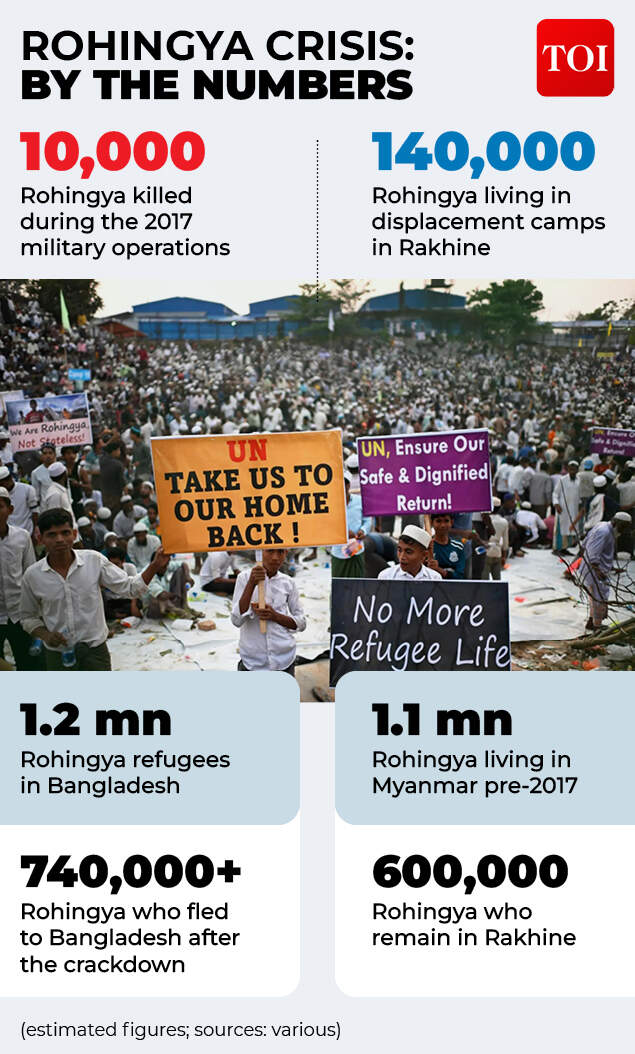
The scale of Rohinya crisis
Today, only around 600,000 Rohingya remain in Rakhine, including 140,000 living in displacement camps.For Rohingya refugees, therefore, the more immediate question is whether the ruling can help secure the conditions needed for their safe and voluntary return to Myanmar, particularly as the ICJ has also directed the state to ensure the safe and voluntary return of those who fled or were displaced, and to provide financial compensation to the victims.However, the judgment does not set an immediate timeline for repatriation. Nor can a legal order by itself create the conditions necessary for refugees to return. The continuing conflict in Rakhine state, the absence of security guarantees and the Rohingya’s longstanding exclusion from Myanmar’s political and social life remain major obstacles.As a result, the prospects of a return home remain extremely limited.“Repatriation will depend on conditions on the ground, including security, citizenship, freedom of movement and guarantees against persecution. Without these, meaningful repatriation remains unlikely in the near term,” Banerjee noted.The verdict may have brought some measure of closure to the victims by holding Myanmar legally responsible for the genocide. But for the Rohingya, justice will remain incomplete until they can return home safely — a prospect that remains unlikely, at least in the foreseeable future.
Political implications for Myanmar
The ICJ ruling came just days before Asean, the Southeast Asian bloc of which Myanmar is a member, extended its exclusion of the country’s military leadership, including Min Aung Hlaing, from participating in its high-level political meetings.The ban was imposed and extended following periodic reviews over Naypyidaw’s failure to implement the Five-Point Consensus agreed with Asean in 2021. The framework aimed at addressing Myanmar’s political and humanitarian crisis following the military coup.
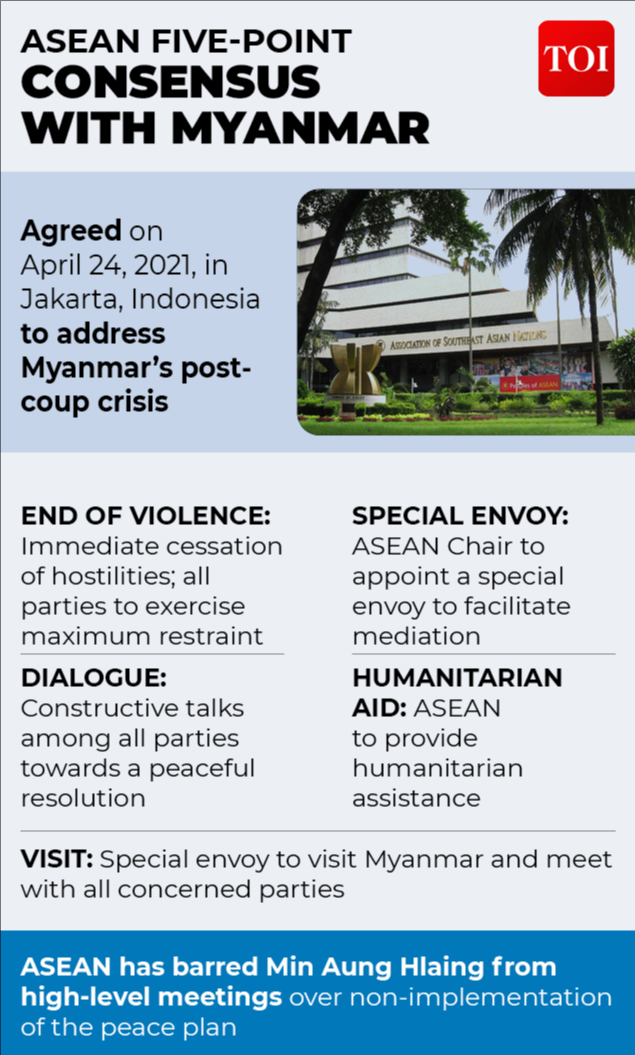
Asean-Myanmar Five-Point Consensus
For the Rohingya, the post-coup crisis has further compounded their suffering. A UN report in August described them as facing “systematic discrimination by all parties, with absolute impunity”, referring to both Myanmar’s military government and the Arakan Army, which now controls almost 90% of Rakhine state.Therefore, for a state seeking international legitimacy, starting with its immediate neighbourhood, the ruling comes as further diplomatic setback.However, its domestic impact is likely to remain limited. “The ruling could become an important reference point in discussions on Myanmar’s future political settlement, particularly concerning accountability, minority rights and inclusive governance. However, amid the ongoing conflict and fragmented political landscape, its immediate influence on the country’s political trajectory is likely to remain limited,” said Banerjee.
The road ahead for the Rohingya
The ICJ judgment represents a significant milestone in the Rohingya’s quest for justice, but it does not resolve the political and humanitarian crisis that continues to affect them. It has established Myanmar’s responsibility and outlined what the state must do to address the consequences of its actions.The challenge now is to ensure that these obligations are fulfilled.The coming months will be important in determining whether the verdict leads to sustained international pressure, progress towards accountability and concrete steps towards repatriation. Much will depend on Naypyidaw’s own willingness, the response of major powers, and the ability of the international community to maintain pressure on Myanmar.The ruling is an important recognition of the Rohingya’s suffering. But its real significance will ultimately be measured not only by the legal precedent it sets, but by whether it changes the conditions in which they live and makes a safe return to their homeland possible.