








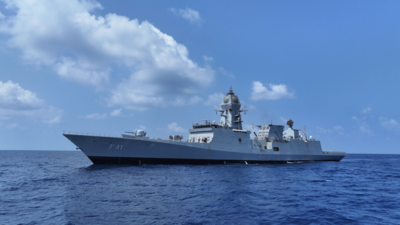
Both India and the United States are ramping up their shipbuilding capability at a moment when China’s share of global ship manufacturing has effectively overtaken the rest of the world combined. According to the Washington-based Center for Strategic and International Studies, China’s share of global shipbuilding output rose from under 5% in 2000 to more than 53% in 2025, while the US accounted for just 0.11 percent in 2024, and effectively nothing by 2025. What makes this particularly significant is that the same Chinese yards, workers and suppliers building commercial tankers also produce destroyers, aircraft carriers and submarines for the PLA Navy, with China State Shipbuilding Corporation alone turning out more commercial tonnage annually than the entire American shipbuilding industry has produced since the Second World War.This scale of dominance has become a genuine strategic concern for New Delhi, and a response is now taking shape. India currently accounts for less than 1% of global shipbuilding output, with an official target of breaking into the world’s top ten shipbuilding nations by 2030, and the top five by 2047. The country operates 61 shipyards in total, eight under the central government, two with state governments and 51 in the private sector. In 2025, the government approved a Rs 69,725 crore package to revitalise the sector, built around a Rs 24,736 crore shipbuilding financial assistance scheme, a Rs 25,000 crore maritime development fund, and a Rs 19,989 crore shipbuilding development scheme aimed at pushing domestic capacity to 4.5 million gross tonnes annually. Output has already risen 41%, from 40,923 gross tonnage in 2024 to 57,637 gross tonnage in 2025, with average contract values more than quintupling in the same period. For context, UN trade and development (UNCTAD) puts global annual ship production at over 6 million gross tonnes.India’s naval shipbuilding capability is already considerably more mature than its commercial side. Prime Minister Narendra Modi said in June 2026 that more than 40 indigenously built warships and submarines had been inducted into service in recent years, with 45 major platforms currently under construction. The Project 17A frigate programme has involved over 200 Indian MSMEs and achieved roughly 75% indigenous content, and construction timelines are genuinely improving, INS Mahendragiri’s launch-to-delivery period was cut from 63 months to 31, while the fifth P17A frigate, INS Dungarpur, was delivered after an 80-month build, down from 93 months for the class’s first ship. Hindustan Shipyard’s upgraded Slipway-4 and a new 300-tonne Goliath crane now allow construction of vessels up to 45,000 DWT, including the Navy’s 43,500-tonne Fleet Support Ships.The commercial shift is becoming visible too, particularly at Cochin Shipyard. In February 2026, it signed a contract with French shipping major CMA CGM for six 1,700-TEU LNG-fuelled feeder container ships, its first order from a global liner operator, worth around $300 million. CSL has since deepened its international partnerships further, including an Rs 1,800 crore joint venture with DP World’s Drydocks World Dubai to jointly operate an international ship repair facility in Kochi, India’s first such public-private collaboration, positioning Kerala as a potential global ship repair hub. GRSE, long dependent almost entirely on warship orders, has diversified as well, with non-defence work now making up 20-25% of its order book, up from roughly 5% five years ago, including a contract for 12 vessels for a German commercial customer.Even so, India remains nowhere close to China’s scale, and the more useful comparison may be with the United States itself, which is grappling with a strikingly similar problem despite operating the world’s most advanced navy. Washington’s own commercial shipbuilding base has hollowed out so significantly that it announced plans for a fifth public Navy shipyard in August 2026, its first in over 80 years, while actively exploring foreign shipbuilding partnerships to rebuild lost capacity. What India doesn’t need to do is replicate China’s entire industrial system. A commercially competitive shipbuilding sector, one building tankers, container ships and offshore platforms, would almost automatically deepen the industrial base the Navy itself draws on. For India, the lesson from both Beijing and Washington is essentially the same: naval power ultimately rests on industrial depth, not simply the number of ships already afloat.