









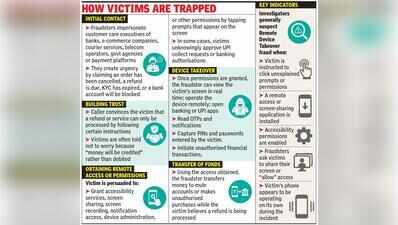
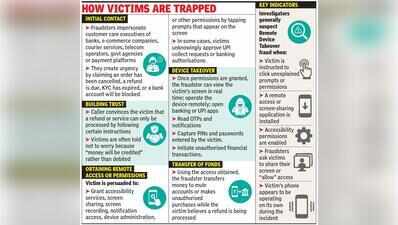
Lucknow: The next time an unknown caller asks you to tap the “three dots” or approve prompts on your mobile phone through SMS or Whatsapp, think twice.Cyber experts warn that it could be the first step in a sophisticated scam known as Remote Device Takeover Fraud, in which fraudsters trick victims into granting access to their smartphones and banking applications.The warning comes after a Lucknow woman allegedly lost ₹3.05 lakh in what investigators suspect was a remote device takeover fraud orchestrated by cyber criminals posing as customer support executives.According to a complaint lodged at Krishna Nagar Police Station, the woman, a resident of Ashutosh Nagar, ordered a pair of shoes through an e-commerce platform.On June 26, she received a call from an unidentified person claiming that the order had been cancelled and that the refund would be credited to her bank account.At the time, her mobile phone was with her child. The caller allegedly instructed the child that three prompts or dots would appear on the phone and asked them to tap them so the refund could be processed. Believing the caller’s claims, the instructions were followed.The complainant later checked her bank accounts only to discover that ₹3.05 lakh had been debited, while no refund had been credited.Police said that the caller used the prompts to obtain screen-sharing, accessibility or other device permissions, a technique commonly associated with Remote Device Takeover Fraud.In such scams, victims are deceived into granting permissions that allow fraudsters to remotely view or operate the device, access banking applications, intercept OTPs, capture PINs and passwords, and carry out unauthorised financial transactions.What is Remote Device Takeover Fraud?Remote Device Takeover Fraud is a form of social engineering-enabled cyber fraud in which cyber criminals deceive a victim into granting remote access or high-level permissions on their smartphone or computer. Once access is granted, the fraudster can view, control or manipulate the device to steal money, sensitive information or credentials.Unlike hacking through malware alone, the victim is tricked into voluntarily authorising access, making it one of the fastest-growing forms of cyber-enabled financial fraud.