








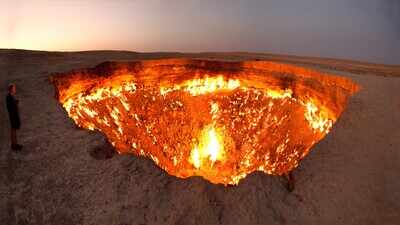
For more than half a century, a giant crater of fire has glowed in the middle of Turkmenistan’s Karakum Desert, drawing travellers from around the world and earning the nicknames “door to hell” or “gates if hell.” By day, it appears as a vast depression in an otherwise barren landscape. After sunset, hundreds of flames illuminate the crater, turning it into one of Central Asia’s most recognisable landmarks.However, the fiery spectacle may not last much longer. Turkmen authorities have spent the past few years trying to reduce the flow of natural gas feeding the crater, and officials now say the blaze has weakened significantly. According to state-owned Turkmengaz and observations shared by researchers and tour operators, the flames are no longer as intense as they once were, although the reasons and what comes next are more complicated than they first appear.
How did the crater form?
The Darvaza Gas Crater lies about 260 kilometres north of Ashgabat, Turkmenistan’s capital. Measuring roughly 60 to 70 metres across and about 30 metres deep, it has become synonymous with the country’s vast natural gas reserves.The crater’s origin, however, is less certain than its popular legend suggests. The most widely accepted account is that Soviet geologists drilling for hydrocarbons in the early 1970s accidentally punctured an underground gas cavern. The ground collapsed, forming a large crater that began releasing methane. To prevent the gas from spreading, engineers are believed to have set it alight, expecting the fuel to burn out within days.No official Soviet records confirming that sequence of events have ever been made public, and researchers including Canadian explorer George Kourounis, who has investigated the crater’s history, have noted that key details remain disputed. Some local geologists have suggested the collapse may have occurred in the 1960s, while others believe the fire itself may not have started until the 1980s.
Why has it burned for so long?
Unlike an ordinary fire, the Darvaza crater is fuelled by methane escaping from underground gas deposits. As long as gas continues reaching the surface, the flames can persist.The site sits within the Karakum Desert, which contains some of the world’s largest natural gas reserves. Turkmenistan itself ranks among the world’s leading holders of proven gas resources, making the crater both a geological curiosity and a reminder of the country’s energy wealth.Although visitors often describe the crater as resembling molten lava, the fire burns natural gas rather than magma. The intense heat comes from methane combustion, with hundreds of individual flames flickering across the crater floor and walls.
From tourist attraction to environmental concern
For years, the crater occupied an unusual place in Turkmenistan’s image abroad. The country receives relatively few international visitors, and the “door to hell” became its best-known tourist attraction, particularly for travellers exploring Central Asia.But the environmental costs have increasingly outweighed its tourism value. In 2022, then-President Gurbanguly Berdimuhamedow instructed officials to find a way to extinguish the fire, saying the crater was harming the environment and wasting valuable natural resources.“It has a negative impact on both the environment and the health of people living nearby,” Berdimuhamedow said during a government meeting. “We are losing valuable natural resources for which we could get significant profits and use them for improving the well-being of our people.”Methane is a powerful greenhouse gas, and although burning converts much of it into carbon dioxide, which has a lower warming effect per molecule than methane, scientists have continued studying emissions from the site using satellite observations.A 2025 study by researchers from the University of Valencia and the University of Turku, analysed hyperspectral satellite imagery collected between 2020 and 2025. The researchers detected dozens of methane plumes above the crater and estimated emissions of roughly 1,000 to 3,000 kilograms per hour, highlighting why the site has become important for climate research as well as geology.
Why the door is closing
Recent changes suggest the famous inferno is entering a new chapter. Speaking at the International Scientific and Practical Conference on Environmental Aspects of Hydrocarbon Resource Development in Ashgabat in June 2025, Irina Luryeva, head researcher at state-owned Turkmengaz, said the intensity of the fire had fallen sharply after engineers reopened nearby gas wells to capture methane that would otherwise have reached the crater. “The reduction is nearly threefold,” Luryeva said, explaining that redirecting underground gas had significantly reduced the flames.In late 2025, Turkmengaz announced plans to drill another well aimed at “completely eliminat[ing] uncontrolled gas emissions into the atmosphere,” signalling that authorities ultimately intend to extinguish the crater altogether.Visitors who returned in 2025 reported seeing only scattered pockets of flame where a roaring inferno once burned. Dylan Harris, managing director of British tour operator Lupine Travel, which regularly organises expeditions to Turkmenistan, told RFE/RL that “in particular last year, the flames were at a significantly lower level,” adding that photographs confirmed the dramatic decline.Researchers involved in the 2025 satellite study caution that the environmental picture is more complex than the shrinking flames suggest. A smaller fire does not automatically mean a lower climate impact: if less methane is burned at the surface but more escapes directly into the atmosphere, total greenhouse gas emissions could remain significant. For that reason, scientists continue using satellite instruments to monitor both the visible flames and the methane escaping from the site.Whether the flames disappear in the coming years or continue burning at a reduced level, the Darvaza Gas Crater has already secured its place in geological history – not only as one of the world’s most unusual accidental landmarks, but also as a reminder of how a decades-old industrial mishap can evolve into a global tourist attraction, an environmental challenge and a scientific laboratory all at once.