








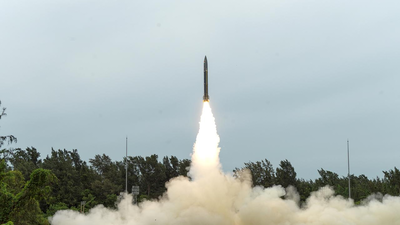
Short-range ballistic missiles have emerged as one of the defining weapons of modern conflict, and nowhere has this been more evident than in the wars raging in Europe and West Asia over the past few years. Russia has employed its Iskander-M missiles extensively against Ukraine, using their speed and manoeuvrability to strike command posts, air bases and logistics hubs while challenging Kyiv’s Western-supplied air defences. Iran, too, has leaned heavily on its short- and medium-range ballistic missile arsenal, firing waves of missiles at Israel during recent exchanges and testing the limits of even the vaunted Iron Dome and Arrow interceptor systems.These conflicts have driven home a hard truth: intercepting short-range ballistic missiles remains one of the toughest challenges in modern air defence. Unlike longer-range ballistic missiles that follow predictable arcs for much of their flight, short-range systems spend less time in the exo-atmospheric phase, leaving defenders with a drastically compressed window to detect, track and engage them. When these missiles can also manoeuvre during their terminal approach, as quasi-ballistic designs do, the problem compounds further, since interceptor systems calibrated for predictable trajectories can struggle to compute a firing solution against a target that keeps altering course in its final seconds of flight.It is against this global backdrop that India’s Pralay missile deserves close attention. Developed by the Defence Research and Development Organisation, Pralay is a canisterised, road-mobile tactical ballistic missile that can be stored and fired at short notice, giving India’s forces considerable battlefield flexibility. Drawing on technology from the Prahaar missile and the Prithvi Defence Vehicle interceptor programme, Pralay was conceived to fill a specific gap: a conventionally armed strike option that operates outside the constraints of India’s nuclear No First Use doctrine. With a range of 150 to 500 kilometres and a payload capacity of between 350 and 1,000 kilograms, the missile can be fitted with high-explosive fragmentation, penetration-cum-blast or runway-denial submunitions, making it suitable for use against airfields, radar installations and command centres.What truly sets Pralay apart, however, is its solid-fuel propulsion combined with the ability to perform terminal-phase manoeuvres, a capability that places it in the quasi-ballistic category alongside China’s Dongfeng-12 and Russia’s Iskander. Slated to join India’s Integrated Rocket Force alongside BrahMos, Nirbhay and Pinaka, Pralay’s combination of speed, trajectory unpredictability and warhead flexibility makes it arguably one of the most capable short-range ballistic missiles in its class today.