








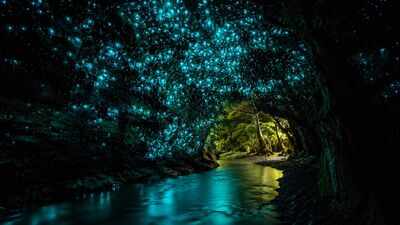
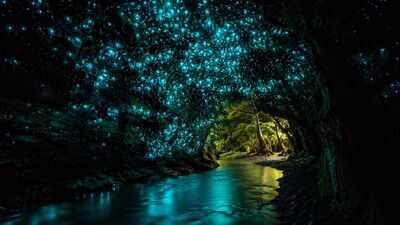
By day, many of New Zealand’s forest tracks appear unremarkable. Ferns crowd the undergrowth, damp rock faces line narrow paths and streams cut through thick vegetation. Yet after sunset, some of these same places take on an entirely different appearance. Tiny blue-green points of light begin to emerge from banks, cliffs and overhanging roots until sections of forest seem to resemble a star-filled night sky turned upside down.The effect is created by glowworms, small insect larvae that spend much of their lives hidden from view. Although visitors often associate them with famous cave systems, glowworms can also be found in shaded forest habitats where darkness and moisture create the conditions they need. What looks at first glance like a natural light display is actually part of a hunting strategy developed by one of New Zealand’s most unusual insects.
How New Zealand glowworms create their blue-green lights
Despite their name, New Zealand’s glowworms are not worms at all. According to Tourism New Zealand, the species responsible for these displays is Arachnocampa luminosa, the larval stage of a fungus gnat found only in New Zealand and Australia.The larvae spend months living in damp environments, attaching themselves to cave ceilings, rock walls, stream banks and sheltered forest overhangs. During this period they emit a distinctive blue-green glow that can remain visible throughout the night. In dense woodland, where artificial light is absent, and the tree canopy blocks much of the moonlight, hundreds of larvae glowing together can create the impression of a miniature galaxy suspended among the vegetation. As per the BBC,the species is unique to New Zealand and is responsible for the famous glowing displays that attract visitors to locations such as Waitomo. Yet similar scenes occur away from the country’s best-known caves, particularly in forested areas where darkness allows the lights to stand out more clearly.
The science behind New Zealand’s blue-green glowworms
The glow itself is not produced for decoration or communication. It serves a practical purpose. According to the BBC, the light is generated through a chemical reaction involving oxygen and specialised enzymes within the larva’s body. The reaction creates the characteristic illumination visible in caves and forests across the country.Darkness plays an important role. During daylight hours, the glow is difficult to notice, but as evening arrives, the surrounding environment becomes black enough for the lights to appear increasingly bright. This gradual shift can be striking in forest habitats. At dusk, only a handful of glowing points may be visible. An hour later, entire sections of rock face can seem covered in stars.As per Tourism New Zealand, outdoor glowworms usually begin shining shortly after sunset and can remain illuminated through the night. Disturbances, however, often cause the larvae to reduce or hide their light, which is why visitors are generally encouraged to approach quietly and avoid shining torches directly at them.
How New Zealand glowworms use light to hunt prey
The glowing display has a less obvious purpose: attracting prey. According to Tourism New Zealand, Arachnocampa luminosa differs from most fungus gnats because the larvae are carnivorous. Each larva produces fine strands coated with sticky mucus and suspends them beneath its resting place. Small flying insects, drawn towards the glow in the darkness, can become trapped on these threads. The larvae construct silk nests and hang mucus-covered fishing lines below them. The glow functions as a lure, bringing potential prey within reach.Seen from a distance, the lights appear calm and decorative. Up close, they reveal an active hunting system. The brightest displays often indicate areas where many larvae are competing for insects drifting through the darkness. What resembles a peaceful celestial scene is, in reality, a collection of tiny predators waiting for food.
From Waitomo caves to Forest trails: Best places to see New Zealand glowworms
The Waitomo region remains the most famous destination for viewing glowworms. According to the BBC, the limestone cave network there stretches across hundreds of known caves and has attracted visitors for well over a century. Boat tours through the darkness allow travellers to view dense clusters of glowing larvae overhead.The phenomenon is not limited to Waitomo. Other locations include the Te Anau Glowworm Caves in Fiordland, forest environments around Auckland and cave systems near Charleston on the South Island’s West Coast. Glowworms also occur in natural forest habitats across different parts of the country, often in places where streams, humidity and limited sunlight create suitable conditions.For those who encounter them in the wild, the experience is often less about individual insects and more about the atmosphere they create together. As daylight fades and the forest darkens, thousands of tiny points of blue-green light emerge from the shadows. For a few hours each night, parts of New Zealand’s landscape resemble a galaxy scattered among roots, rocks and trees.