











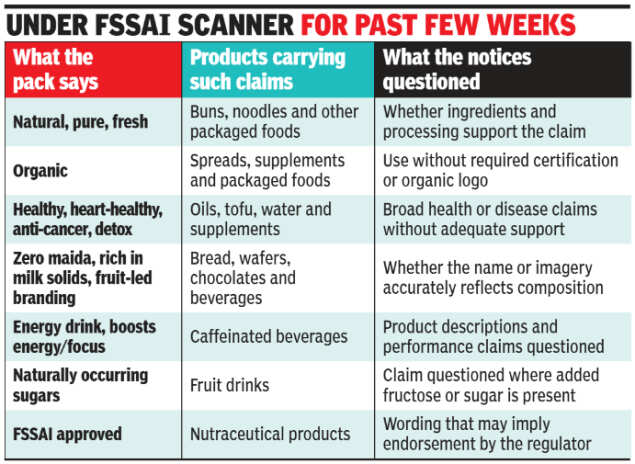
“Natural”, “healthy”, “organic”, “heart-friendly”, “high protein” and “zero maida” often persuades a shopper before the packet is even turned over. In a spate of notices sent in the past month, Food Safety and Standards Authority of India (FSSAI) has asked several brands whether their front-of-pack promises say more than the product can support.FSSAI has issued notices to food businesses across categories including breads, chocolates, juices, cooking oils, noodles, supplements, packaged water and caffeinated drinks. The claims questioned range from “100% natural” and “organic” to immunity, detoxification, disease reduction and energy-boosting promises. Since these are notices rather than final rulings, the issues remain subject to the companies’ replies and regulatory examination. TOI reached out to FSSAI over e-mail, but was yet to receive a response.The scrutiny comes as India’s health-and-wellness food market expands and brands compete for shoppers seeking healthier choices. Experts say the front of a packet increasingly functions as advertising, while the information needed to judge the product — ingredients, sugar, fat, sodium and additives — is usually on the back.
Former FSSAI CEO Pawan Kumar Agarwal says consumers rarely read or fully understand the mandatory information panel. Marketing teams therefore have a powerful incentive to foreground attractive words, sometimes stretching the meaning permitted by regulation. For large companies, he argues, penalties may need to be linked to turnover or the commercial gain from a misleading claim rather than treated as a routine cost.Nutrition experts call this the “health halo” effect: one positive phrase can make the entire product appear healthier and reduce the buyer’s inclination to examine it critically. A packet labelled “natural” can still be high in sugar or sodium. “Sugar-free” does not automatically mean low-carbohydrate. “Organic” requires certification; it is not merely a lifestyle description. Disease-treatment or prevention claims require scientific and regulatory support.AIIMS dietician Monita Gahlot advises shoppers to start with the ingredient list, which records ingredients in descending order by weight. The nutrition panel should then be checked for total and added sugars, saturated and trans fats, sodium, protein and carbohydrates. Serving sizes deserve particular attention: a modest-looking number can be based on a portion far smaller than what people normally consume.
Share your thoughts in the comments
Be respectful · TOI community guidelines
The clearest warning sign, food-testing expert Ashwin Bhadri says, is a bold front claim that is not supported or adequately explained elsewhere on the label. The simplest consumer rule is therefore to turn the packet over before deciding.Food author Krish Ashok argues that companies are not acting in a vacuum. Consumers increasingly seek a purchasable shortcut to good health. Products labelled “high protein”, “low GI”, “A2” or “heart-healthy” can offer the feeling of making a healthy choice without the slower work of eating fewer ultra-processed foods, increasing fibre and protein, exercising and sleeping well.That is why tighter enforcement alone will not end the health halo. Brands must make precise, evidence-backed claims, but consumers must also stop treating the front of a packet as nutritional advice.