






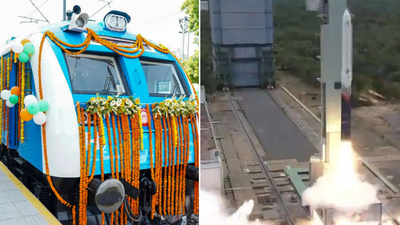
From breakthroughs in defence, space and clean energy to key geopolitical developments, this week’s current affairs featured several significant developments. India boosted its naval capabilities with another MH-60R Seahawk helicopter, launched its first hydrogen-powered passenger train, celebrated Skyroot Aerospace’s historic private orbital rocket launch, and saw Indian-origin NASA astronaut Anil Menon begin his maiden ISS mission. Globally, oil markets remained resilient despite the Strait of Hormuz crisis, Ukraine witnessed political unrest amid a government reshuffle, China claimed a breakthrough in advanced chipmaking, and Japan retained its male-only imperial succession law. Here’s a quick roundup of the biggest stories shaping India and the world.
India
India’s naval power gets a boost with another MH-60R ‘Romeo’
India has received another MH-60R Seahawk (“Romeo”) naval helicopter from the US, with two more expected this week, under the $2.13-billion deal for 24 helicopters signed in 2020. Developed by Lockheed Martin’s Sikorsky division, the MH-60R is among the world’s most advanced multi-mission naval helicopters and is being inducted to replace the Navy’s ageing Sea King fleet. Equipped with advanced maritime surveillance radar, dipping sonar, secure communication systems, Mk 54 torpedoes, Hellfire missiles and guided rockets, the helicopter is designed for anti-submarine warfare, anti-surface operations and maritime surveillance. Operating from aircraft carriers, destroyers and frigates, the MH-60R will significantly strengthen the Navy’s ability to detect and track submarines, protect carrier battle groups and enhance maritime security in the Indian Ocean. Read full story
Inside India’s first hydrogen train : How it works and why it’s special
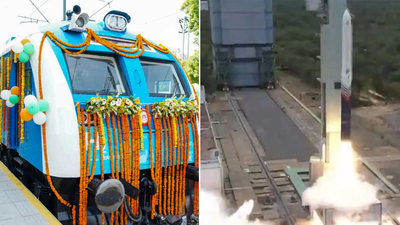
India has launched its first hydrogen-powered passenger train, becoming one of a select group of countries to deploy the clean-energy technology. Designed and built largely in India, the 10-coach train—currently the world’s longest hydrogen-powered passenger train—runs on hydrogen fuel cells that generate electricity with water vapour as the only emission. Intended mainly for non-electrified and remote routes, the project supports India’s green mobility and net-zero goals while reducing dependence on diesel. Experts, however, say its long-term success will depend not just on the train itself but on building a complete hydrogen ecosystem, including affordable green hydrogen production, storage, refuelling infrastructure, safety systems and maintenance capabilities, to make the technology economically viable at scale. Read full story
India’s private space sector reaches orbit as Skyroot launches Vikram-1
Skyroot Aerospace created history by becoming the first private Indian company to successfully design, build and launch an orbital rocket, as its Vikram-1 launch vehicle placed multiple payloads into a 450-km low-Earth orbit on its maiden flight. Built with an all-carbon-composite structure, 3D-printed engines and indigenous propulsion systems, the rocket carried Skyroot’s SCOPE satellite along with payloads from Grahaa Space, Cosmoserve Space and international partners. The mission, named “Aagaman”, marks a major milestone for India’s private space sector, validating the company’s launch technology and paving the way for future missions, including the larger Vikram-2 rocket and reusable launch vehicles. Prime Minister Narendra Modi, ISRO and IN-SPACe hailed the achievement as a significant boost to India’s growing commercial space ecosystem. Read full story
Indian-origin Nasa astronaut Anil Menon begins first ISS mission
Indian-origin Nasa astronaut Anil Menon on Tuesday launched aboard Russia’s Soyuz MS-29 spacecraft from Kazakhstan for his first spaceflight, beginning an approximately eight-month mission to the International Space Station (ISS) alongside Russian cosmonauts Pyotr Dubrov and Anna Kikina. During Expeditions 74 and 75, Menon will conduct scientific research on the effects of long-duration spaceflight on the human body, test medical technologies such as in-space IV fluid production and AI-assisted diagnostics, and participate in experiments on semiconductor crystal growth and bioprinting in microgravity. The mission, which is scheduled to conclude in April 2027, highlights continued cooperation between Nasa and Roscosmos aboard the ISS despite wider geopolitical tensions. Read full story
World
Why oil prices stayed in check despite the Strait of Hormuz crisis
The closure of the Strait of Hormuz triggered the biggest oil supply disruption in recent history, yet crude prices did not soar as sharply as in past crises. Experts say the global oil market is now more resilient, with increased production from non-OPEC countries, alternative export routes, strategic petroleum reserves and diversified energy sources helping stabilise supplies. China’s lower oil demand and coordinated stock releases by the International Energy Agency also eased market pressure. While analysts believe prolonged disruptions could push prices higher, they say a sustained surge to $200 per barrel is now far less likely. Read full story
Ukraine protests as Zelenskyy reshuffles government
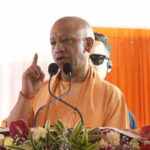
Hundreds of people protested in Kyiv after President Volodymyr Zelenskyy moved to replace defence minister Mykhailo Fedorov during a wider government reshuffle. Parliament approved Serhii Koretskyi, head of state energy company Naftogaz, as the new prime minister, with Zelenskyy citing his experience ahead of another wartime winter. Fedorov, credited with advancing Ukraine’s drone programme and digital military reforms, declined an advisory role and acknowledged that some planned defence reforms remained unfinished. The protests recalled last year’s demonstrations that forced Zelenskyy to reverse a controversial anti-corruption law. Read full story
China’s chip breakthrough challenges Western technology dominance
China is reportedly claiming a major breakthrough in developing its own extreme ultraviolet (EUV) lithography technology, long considered beyond its reach due to Western export controls. The reported prototype, developed in Shenzhen, could challenge the dominance of Dutch firm ASML, the world’s only producer of commercial EUV machines. The project is said to combine indigenous research with reverse-engineered components and expertise recruited from overseas. While experts believe China remains years away from commercial-scale production, the development signals a significant shift in the global semiconductor race and could reshape the future balance of technological and geopolitical power. Read full story
Japan keeps male-only imperial succession despite heir concerns
Japan’s parliament has approved changes to imperial succession rules aimed at preserving the shrinking royal family while retaining the ban on women inheriting the Chrysanthemum Throne. The law allows unmarried male descendants from former imperial branches to return to the royal household and lets female royals keep their status after marrying commoners. However, only men in the male bloodline remain eligible to become emperor. The move comes amid growing concern over the lack of male heirs, although public opinion strongly favours allowing women, including Princess Aiko, to succeed to the throne. Read full story