









Relationships in modern life are quite unpredictable. Friends reschedule, bosses send late-night emails, plans change at a moment’s notice, and even the most carefully constructed routines can be disrupted by an unexpected call or a delayed commute.But there is one relationship in our lives that is remarkably dependable. It asks very little in return and offers a small, reliable dose of comfort almost every morning: our coffee. And today, we will discuss how the most dependable relationship of our times is our silent, comforting and unbreakable bond with the cuppa containing coffee.Because today is International Coffee Day – a day where the world celebrates the journey of coffee from bean to cup while supporting millions of farmers and advocating for fair trade and sustainability.In an increasingly chaotic world, the morning cuppa has evolved into something much more than a quick shot of caffeine to kickstart the day. It has become a fiercely protected ritual, a pocket of familiarity and, for many of us, one of the few things we can still control.We know exactly how it should taste, which mug we want to drink it from, where we want to sit while drinking it and, most importantly, when we want to be left alone with it.The coffee itself may take only a few minutes to make, but the ritual around it can hold an entire morning together.
How we fell in love: A quick history
We didn’t build this deep bond overnight. Coffee has travelled a long way from being something consumed primarily for its stimulating effect to becoming a lifestyle, a social experience and finally, for many people, a deeply personal ritual.The early history of modern coffee culture was largely utilitarian though. Coffee was something that helped people wake up, work longer and get through the day. Instant coffee and canned grounds made preparation quick and convenient, and the emphasis was less on the experience of making or drinking coffee than on what it could do for you. It was, quite literally, fuel.Then came the coffee shop boom of the late twentieth century, and coffee began to acquire a different meaning. Cafés turned the drink into a social experience. We learned the vocabulary of espresso, cappuccino, latte and mocha, developed preferences about milk and sugar, and began meeting friends, colleagues and dates over coffee. Coffee shops became places to linger rather than merely places to consume a beverage.Coffee also became a lifestyle marker. The cup in your hand could say something about you: what you liked, where you went, what kind of neighbourhood you belonged to, even how you wanted to be perceived. The humble cup of coffee had acquired a social life of its own.
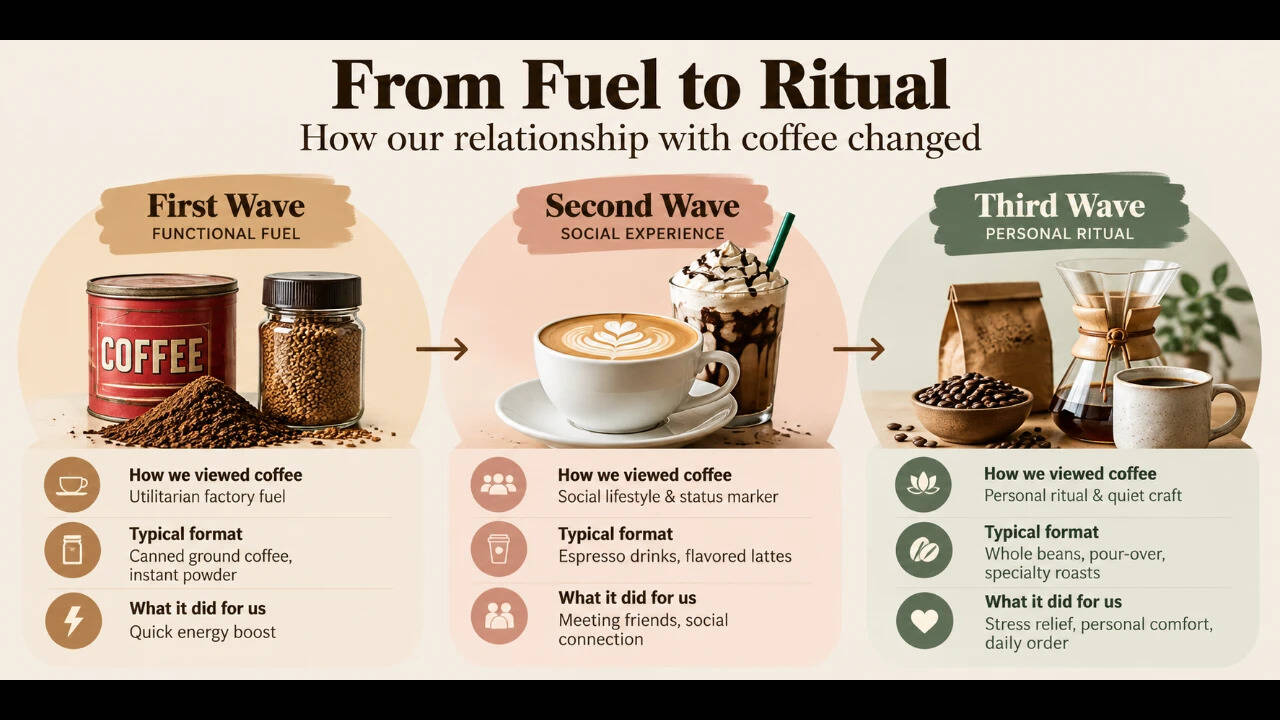
You are in the Third Wave of Coffee-ism.
Today, that relationship has taken a more intimate turn. We have brought the coffee shop into our kitchens. Armed with whole-bean grinders, pour-over equipment, French presses, Aeropresses and carefully-chosen beans, we have turned brewing into a quiet personal craft. Water temperature matters. Grind size matters. The origin of the bean matters. Even the shape of the mug matters.The heartbeat of coffee culture has, in some ways, moved from the noisy commercial café back into the home. And that has laid the groundwork for the personal morning rituals we protect today.Coffee has moved from fuel, to social experience, to personal ritual.That evolution explains why the first cup of the day can feel strangely important even when the drink itself is relatively ordinary. Or, is it?
The science of the morning ritual
Why does such a simple routine mean so much to us? There is an important distinction between a habit and a ritual. A habit is something we do almost automatically because we have done it so many times before. A ritual involves greater attention and intention. The steps may be familiar, but we attach meaning to them.A 2018 Northwestern University study offers an interesting clue as to why coffee became the morning ritual all over the world. Researchers found that people who were more sensitive to the bitter taste of caffeine actually tended to drink more coffee. One possible reason, they suggested, is that we learn to associate that bitterness with the alertness and energy that follows. In other words, we may come to like coffee not despite its bitterness, but because our brain has learned what that bitterness promises.Plus, making coffee is a ritual for us because it engages so many senses and involves a sequence we have consciously created. Measuring the beans, grinding them, hearing the machine come to life, watching hot water move through the coffee, smelling the aroma and finally taking that first sip all turn a mundane activity into a small sensory experience.And when life outside that ritual feels unpredictable, predictability can itself be comforting.There is a reason people become very particular about their morning coffee. It is not necessarily being fussy. It is often about familiarity. We know what we are going to get. We know what the first sip will taste like. We know where we will sit and how long we have before the rest of the day begins.Psychological research on rituals has suggested that performing meaningful, structured routines can help people feel a greater sense of control, particularly when circumstances around them feel uncertain. The ritual does not magically make the problem disappear. What it can do is create a brief moment in which the person feels grounded enough to face it.This may explain why the coffee ritual becomes especially precious during periods of stress. When work is chaotic, when the news is overwhelming or when the day ahead feels difficult to predict, there is something reassuring about doing the same small thing in the same familiar way.And there is another curious element to this: slowing down can change the way we experience the coffee itself.When we pay attention to what we are drinking rather than swallowing it while scrolling through emails, the sensory experience becomes richer. We notice the aroma, temperature, texture and aftertaste. The coffee may not actually have changed, but our experience of it has.The ritual, in other words, can make us better at experiencing the thing we are consuming.

Waking up and smelling the coffee is our most protected time, read “me time”.
It’s all in your mind — and your favourite mug
Scientists studying sensory perception have long established that flavour is not simply a property of food or drink. It is constructed by the brain using information from several senses at once.That helps explain why the same coffee can feel different depending on where, how and from what we drink it.Take the mug. Most of us have one. Or many. Our favourite one may be chipped, oversized, inherited from someone or completely unremarkable to anyone else, but somehow it is our mug. We reach for it without thinking.Research into cross-modal perception—the ability of the brain to interact, exchange, and combine information from two or more different sensory systems—suggests that the physical characteristics of a vessel can influence how we perceive what is inside it.For instance, a heavier cup can contribute to an expectation of a more substantial or premium experience. Colour can influence expectations about flavour too, with different colours being associated with qualities such as sweetness, bitterness or intensity.Then there is sound. The environment in which we drink coffee can affect how we experience its flavour. Loud background noise can interfere with the perception of certain tastes, while a quieter environment allows us to pay greater attention to aroma and flavour.This is why the perfect cup is rarely just about the coffee. It is the mug. It is the chair. It is the light coming through the window. It is the smell of toast in the kitchen, the newspaper on the table or the playlist you have been listening to for years. It is the first few minutes before the phone starts buzzing.The coffee becomes a kind of sensory shorthand for all those things. Which is perhaps why spilling coffee on your shirt at 8.30am can feel like much more than spilling coffee.
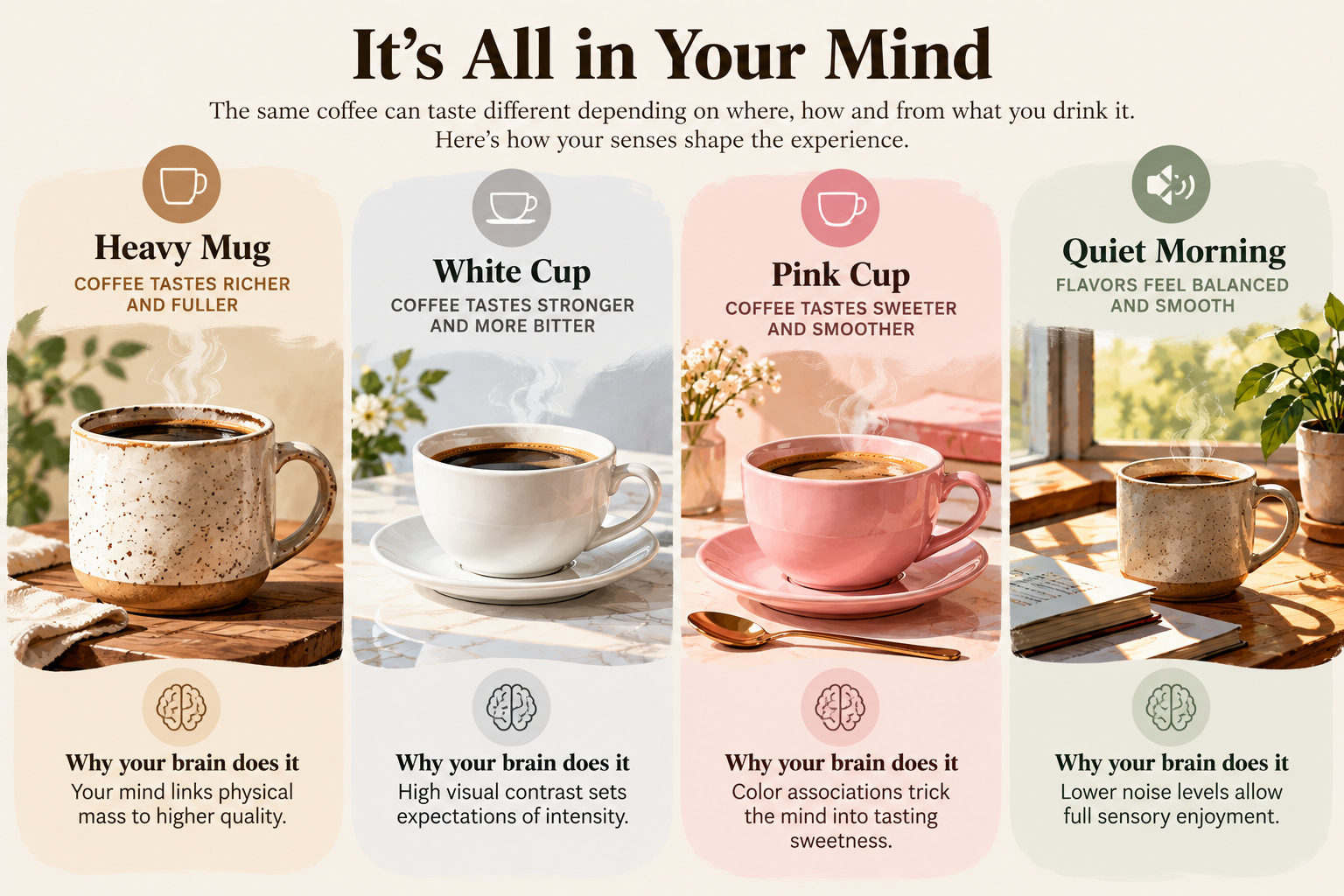
Do we really need to explain why we all have our favourite mug at home?
The protected 10 minutes
Think about your ideal morning. It may involve a favourite worn mug, a particular roast, your balcony, a kitchen counter or a corner chair where you like to sit. Perhaps, there is a newspaper, a book or a playlist. Perhaps, you simply stare out of the window and do absolutely nothing.The details are different for everyone, but the underlying idea is remarkably similar: these few minutes belong to you.That is what has become most valuable. Because modern life is filled with interruptions. Notifications begin before breakfast. Work messages arrive on phones that were once meant to connect us only to other people. Meetings stretch across time zones. Social media delivers an endless stream of other people’s lives. Even leisure time can feel crowded with things we are expected to watch, read, respond to or keep up with.Against that backdrop, a simple coffee ritual can feel almost rebellious. For 10 minutes, you decide the pace. It is a tiny form of control in a life that often offers very little of it.This is why people can become surprisingly protective of their coffee time. Interrupt someone during their morning coffee and you may discover just how emotionally invested they are in those few minutes. It is not the caffeine they are defending. It is the space around it.There is something comforting about having one small part of the day that remains almost exactly as you expect it to be. The world may have changed overnight. Your inbox may be overflowing. Your schedule may already be running late. But the coffee is there, familiar and reassuring, waiting in the same mug.Of course, coffee is not a substitute for human relationships. It cannot listen to your problems, remember your birthday or tell you that everything is going to be fine. But it can occupy a peculiar emotional space in our lives because it asks so little of us. We don’t have to explain ourselves to our cuppa. We don’t have to be interesting, productive or available. We simply have to sit down and drink it.The relationship is wonderfully uncomplicated. We know what to expect from it, we can personalise it endlessly and, unlike most modern relationships, it rarely sends a confusing message at midnight.That’s why the morning cup has become a daily reset button – a sensory pleasure and a small declaration that before the demands of the day begin, there will be a few minutes that belong entirely to us.So yes, we drink coffee for the caffeine. We drink it because we like the taste, because we need to wake up, because someone has invited us for a coffee or because the café makes an excellent latte.But mostly, we are drinking it for familiarity. For ritual. For the comfort of repetition. For 10 quiet minutes before the world comes rushing in.