








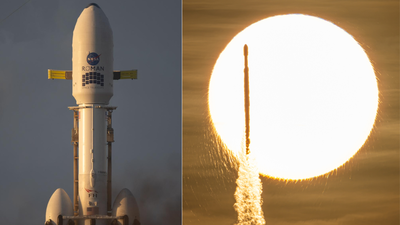
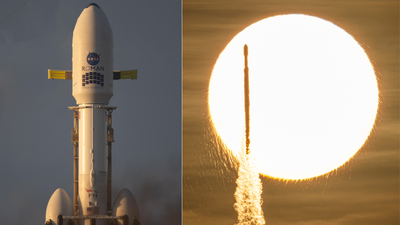
Imagine pointing a telescope at the crowded heart of the Milky Way and asking it to keep watching, not for hours or days, but for years. Every tiny flicker, movement or change in the light of hundreds of millions of stars could potentially tell astronomers that something is there: a new planet, a wandering world, a distant black hole or perhaps an Earth-like planet hidden among the stars.That is the promise of Nasa’s newest space observatory, the Nancy Grace Roman Space Telescope.Roman was launched on August 30 aboard a SpaceX Falcon Heavy rocket from Nasa’s Kennedy Space Center in Florida. The telescope is now on its journey to its destination nearly 1 million miles from Earth, where it will spend years surveying the universe.And there is already plenty of excitement around it. During a post-launch press conference, Nasa official Jared Isaacman received a phone call from US President Donald Trump, who was reportedly enthusiastic about the mission.“The president’s excited about Roman,” Isaacman said before putting Trump on speaker. Trump congratulated the team and remarked that the launch had looked beautiful on television.But what exactly is Roman going to do? And the question that is likely to grab the most attention: could this telescope actually find aliens?The short answer is: it could help scientists find planets that might be capable of supporting life, but it is not designed to directly discover little green men, or even alien microbes.Here is why Roman could nevertheless become a major step in the search for life beyond Earth.
So, what is Roman Space Telescope?
Named after Nancy Grace Roman, Nasa’s first chief astronomer, the Roman Space Telescope is a new-generation observatory designed to study some of the biggest mysteries in the universe.Its targets include dark energy, the mysterious phenomenon associated with the accelerating expansion of the universe; distant galaxies; stars; and, importantly, exoplanets — planets orbiting stars beyond our Sun.Roman is not simply a replacement for the Hubble Space Telescope or the James Webb Space Telescope.Think of the three as having different jobs.Hubble is famous for producing extraordinarily detailed images of individual cosmic objects and studying the universe in ultraviolet, visible and near-infrared light.James Webb, meanwhile, is particularly powerful for looking at very distant and ancient objects in infrared wavelengths. It effectively gives astronomers a highly sensitive zoom lens into deep space.Roman brings something different, a panoramic view.Instead of concentrating on one small patch of the sky at a time, Roman can survey enormous areas and detect changes across them. Its observations can then help astronomers identify objects that Hubble or Webb can examine in much greater detail.In other words, if Hubble and Webb are cosmic photographers with powerful zoom lenses, Roman is more like a giant wide-angle camera scanning the sky for anything interesting.
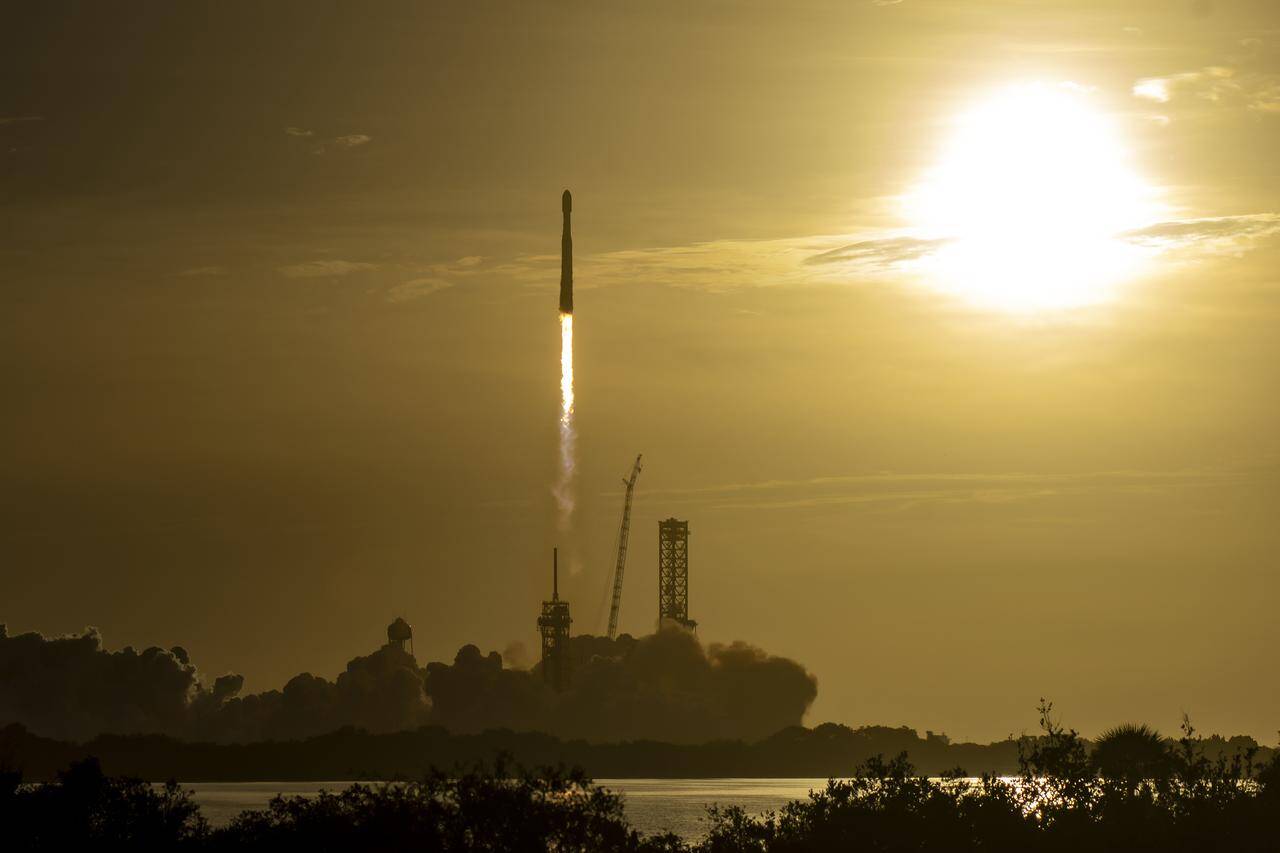
Nancy Grace Roman Space Telescope rises to space atop a SpaceX Falcon Heavy rocket
Why is Milky Way so important?
One of Roman’s most fascinating assignments will take it into the heart of our own galaxy.More than a quarter of its planned five-year primary mission will be devoted to repeatedly observing the galactic bulge — the densely packed central region of the Milky Way.This region is roughly 10,000 light-years wide and contains an enormous number of stars. It is so crowded that previous telescopes have struggled to study its depths.Roman will repeatedly photograph a relatively narrow section of this region, recording an image approximately every 12 minutes during its Galactic Bulge Time-Domain Survey.
Why keep looking at same stars again and again?
Because the universe is constantly changing.Stars brighten and dim. Objects move. Planets pass in front of their stars. And sometimes the gravity of an unseen object causes a distant star to suddenly appear brighter.Roman is designed to catch these fleeting changes.Scientists expect it could monitor hundreds of millions of stars in this relatively small area of the Milky Way.And that huge number is important because some of the events astronomers are looking for are extremely rare.The cosmic trick called gravitational microlensingOne of Roman’s most important planet-hunting tools will be gravitational microlensing.The idea sounds complicated, but the basic principle is surprisingly simple.Imagine a distant star sitting behind another star from our point of view on Earth. The gravity of the closer star bends the light coming from the distant one.As the foreground object moves across our line of sight, the background star can briefly appear brighter.That is gravitational microlensing.Now add a planet.If the foreground star has a planet orbiting it, the planet can create a tiny additional change in the star’s light. Roman can detect that brief signal.This technique is particularly useful because it can detect planets that other methods struggle to find, including relatively small, rocky worlds.It could even help scientists find Earth-sized planets and determine how common such worlds are in our galaxy.There is, however, a catch.A microlensing event is generally a one-time cosmic alignment. Once it is over, astronomers may not get another chance to observe the same planet in the same way.That makes these discoveries incredibly valuable, but sometimes difficult to study further.
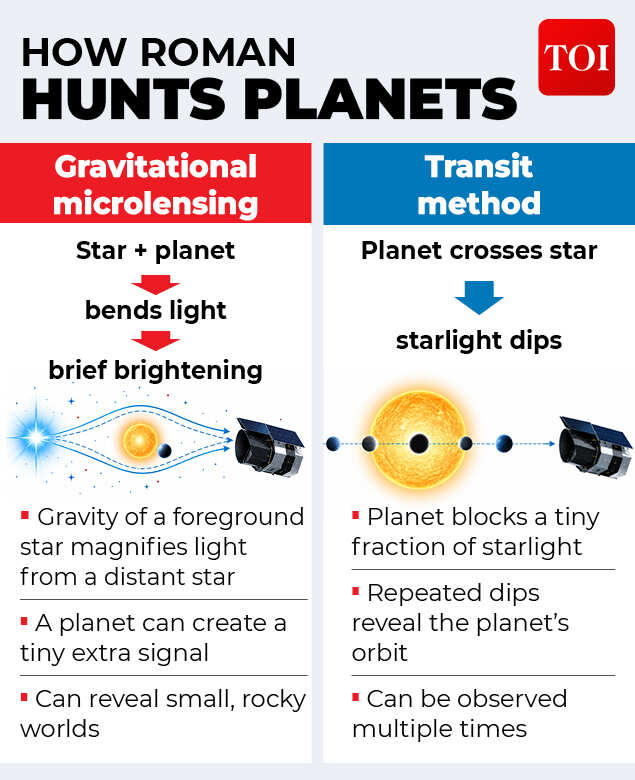
Astronomers can detect distant planets by tracking tiny changes in the light reaching their telescopes
Roman will also look for planets crossing stars
Microlensing is not Roman’s only trick.The telescope will also search for transits.A transit happens when a planet passes directly in front of its star from our viewpoint. The planet blocks a tiny amount of the star’s light, creating a small dip that astronomers can detect.Unlike microlensing, transits happen repeatedly as a planet completes its orbit.This makes them particularly useful because scientists can observe the same planetary system again and again.Roman’s observations of the galactic bulge are expected to uncover an astonishing number of new worlds. Scientists estimate the survey could identify around 100,000 exoplanets, with its sensitivity potentially extending down to objects as small as the Moon.That could dramatically expand our understanding of how many planets are out there — and what kinds of planetary systems exist.
So, can Roman discover aliens?
This is where things get really interesting.Roman is not an alien-detection machine. It will not necessarily photograph an alien civilisation or pick up a message from extraterrestrials.What it can do is help answer a question that comes before that:
How common are potentially Earth-like worlds?
Scientists currently know of more than 6,000 confirmed exoplanets, but there are almost certainly vastly more waiting to be discovered.Roman could help astronomers determine how frequently small, rocky planets form, whether they tend to orbit stars, and where such planets are located.Its coronagraph instrument adds another exciting capability. A coronagraph blocks the overwhelming glare of a star, making it easier to see much fainter objects nearby.Roman’s coronagraph is designed to potentially capture direct images of Jupiter-sized exoplanets around nearby stars.That does not mean it will immediately reveal an alien civilisation. But directly observing planets is an important step towards understanding their atmospheres, environments and potential habitability.The broader search for life will also involve other telescopes and future missions. If Roman identifies particularly interesting worlds, those targets could potentially be studied in greater detail by observatories such as Webb.It isn’t just about planetsRoman’s science programme goes far beyond the search for alien worlds.By repeatedly surveying huge numbers of stars, it could uncover previously unknown brown dwarfs, black holes, neutron stars and other unusual objects.It could also help scientists understand the history of the Milky Way itself.The galactic bulge is believed to contain some of the oldest stars in our galaxy. But astronomers still do not have a complete picture of exactly how old those stars are or how the region evolved.Roman could effectively conduct a huge population survey of the galactic centre — revealing not just individual objects but patterns in how stars and planets formed and changed.And beyond our galaxy, Roman will investigate dark energy, one of the biggest unanswered questions in modern cosmology.Dark energy is linked to the observation that the expansion of the universe is accelerating. Understanding it could help scientists explain how the universe evolved and what its ultimate fate might be.
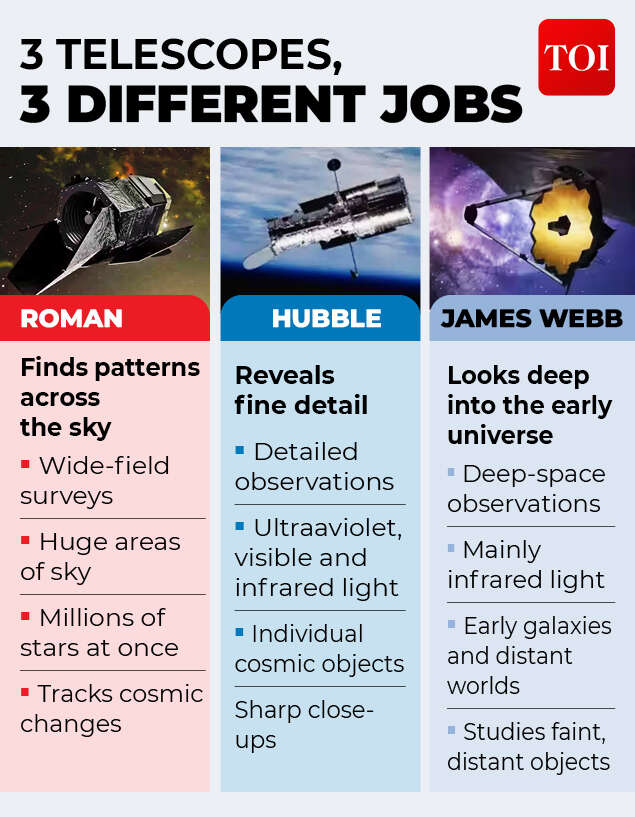
From detailed cosmic portraits to sweeping views of the universe, each telescope brings a different lens to space.
When will Roman start working?
The launch was only the beginning.After reaching space, Roman began deploying its solar panels, high-gain antenna and large deployable aperture cover, essentially a giant sunshade designed to keep unwanted light from interfering with its observations.The telescope’s Coronagraph Instrument was also powered on in early September. Engineers will spend weeks testing and calibrating it before science operations begin.Roman is targeted to become fully operational around January 2027.And that is when the real cosmic treasure hunt begins.For astronomers, the most exciting possibility may not be one spectacular discovery. It could be the sheer volume of information Roman produces.Hundreds of millions of stars. Tens of thousands of planets. Countless changes in the night sky.Somewhere in all that data could be an entirely new class of planet, an unexpected kind of star or a cosmic object scientists never knew existed.And perhaps, among those distant worlds, Roman may help answer one of humanity’s oldest questions:
Will it find aliens?
It may not find aliens directly. But by showing us just how many potentially Earth-like worlds are out there, Roman could bring us closer than ever to finding out.