

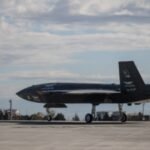






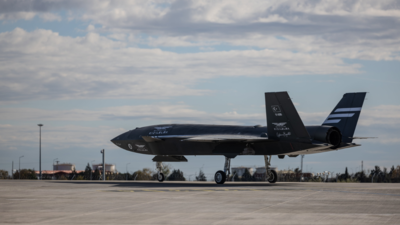
Turkish drone maker Baykar says the first three Bayraktar Kizilelma uncrewed combat aircraft have entered the inventory of Turkey’s security forces after completing acceptance testing. The Turkish firm calls it the world’s first operational induction of an uncrewed fighter jet, a claim that rests largely on how one defines the term.The programme has moved quickly since its unveiling in 2021, through flight trials and weapons integration to military acceptance. Baykar says it has logged about 600 test and training sorties. Unlike most armed drones, which are built for surveillance and ground strikes, Kizilelma was designed for fighter-type work, including air-to-air combat. It is meant to complement Turkey’s crewed TF Kaan fighter, and a naval version for ships with short decks is also being pursued.The basic aircraft has a reported top speed of Mach 0.9, a payload of about 1,300kgs, a mission radius of roughly 900 km and a service ceiling of 40,000 feet. That puts it closer to a light fighter than to most combat drones. In November 2025, it used the indigenous Gökdoğan missile to destroy a jet-powered target, guided by Aselsan’s Murad radar. It has also flown in autonomous formation, and in May 2026 it flew alongside Italian M-346 aircraft, a step towards crewed-uncrewed teaming.Baykar has not named the receiving service, though Janes reported that an officer believed to be from the Turkish Land Forces Command was seen at the handover. Acceptance does not mean full operational capability, and it is unclear how far the aircraft’s air-to-air weapons have been cleared for use. Autonomous formation flight and one successful missile shot do not prove it can detect, track and engage hostile aircraft on its own. The Pakistanis too have incorporated Baykar’s Akinci and Bayraktar TB-2 drones. The two countries are also aligning their defence industries.Kizilelma is not alone, the United States is advancing its Collaborative Combat Aircraft programme, with production contracts awarded in June 2026 for General Atomics’ YFQ-42A and Anduril’s YFQ-44A. The YFQ-44A fired an AMRAAM missile in July, and the first jets reached an experimental unit in September. China’s GJ-11 was declared in service in November 2025, though its publicly stated role is mainly air-to-ground. Australia’s Boeing MQ-28 Ghost Bat has made its first live missile firing, while Saab and Airbus are developing their own concepts.India is pursuing a similar route through the Hindustan Aeronautics Limited-led Combat Air Teaming System (CATS). A twin-seat Tejas will act as a mothership, coordinating swarms of unmanned aerial and combat vehicles. The centrepiece is the CATS Warrior, a low-observable loyal wingman drone developed by HAL with NewSpace Research and Technologies. First unveiled in 2021, the programme aims to provide affordable combat mass, from CCAs to smaller drones. As the CCA member of the family, the Warrior is expected to serve as a sensor amplifier for the supporting fighter. Its internal weapons bay is designed to carry the next-generation close combat missile and the smart anti-airfield weapon. Testing of these aircraft is under way.Whether Kizilelma becomes a truly independent fighter, a wingman for the TF Kaan or both is yet to be settled. Service with Turkish forces will now give the programme operational experience that should speed up that answer.