







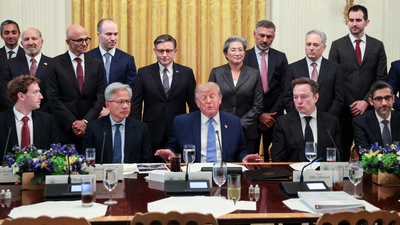
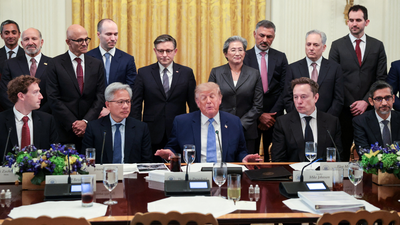
TOI correspondent from Washington: Halloween, America’s spooky annual celebration, is still a month away, but US President Donald Trump decided the country could use an early Monster Bash, bringing together the nation’s top tech fiends, some of whom trace their origins to India.“This guy is a monster, and nobody knows him,” Trump joked on Tuesday, pointing to Google CEO Sundar Pichai at a White House luncheon packed with enough tech beasts to make a Silicon Valley Halloween party look tame “What a great life! To be a monster and not have to go through this,” he continued, before helpfully reminding everyone that the monster’s name was Sundar. Pichai, who has spent much of his career being conspicuously less theatrical than the MAGA boss, took the joke in his stride. “Hopefully a better tagline than I’m a monster!” he kidded back.Levity aside, two-hour-plus gathering brought together an extraordinary concentration of tech and financial power: Pichai, Elon Musk, Mark Zuckerberg, Jeff Bezos, Nvidia’s Jensen Huang, Microsoft’s Satya Nadella, Micron’s Sanjay Mehrotra, Palantir’s Shyam Sankar, Palo Alto Network’s Nikesh Arora, Anthropic’s Dario Amodei, executives from AMD, Broadcom and other major tech companies, were joined by veep JD Vance, speaker Mike Johnson and other senior administration officials.It was quite a lineup — essentially the people who make the chips, build the models, own the clouds, run the platforms and increasingly determine what the machines can do. And it came less than a week after Trump had wheeled out many of the same tech heavyweights to impress Chinese President Xi Jinping. This time they came to discuss how to stay ahead of China and how to make sure their increasingly powerful creations do not become too impressive.The jokes, however, were wrapped around serious business. Trump and some of the world’s most powerful technology executives signed a new White House Accord on “Super Intelligence,” a voluntary framework for companies developing frontier AI systems to impose multiple layers of safety controls and audits. The accord calls for four layers of AI controls. First, companies are to monitor their models for risks including cybersecurity, biosecurity and chemical threats, and ensure they do not breach or access technical systems in unintended ways. Second, an internal team is supposed to check whether those safeguards actually work. Third comes an independent external auditor or evaluator. And fourth, an independent board committee is supposed to review the findings and press for fixes.The companies also agreed to meet regularly to develop common standards, with the possibility that the principles could eventually be turned into law or regulation. For now though, the accord is voluntary, and contains no penalties, no reporting deadlines, and no requirement that audit results be made public.Trump called it “almost like a constitution” and said it was “morally binding.” Musk supplied the less diplomatic translation: the companies were essentially grading each other’s homework, which effectively means they are largely responsible for policing themselves. In Trump’s words, “The smartest people in the world will keep an eye on each other” — a proposition that did not exactly allay fears of AI skeptics who feel America’s tech oligarchy and their patron in the White House are playing with fire. “When a handful of billionaire monopolists sit down with political leaders to negotiate the rules of artificial intelligence, who is actually looking out for the public interest?” one critic asked.Of course, the tech monsters were effusive in their praise of the MAGA boss, publicly embracing his preferred term “super intelligence” for AI and pawing the ground before him. “(President Trump) showed us what a true leader is. He was thoughtful and focussed on ensuring that SI was developed at pace and was going to be deployed safely and securely,” gushed Palo Alto Networks Nikesh Arora. “The White House Accord and the Joint Commitment on Frontier Responsibilities signed today …contains real tangible steps to promote safe development, while delivering the economic and scientific benefits of this technology,” asserted Pichai.But somewhere, one imagines, AI algos were taking notes, drafting minutes, and smirking to themselves about who the joke was on.