








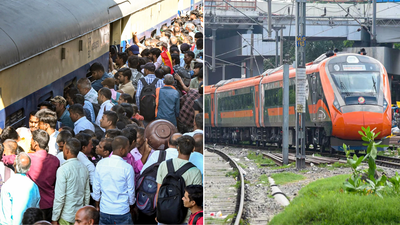
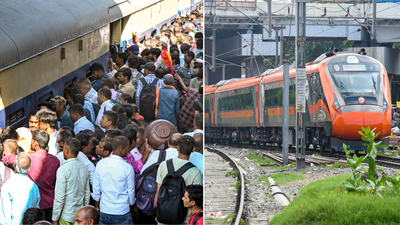
NEW DELHI: New trains, redeveloped stations and upgraded infrastructure are changing the face of Indian Railways. But has the passenger experience changed at the same pace?For millions of people who depend on the network every day, the real test of modernisation begins well beyond a station’s new facade or a train’s sleek exterior. It lies in whether platforms are manageable, toilets are clean, drinking water is safe, coaches are well maintained and trains arrive on time.While the Railways has invested heavily in modernisation, government audits continue to flag gaps in basic passenger amenities, onboard cleanliness and maintenance. The contrast raises a larger question: Is Indian Railways building a more modern network without doing enough to improve the everyday journey?The challenge now is to ensure that the transformation is felt not just in the infrastructure passengers see, but in the quality of service they experience.
A makeover on a massive scale
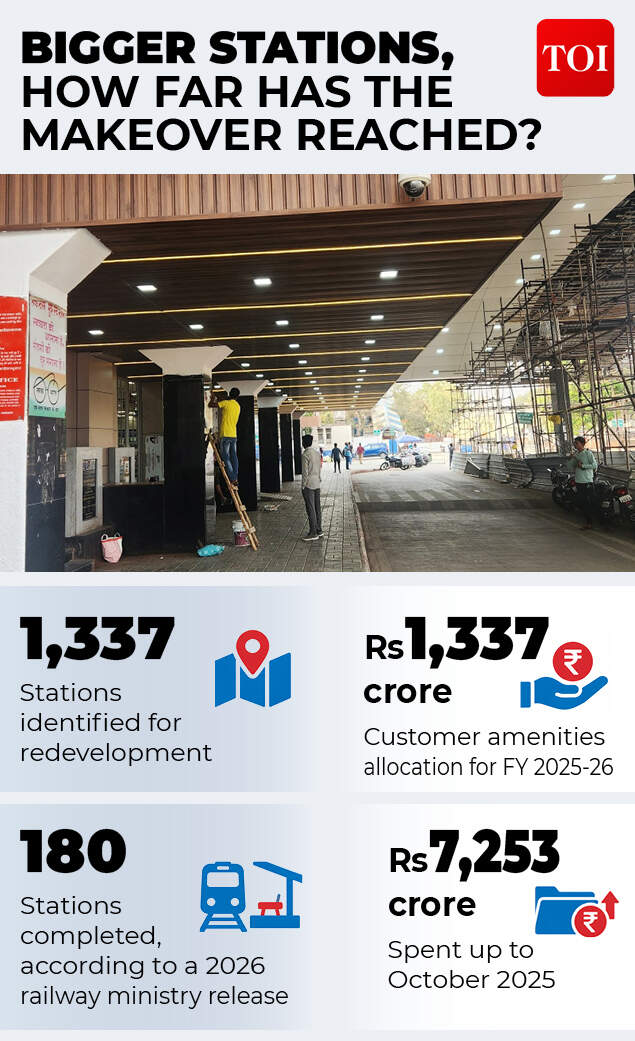
The Amrit Bharat Station Scheme is among the most visible parts of the railway modernisation drive. Under the scheme, 1,337 stations had been identified for redevelopment by December 2025, with work complted at 155 stations at that point, according to the ministry of railways. The programme envisages improvements to station buildings, waiting halls, toilets, seating, drinking-water facilities, platforms, foot overbridges, lifts, escalators and passenger information systems.
From station facelifts to faster trains: Inside Indian Railways’ makeover
The plan also seeks to improve access to stations, connect them better with the surrounding city and integrate different modes of transport. Facilities for passengers with disabilities and spaces for local products under the One Station One Product initiative are part of the wider approach. The idea is to make stations more accessible and useful, rather than treat redevelopment as a cosmetic exercise alone.The scale of the programme matters in a network where stations serve very different kinds of traffic. A major city terminal may need to handle large crowds, multiple platforms and complex interchange movements. A smaller station may need reliable drinking water, sufficient seating, accessible toilets and a safe way to cross between platforms. A uniform-looking makeover cannot substitute for facilities suited to the number and needs of passengers using each station.Redevelopment also has to take place while trains continue to run. Railway minister Ashwini Vaishnaw has cited the difficulty of carrying out major construction without shutting down busy stations. Work near operational tracks, shifting utilities, statutory clearances and restrictions imposed to protect passengers and train movements can all affect project schedules.That is a reminder that infrastructure transformation takes time. It also raises a separate question: While construction continues, how effectively are existing facilities being maintained?
New trains, new expectations
The train itself is another important part of the modernisation story. Vande Bharat has become the most recognisable symbol of a more contemporary railway experience, with modern coaches, improved passenger amenities and a focus on faster intercity travel.The demand for these services has been substantial. The ministry of railways said nearly 3.98 crore passengers travelled on Vande Bharat Express services in 2025-26, up from 2.97 crore in 2024-25, an increase of about 34%. Since its introduction, the service had carried more than 9.1 crore passengers through approximately one lakh trips, according to a ministry statement issued in April 2026.The appeal is understandable. Modern coaches, comfortable seating and onboard amenities can make a long journey less tiring. Faster services can also help passengers who travel regularly for work, education, business or family commitments. The introduction of a sleeper version in January 2026 extended the modern-train push to overnight travel. In its first three months, the sleeper service carried 1.21 lakh passengers over 119 trips, with reported occupancy exceeding 100%.A railway official, speaking to TOI on condition of anonymity, said the introduction of newer trains was part of a broader effort to improve passenger facilities.“New trains such as Vande Bharat and Amrit Bharat are being introduced using push-pull technology, offering passengers improved facilities. The work undertaken over the past few years is gradually beginning to show results,” the official said.These figures indicate that passengers are willing to use newer services when they offer a compelling travel option. But the success of a premium service should not become the sole measure of progress across a network that serves passengers with widely differing budgets and travel needs.For a family travelling in a reserved sleeper coach, the condition of the toilets and availability of water may matter as much as the train’s design. For an unreserved passenger, access to a platform without dangerous crowding may be the more immediate concern. For someone travelling with an elderly relative, working lifts and clear signage can make the difference between a manageable journey and a stressful one.The next phase of modernisation must therefore be about raising the baseline across the network, not just creating pockets of premium travel.
The basic amenities test
A Comptroller and Auditor General (CAG) audit provides a sobering measure of the gap between infrastructure ambitions and everyday facilities. Its Report No. 31 of 2026, tabled in Parliament on August 12, examined passenger amenities and sanitation at non-suburban railway stations. Of the 512 stations covered, 458 had deficiencies in one or more essential passenger amenities.According to the CAG report, the deficiencies involved basic facilities such as toilets, urinals and drinking water. The audit also found E. coli contamination in water samples collected from coolers at eight locations, raising concerns about the safety of drinking water available to passengers.
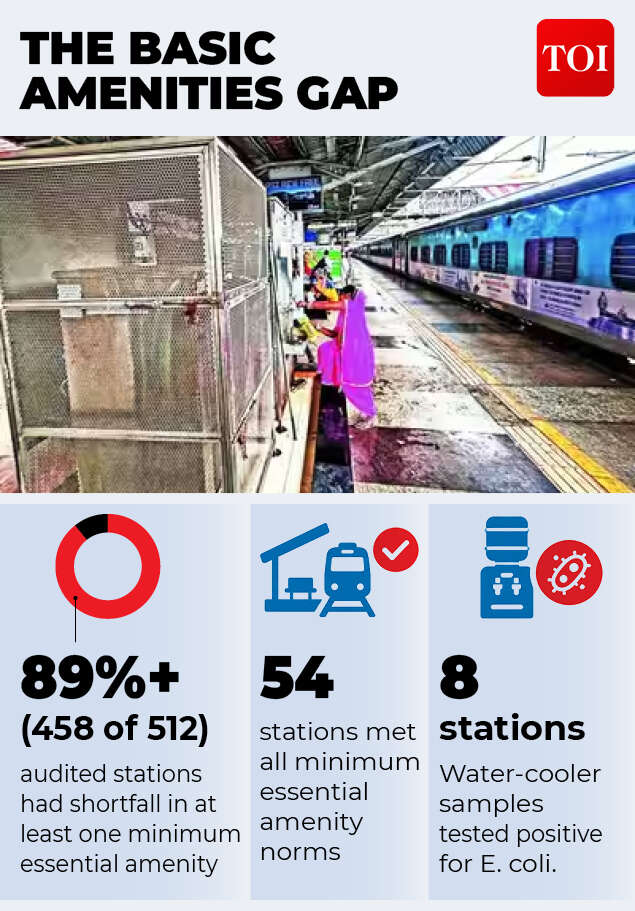
Railway modernisation vs ground reality: The widening passenger amenities gap
These findings matter because the usefulness of a facility depends on more than its installation. A water cooler may appear on a station’s list of amenities, but it serves little purpose if the water is unsafe or the equipment is not maintained. A newly built toilet is not a meaningful improvement if it is dirty, lacks water or is routinely out of order.The distinction between providing an amenity and delivering a functioning service is central to the passenger experience. Construction can be measured through expenditure, project completion and the number of facilities created. Maintenance is less dramatic, but it determines whether passengers can actually use those facilities on a particular day.The CAG findings do not mean every station performs poorly, nor do they erase the benefits of redevelopment. They point instead to unevenness across the network. The task is to ensure that passengers do not have to depend on a station’s size, location or level of visibility to access basic services.
Cleanliness does not end at the platform
The problem extends from stations to the trains themselves. A separate CAG audit on cleanliness and sanitation in long-distance trains, covering the period from 2018-19 to 2022-23, found that more than 40% of surveyed passengers were dissatisfied with toilet cleanliness, while over half expressed dissatisfaction with onboard housekeeping.The survey covered 2,426 passengers across 96 selected trains. The audit identified issues including dirty lavatories, choked washbasins, waterlogging and unclean vestibules. It also found that 366 passengers, or about 15% of those surveyed, reported a lack of water in toilets or washbasins. More than one lakh complaints about water shortages in train toilets and washbasins were registered through Rail Madad in 2022-23.The audit also highlighted shortcomings in the deployment of cleaning staff and equipment, as well as gaps in monitoring and enforcement of contractual obligations. It mentioned that 89% of complaints related to toilet cleanliness were addressed within the stipulated timeframe. That points to a system capable of responding to complaints, but also to the need to reduce the conditions that generate them in the first place.The railway official said bio-toilets had played an important role in the effort to improve sanitation, but maintenance and passenger awareness remained challenges.“Indian Railways has taken extensive measures to improve cleanliness, with bio-toilets playing an important role in this effort. However, the key challenge lies in their adequate maintenance, due to which problems continue to arise. Lack of awareness among passengers also contributes to sanitation-related issues,” the official said.“Although the Railways is working to spread awareness through advertisements and other means, a change in public attitude towards cleanliness is still needed,” the official added.A complaint mechanism is essential. Yet a passenger should not have to repeatedly report a choked toilet or an empty water tank for routine services to be delivered. Onboard housekeeping, water refilling and regular inspections need to work as part of normal railway operations, not only after a problem has been flagged.Cleanliness is not a minor comfort issue. It affects dignity, health and the willingness of passengers to trust the service. A train can have modern coaches and advanced safety features, but if the washroom becomes unusable halfway through a long journey, the experience quickly falls short of the promise.
Punctuality: Progress, but not the whole picture
Reliability is another test of whether the passenger experience is keeping pace with infrastructure investment. A faster train is useful only if its schedule is dependable, while an upgraded station cannot compensate for a journey that routinely runs late.The ministry of railways reported that punctuality improved from 73.62% in 2023-24 to 77.12% in 2024-25, reaching 77.24% in 2025-26 up to February 2026. The ministry said the network operates around 25,000 trains a day and attributed delays to a range of factors, including fog, track and route constraints, maintenance, signalling issues, agitations and other unforeseen events.The improvement is significant, but the latest figure also shows that punctuality remains a work in progress. Railway operations involve a vast network in which a disruption in one section can affect services elsewhere. Track maintenance, signalling upgrades and other work may be necessary to improve long-term reliability, even when they cause short-term inconvenience.The railway official said the growing demand for passenger trains had put pressure on punctuality, and that infrastructure upgrades were being undertaken to address the issue.“To address this, the Railways has started operating dedicated freight corridors or undertaken work on them to provide separate tracks for goods trains. The Delhi-Mumbai Dedicated Freight Corridor is a key example,” the official said.“Major stations are also undergoing remodelling and interlocking work to reduce additional halts and delays for trains. Sections with heavy traffic are being converted to automatic signalling systems,” the official added.The official said fog and mist also affected train operations by reducing visibility. “To address this, fog signal devices have been installed in locomotives. In addition, the Railways is installing the advanced Kavach system, which not only helps improve punctuality but also plays an important role in ensuring train safety,” the official said.For passengers, however, the experience is immediate. A late train can mean a missed connection, a longer wait at a station or an uncertain arrival time. Better information about delays and platform changes can ease some of that burden, but communication cannot replace reliable operations.More dependable schedules, clear announcements, accurate digital information and prompt assistance during disruptions are as important to many travellers as the design of the coach.
Crowds are an infrastructure problem, too
Crowd management has become another part of the passenger experience that cannot be separated from station design. Wider foot overbridges, holding areas, better access points and clearer passenger information can help manage movement, but they need to be matched to actual footfall and train capacity.The New Delhi railway station witnessed a stampede in February 2025 that killed at least 18 people.In March 2026, the railway ministry announced plans for permanent holding areas at 76 identified stations, alongside measures including access control, wider foot overbridges and technology-assisted monitoring. The ministry also referred to additional ticketing facilities, drinking-water arrangements and separate toilets at New Delhi Railway Station.The railway official said satellite stations were being developed in large and industrial cities to reduce pressure on major stations during periods of heavy passenger movement.“In large and industrial cities, where passenger footfall rises sharply during holidays and other occasions, the Railways has started developing satellite stations to reduce the pressure on major stations,” the official said.The official also referred to the Train on Demand initiative, particularly services with high-capacity unreserved coaches, to accommodate more passengers through fewer trains.Such measures recognise that a station is not simply a building through which passengers pass. It is a space where thousands of people may arrive at the same time, often carrying luggage, travelling with children or trying to reach a platform minutes before departure.But crowd management cannot depend on temporary arrangements alone. It also requires better coordination between train schedules, platform allocation, ticketing, station staff and the movement of people inside and outside the premises. The test is whether a passenger can reach the right platform safely and without confusion, particularly during holiday rushes, festivals and other peak periods.A station’s success should not be judged only by its appearance when relatively empty. Its real test comes when several trains arrive close together and thousands of passengers have to move through the same spaces.
From construction to service delivery
The larger question facing Indian Railways is how to turn a massive modernisation programme into a consistently better everyday service. The answer lies partly in investment, but also in maintenance, staffing, monitoring and accountability.The government has committed substantial resources to passenger amenities. In December 2025, the ministry said an allocation of Rs 12,118 crore had been made under the customer amenities budget head for 2025-26, with Rs 7,253 crore spent up to October that year. Such spending can create the physical conditions for better journeys. Whether it produces lasting improvement depends on how effectively facilities are operated and maintained.There is no single measure that captures the passenger experience. Station redevelopment figures tell us how much work has been undertaken. New-train numbers indicate the expansion of services. Punctuality statistics measure one aspect of reliability. Audit findings reveal whether basic facilities meet the expected standard. Together, they offer a more complete picture than any one headline figure.A meaningful assessment would ask how many station amenities remain functional, whether drinking water is safe, how often toilets are cleaned, whether complaints are resolved promptly, and how consistently trains run to schedule. It would also compare performance across stations and railway zones, so that strong results in one area do not conceal persistent gaps elsewhere.Indian Railways has good reason to invest in bigger stations, modern trains and improved infrastructure. For a country of India’s size, rail travel remains essential to mobility, livelihoods and social connection. The scale of the network makes the task difficult, but it also makes the quality of everyday service especially important.
Share your thoughts in the comments
Be respectful · TOI community guidelines
The next measure of progress should be visible not just in the station’s new facade or the train’s sleek exterior, but in the ordinary details of a journey: A clean washroom, safe water, a working lift, a manageable platform and a train that arrives when expected.