











Artillery has remained one of the most decisive weapons in warfare for centuries. Even with the introduction of combat aircraft, precision weapons, drones and sophisticated surveillance systems, the ability to deliver sustained firepower over distances still shapes outcomes.From the trenches of World War I to the mountains of Kargil and the battlefields of Ukraine, artillery has played a key role across different terrains and weather conditions.Guns and rockets can strike beyond the line of sight, suppress defences, deny access to terrain and force opposing forces to disperse and take cover. Unlike aircraft, which need airspace access and suitable conditions, ground-based artillery can theoretically provide sustained fire for as long as ammunition is available.The scale of its contribution was clear in World War I, when artillery is estimated to have accounted for around 60% of battlefield casualties, though the proportion varied across armies and theatres. At Verdun in 1916, German forces fired about one million shells at French positions on the first day.Artillery destroyed trenches, communication lines and supply routes, making it hard for troops to hold ground. In World War II, historical US Army medical studies found that artillery and mortar fire together caused 65% of casualties in the European theatre and 69.1% in the Mediterranean, against 47% in the Pacific theatre.
Kargil and the lessons of high altitude
The 1999 Kargil conflict brought the destructive power of artillery into the public consciousness in India. Pakistani troops had occupied dominating heights along the Line of Control (LoC), placing Indian infantry at a serious disadvantage as they moved up, quite literally fighting an uphill battle. Artillery became central to Operation Vijay, providing the firepower to weaken fortified positions before infantry assaults. 155mm howitzers played a major part because of their ability to deliver accurate fire at high angles in the mountains.
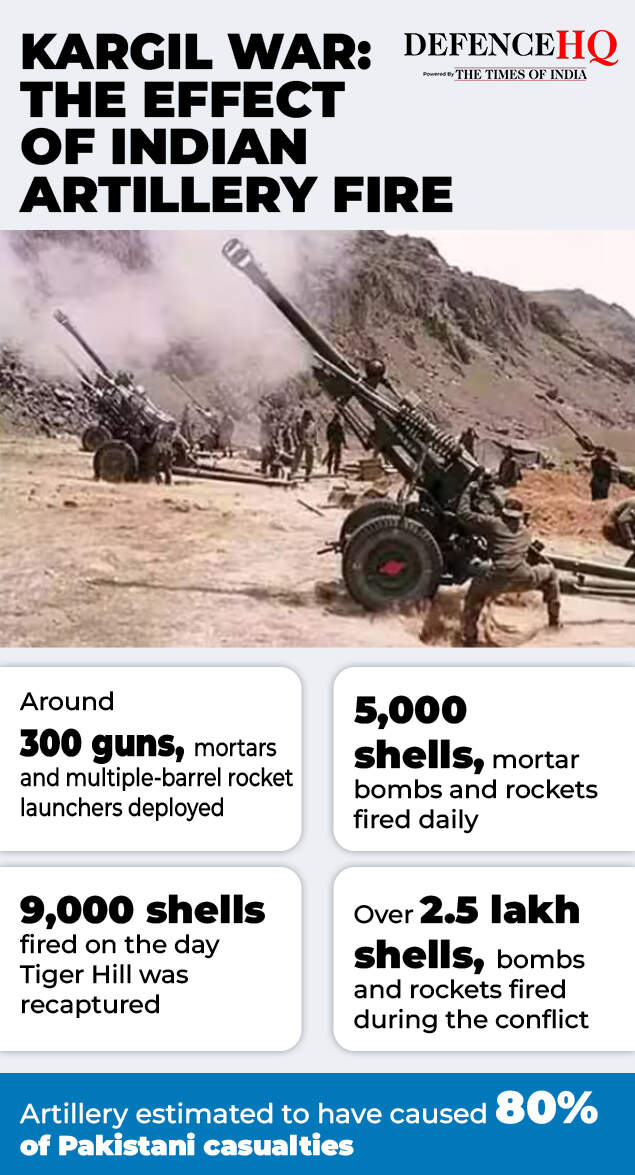
The Regiment of Artillery played a very critical role in the operations to evict Pakistanis from the Kargil heights.
According to the Ministry of Defence’s account, about 5,000 artillery shells, mortar bombs and rockets were fired every day from around 300 guns, mortars and multiple-barrel rocket launchers, and about 9,000 shells on the day Tiger Hill was recaptured. Indian artillery fired more than 2.5 lakh shells, bombs and rockets in all and was estimated to have caused around 80% of enemy casualties, a figure cited by the defence spokesperson.
Ukraine and the rise of the drone
The Russia-Ukraine war initially reaffirmed the importance of artillery. Both sides relied on guns, mortars and multiple-launch rocket systems along a long frontline, using them to destroy defences, support advances, disrupt logistics and carry out counter-battery fire. Ukraine reportedly fired more than 200,000 rounds a month in the summer of 2023, and Russian forces at their peak in 2024 were firing up to 40,000 rounds a day.But the war has also shown how drones are changing the balance. First-person-view drones, reconnaissance platforms and loitering munitions can find and hit targets with precision, often without large volumes of ammunition, and they shorten the time between identifying a target and striking it. A 2026 study in Military Review estimated that unmanned aerial systems caused 70 to 80% of military casualties on both sides by mid-2025.This does not make artillery redundant. Drones face limitations in bad weather, in electronic warfare environments and against heavily protected targets, and they cannot replace the sustained, massed fire of guns. The emerging model is integration, with drones spotting targets and correcting fire while precision weapons hit high-value positions.
India’s artillery modernisation
Indian Artillery is the most modern and scientific arm in the Army. Its capability has increased maniforld in recent years.Modern artillery is all about a combination of Drones, Rockets, Artillery and Missiles networked together seamlessly through multilayered failsafe communications. As the range of modern Artillery has expanded, its lethality has increased due to deadly warheads and pinpoint accuracy which is a product of ground, air and space based surveillance. Today there is no place in the battlefield in which you can hide from the king of the battlefield. No wonder it is said that renown awaits the commander who can restore to its rightful place in battle
Lt Gen PR Shankar (retired), Professor, Aerospace Dept IIT Madras and former DG Artillery
For the Indian Army, Kargil still shapes modernisation, but the Army is moving towards a mix of longer-range guns, precision-guided ammunition, rocket artillery, surveillance drones and loitering munitions. This multi-pronged approach was also showcased during Operation Sindoor with the use of long-range artillery, loitering munitions and stand-off precision weapons. Seven of the nine terrorist camps targeted were engaged by artillery.
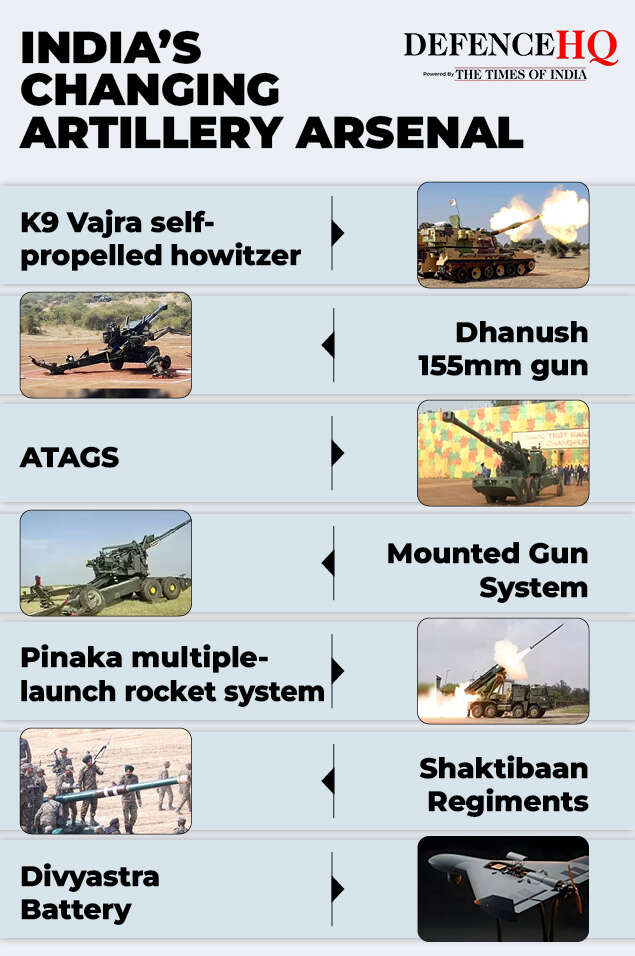
The Regiment of Artillery is upgrading to new, more powerful weapons in order to increase combat effectiveness through firepower.
The Army is also restructuring its artillery to make it a more effective tool in future conflicts. The Shaktibaan concept envisages specialised formations with drones, surveillance systems and loitering munitions, and the government has approved loitering munitions for artillery regiments and long-range guided rockets for the Pinaka multiple-launch rocket system. On the conventional artillery front, the Army is inducting more K9 Vajra self-propelled howitzers, Dhanush guns, the Advanced Towed Artillery Gun System (ATAGS) and mounted guns, with a Rs 7,628.70 crore contract for K9 Vajra guns signed in December 2024.
The next generation of shells
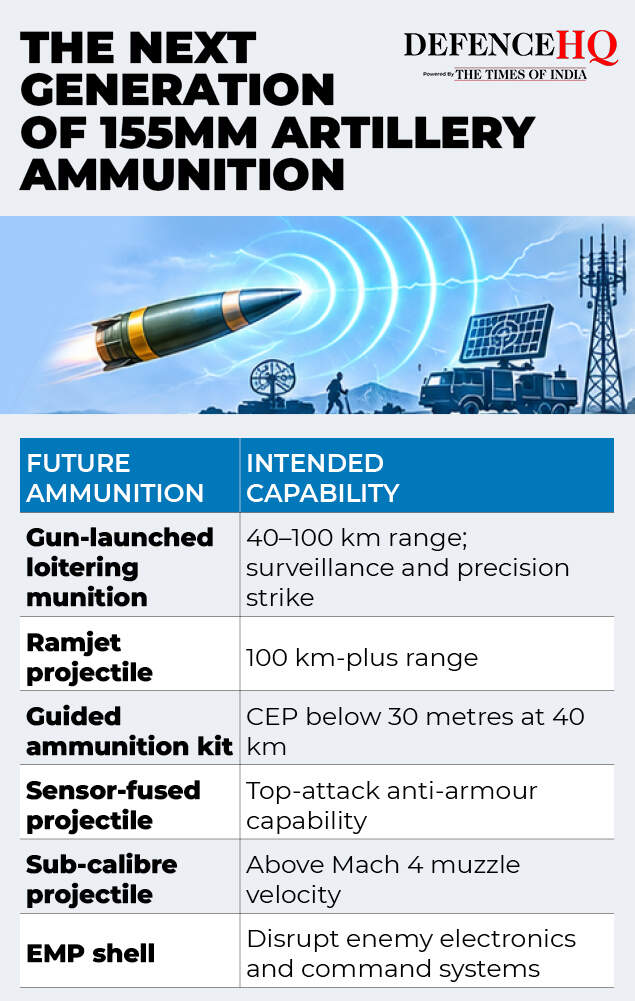
Smart modern artillery shells are reshaping how armies will use this decisive battlefield arm in combat.
The Army is now also looking to transform what its 155mm guns fire, as it standardises around that calibre under the Field Artillery Rationalisation Plan (FARP). One requirement is a gun-launched loitering munition packed into a standard 155mm shell casing, able to survive the shock of launch before deploying its wings and flying. With a range of 40 to 100 km, it could carry out surveillance and precision strikes without a separate launcher, while its high-speed launch could help it get past some frontline air defences and electronic warfare systems.Another area that will see a change is the range at which targets can be hit. Existing 155mm high-explosive, base-bleed and rocket-assisted shells reach up to 45 km, and the Army is exploring solid-fuel ramjet projectiles that could exceed 100 km, with NavIC and GPS guidance and a target accuracy, or circular error probable (CEP), of under 10 metres at 100 km. The Army wants affordable guidance kits with anti-jamming satellite navigation to achieve a CEP of under 30 metres at ranges of up to 40 km, saving ammunition, reducing barrel wear and giving enemy counter-battery systems less time to locate Indian guns.The Army is also seeking sensor-fused top-attack rounds carrying two autonomous submunitions with radar and infrared sensors to hit the vulnerable upper armour of tanks, and low-drag projectiles with muzzle velocities above Mach 4 to reduce flight time, since an ordinary shell takes 60 to 90 seconds to travel 40 km, long enough for a gun to move. It is examining electromagnetic pulse ammunition to disrupt electronics and command systems, and a just-in-time ammunition supply system using real-time tracking and drone-based last-mile delivery in place of large stockpiles at gun positions.The concept is already being pursued abroad. General Atomics Electromagnetic Systems’ Vektrex is a 155mm manoeuvring projectile with deployable wings that allow it to glide to a range of around 120 km, two to three times the range of conventional rounds, depending on the gun and propellant. It is designed to maintain its accuracy in GPS-degraded environments, can hit stationary, moving and obscured targets, offers payloads ranging from surveillance to electronic warfare, and works with existing 39- and 52-calibre guns without modifications.From the massed shelling of the World Wars to the precision strikes of Ukraine and Operation Sindoor, artillery is adapting, not fading. Drones and loitering munitions are taking over target identification and precision engagement, but guns still provide the sustained firepower that ground operations need. The challenge for India is to combine the destructive capacity of traditional artillery with the speed, accuracy and flexibility of new technology, and to turn these requirements into capabilities backed by domestic manufacturing and reliable ammunition supply.