









Advertised fares into Hyderabad on the morning of 2 November 2026 showed that booking 30 days before departure costs 28.5 per cent less than booking the day before, measured across all seven routes into the city. The same comparison across the broader domestic network produced a saving of 13.4 per cent, meaning Hyderabad routes sit 15.1 percentage points better than the network average.The chart below shows how the fare index moves from 90 days out to the day before departure for Hyderabad routes against the network.
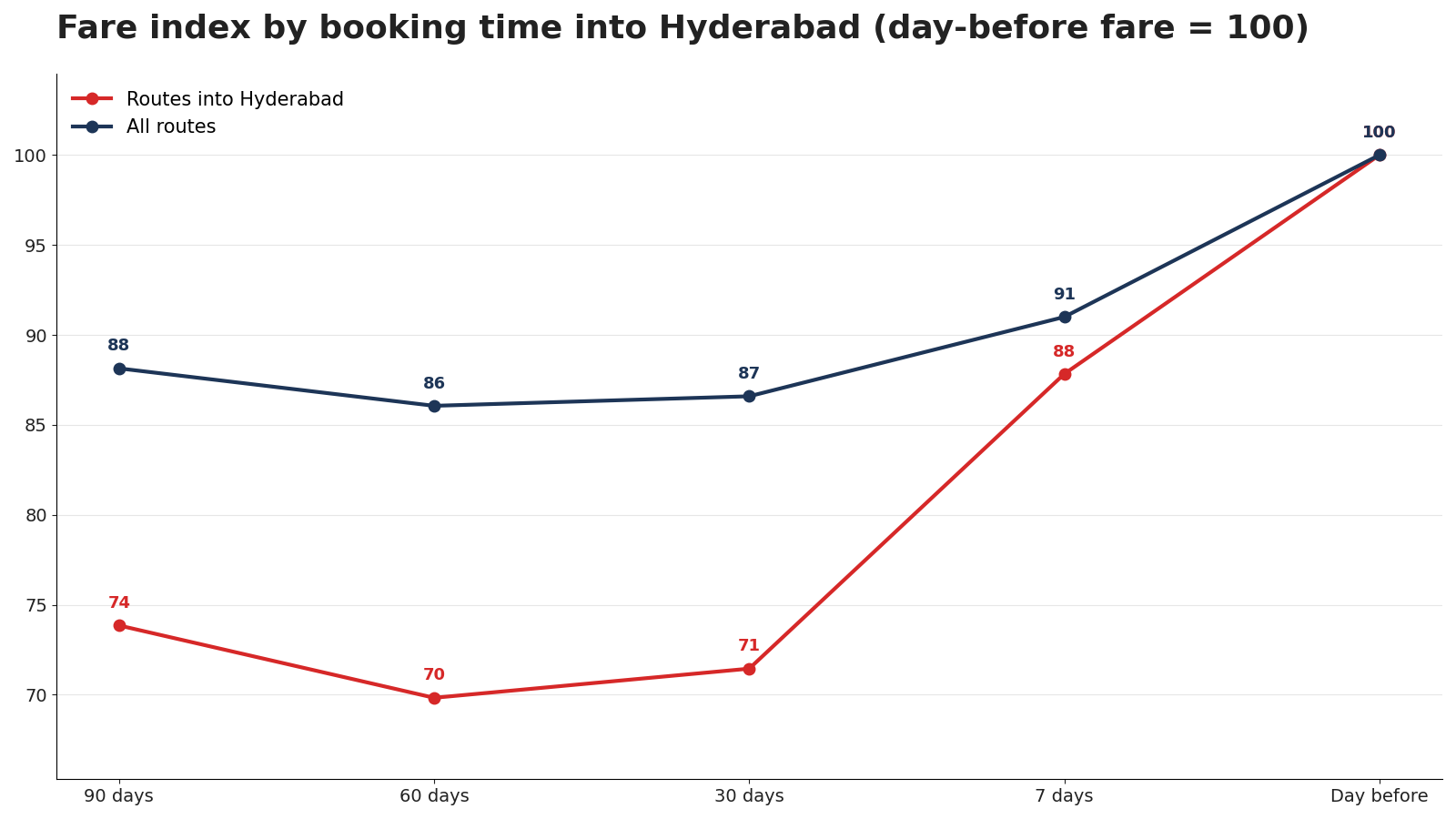
Median fare-time index by days before departure, 7 routes into Hyderabad against all routes. Captured on 2 November 2026.
What the numbers show
The fare-time index sets each route’s day-before fare at 100 and expresses every other booking time against it. An index of 71.5 at 30 days before departure, as recorded for Hyderabad routes, means a fare quoted at that point was, on average, 71.5 per cent of what the same route cost when quoted the day before. The network index at 30 days was 86.6, well above Hyderabad’s 71.5, which is what produces the 15.1 percentage-point gap.The percentages come from the tracker’s fare-time index, which is built over a longer window than a single morning, and this compares what different departure dates cost when quoted at different booking times, not what one flight cost as its date approached.
When is the cheapest point to book?
For Hyderabad routes, the lowest point in the index is at 60 days before departure, where the index sits at 69.8, slightly below the 71.5 recorded at 30 days. At 90 days out the index is 73.8, and it climbs to 87.8 at 7 days before departure before reaching 100 on the day before. Every one of the seven routes into Hyderabad was cheaper at the 30-day mark than the day before, making the pattern consistent rather than driven by one outlier route.
Which route punishes late bookers most?
The Kolkata to Hyderabad route carries the sharpest penalty for waiting. Its fare-time index at 30 days stands at 60.9, which means a fare quoted the day before departure was 64.3 per cent higher than one quoted 30 days out. Six flights per day operate on that route, according to the morning’s capture. At the other end of the range, Mumbai to Hyderabad is the route where waiting hurts least. Its 30-day index is 89.4 and the day-before fare is 11.8 per cent above the 30-day fare. Mumbai to Hyderabad also has the highest frequency among the routes with available flight counts, at 11 flights per day. Flight counts move between captures, so how busy a route is should be read as approximate.
What should you keep in mind?
If the index pattern holds, the 60-day mark appears to be the point where fares into Hyderabad are at their lowest relative to the day-before price. Booking at 30 days still produces a meaningful gap against last-minute fares. The gap between Hyderabad and the broader network is wide enough that the pattern is unlikely to be noise, though a single morning’s fares can move.
About this data
These are advertised fares and medians across routes, not what any passenger finally paid, and a quote visible on one morning can move. All fares were captured on the morning of 2 November 2026. The data does not record which airline charged a fare, so it cannot say who sets these prices. Fare data was not available in this capture for Mumbai to Pune and Pune to Mumbai.The percentages come from the tracker’s fare-time index, which is built over a longer window than a single morning. This compares what different departure dates cost when quoted at different booking times, not what one flight cost as its date approached. Flight counts move between captures, so how busy a route is should be read as approximate.The seven routes into Hyderabad move together in a way that separates them from the broader domestic network: the 28.5 per cent saving from booking 30 days ahead, against 13.4 per cent across the network, holds across every route in the city set, and the Kolkata to Hyderabad route alone shows a 64.3 per cent jump from the 30-day fare to the day-before fare. That consistency, spread across routes with very different frequencies, is the clearest signal in the morning’s data.TOI-DPA Airline Price Index is a joint initiative of The Times of India and Decimal Point Analytics.Source: Decimal Point Analytics Airline Price Index