








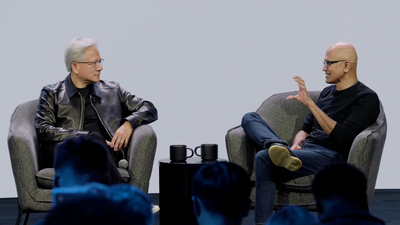
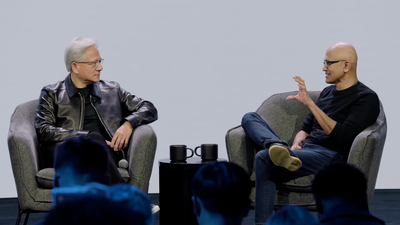
Nvidia CEO Jensen Huang has said his company owes its existence to Microsoft’s operating system. Speaking on stage at Microsoft’s Windows and Surface event in San Francisco on October 7, Huang told the audience that “Nvidia was founded because of Windows,” and traced a line from Windows 3.1 in 1992 to the GPUs that now power much of the AI industry.Microsoft CEO Satya Nadella, sitting next to him, had a quick reply. “If you could just do a little transfer of market cap back to me,” he joked, a nod to how far Nvidia’s valuation has climbed. Huang shot back: “I do that every day.” The conversation, hosted by Sriram Krishnan, former senior policy adviser for AI at the White House, came right after Microsoft unveiled the Surface Laptop Ultra and a range of laptops built on Nvidia’s new RTX Spark chip.
Windows 95 and DirectX gave Nvidia’s GPUs a way into the PC
Huang went back to late 1992, when Windows 3.1 was showing what a personal computer could become. He admitted he had never seen a PC at the time, having mostly worked on workstations, file servers and the supercomputers used to design chips. He and his co-founders imagined a PC with 3D graphics that could play games, work as a workstation and be used to design things.Windows 95 then made it possible to connect a GPU to a PC, and DirectX, through its Direct3D API, let applications use what the GPU could do. With DirectX 8, Huang said, Nvidia and Microsoft co-invented the first programmable GPU with programmable shaders. A few steps later, that work evolved into CUDA, Nvidia’s parallel computing platform.“If not for Windows, there would be no GeForce,” Huang said. Without GeForce, he added, there would be no CUDA, and AI researchers like Andrew Ng would not have found a computer to do deep learning on.
A four-year-old conversation between Huang and Nadella led to RTX Spark
Nadella called the story “the history of computing in some sense” and credited Huang as the most consistent voice on what accelerated computing could become. He recalled an early Azure deal to scale high-performance computing in the cloud, which led Microsoft to build the supercomputer it later offered to OpenAI. When Sam Altman asked if Microsoft had the compute, Nadella’s answer was “yeah, maybe.”That partnership eventually brought the two back to the PC. Huang said they discussed how to put every major tool, from Blender to Adobe and Autodesk apps, on the same machine as AI agents. “By the way, took four years,” Nadella added.The result is RTX Spark, which Huang said took over 4,000 engineering years and has been tested on more than 1,200 applications. RTX Spark laptops from Asus, Dell, HP, Lenovo, MSI and Microsoft’s own Surface are now up for preorder and begin shipping on October 16.As the session wrapped up, Huang summed up the relationship himself: “Windows has been with me for 34 years, it looks like it’s going to be with me for 34 more.”