









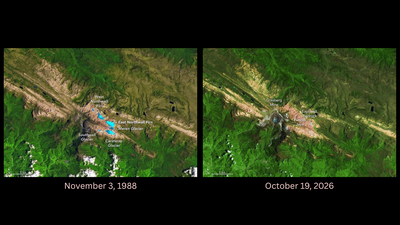
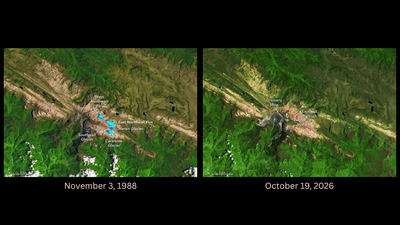
As the last ice on the mountain of eternal snow melts, Indonesia’s Puncak Jaya bids farewell to its iconic snow-covered peaks.NASA published new findings on November 16, 2026, comparing two satellite images of the Sudirman Range taken 38 years apart. The first, captured in November 1988, showed 4.31 square kilometres of glacier ice. By September 2025, only 0.09 square kilometres remained. That is just 2% of the original ice cover.Moreover, at the principal monitoring site on the East Northwall Firn glacier, ice thickness fell from 32 metres in 2010 to just four metres in 2023. By November 2024, the ice at that particular monitoring site had disappeared. According to NASA, a glacier must be thick enough to flow downhill under its own weight. The remaining ice on Puncak Jaya has fragmented into small, stagnant patches that no longer meet this condition. In other words, its functional life as an active glacier is effectively over, even though small pieces of ice remain.
About the Puncak Jaya
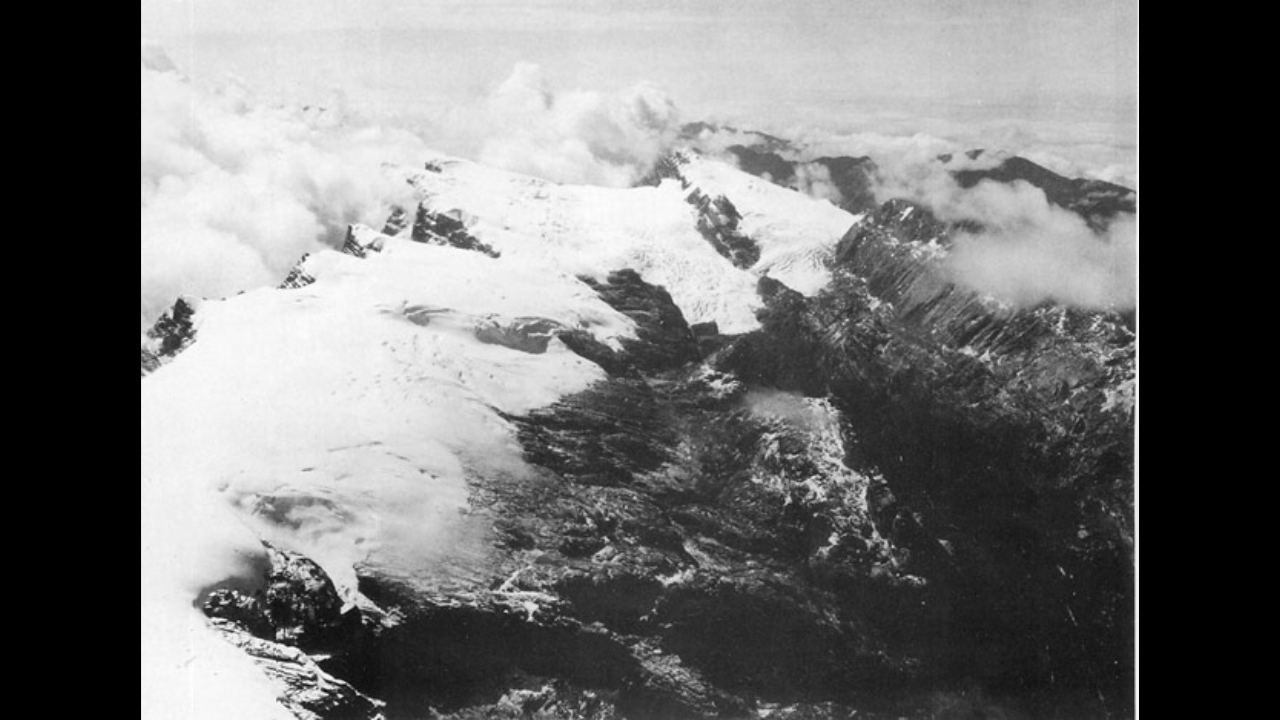
Puncak Jaya icecap in 1936. Image Courtesy: WikiMedia Commons
Puncak Jaya, also known as Carstensz Pyramid, is located in the Sudirman Range on the Indonesian side of New Guinea. Standing at 4,884 metres above sea level, it is the highest mountain in Indonesia and the tallest peak in Oceania. It is also one of the famous Seven Summits, the highest mountains on each of the seven continental landmasses.Despite being near the equator, around 454 kms to its south (for context, that is roughly the straight-line difference between Delhi and Lucknow), and being surrounded by tropical rainforests, the Puncak Jaya still had cool temperatures. Its extraordinary elevation allows temperatures to fall low enough for snow and ice to survive throughout the year. Thus, Puncak Jaya is a tropical glacier. Unlike glaciers in polar regions, which exist in consistently cold environments, tropical glaciers survive in a delicate balance between snowfall and melting.Moreso, they are located in the Western Pacific Warm Pool, an enormous region of exceptionally warm ocean water. NASA describes the mountain’s glaciers as existing close to the warmest conditions in which ice can survive throughout the year.The glaciers of Puncak Jaya are locally known as Salju Abadi, an Indonesian expression meaning eternal snow. They are also commonly referred to as the Eternity Glaciers. Unfortunately, the name eternal snow has proved less enduring than anyone might have hoped.
About Project Pressure
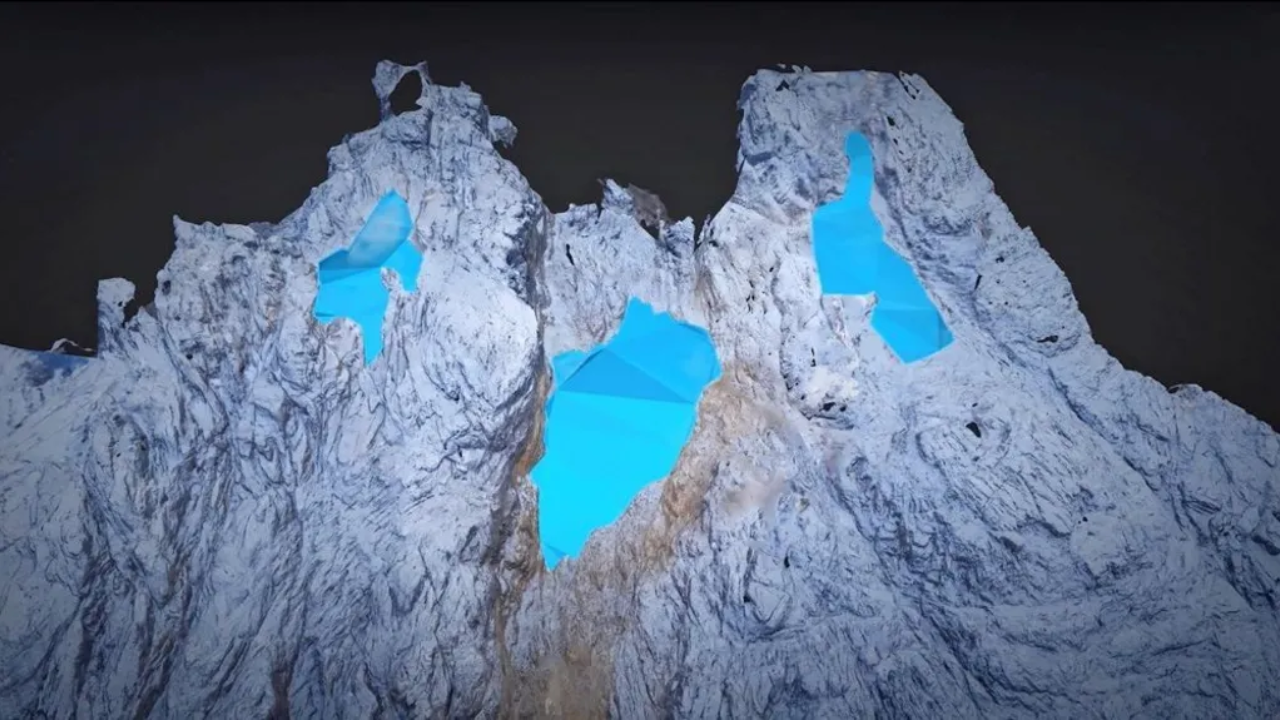
This 3D rendition by Klaus Thymann’s Project Pressure shows ice coverage in 2025.
As the glaciers approach extinction, documenting what remains has become increasingly important. This is where Project Pressure, a charity founded in 2008 by photographer and explorer Klaus Thymann, comes in.The organisation works at the intersection of art, science and environmental conservation, documenting glaciers around the world through photography, scientific research and visual storytelling. Its work aims to create a record of glaciers that future generations may otherwise only encounter in photographs.Its recent expedition to Puncak Jaya was part of an effort to document the remaining tropical ice before it disappears. The team set out to create a detailed, three-dimensional map of the East Northwall Firn glacier, capturing its remaining ice with remarkable precision.Project Pressure’s findings suggest that the East Northwall Firn glacier has lost approximately 95% of its area since 2002. While this figure applies to the particular glacier studied, it offers another indication of just how rapidly the mountain’s ice is disappearing.
The melted ice caps and what it means for the rest of the world
The disappearance of Puncak Jaya’s glaciers is not just a consequence of rising temperatures. Their decline is also closely connected to changing weather patterns, particularly El Niño.El Niño is a recurring climate phenomenon that causes changes in ocean temperatures and atmospheric circulation across the tropical Pacific. In Indonesia, it can bring warmer and drier conditions, reducing the snowfall needed to replenish glaciers while increasing the amount of ice lost to melting.The 2015–2016 El Niño was particularly destructive for Puncak Jaya. Research found that the rate of ice thinning increased approximately 5.4 times during this period. NASA reported that the glacier lost around 5.3 metres of thickness in just one year.There is another problem. Fresh snow reflects sunlight back into the atmosphere, helping keep the surface cool. As the snow disappears, darker exposed rock absorbs more solar energy, encouraging further warming and melting. This creates a cycle that makes the remaining ice increasingly vulnerable.But the loss of these glaciers also means the disappearance of an important record of Earth’s climate history.In 2010, researchers from Ohio State University’s Byrd Polar and Climate Research Center travelled to Puncak Jaya to extract ice cores from its glaciers. These cylindrical samples preserve layers of ice containing information about past atmospheric conditions, including changes in temperature and precipitation. By studying the oxygen isotopes trapped within them, scientists were able to reconstruct variations in the climate of the Western Pacific Warm Pool dating back to 1964.These ice cores represent a rare record of climate history from this part of the tropics. Once the remaining glaciers disappear, scientists will no longer be able to extract new samples. The ice already preserved in freezers at Ohio State University may become the only surviving physical record of these glaciers.Puncak Jaya is not alone in facing this fate. Tropical glaciers in the Andes, on Mount Kilimanjaro in Africa and in the Rwenzori Mountains are also retreating as temperatures rise and snowfall patterns change. Their relatively small size and dependence on a delicate balance of snowfall and melting make them particularly vulnerable.According to the World Glacier Monitoring Service, glaciers worldwide lost approximately 408 billion tonnes of ice during the 2025 hydrological year. While Puncak Jaya’s remaining ice is too small to make a significant contribution to global sea-level rise, its disappearance is an important warning about the vulnerability of glaciers in a warming world.The mountain of eternal snow may soon have no snow left to justify its name. What remains will be photographs, scientific records and a few carefully preserved samples of ice, reminders of a landscape that once seemed as though it would last forever.