









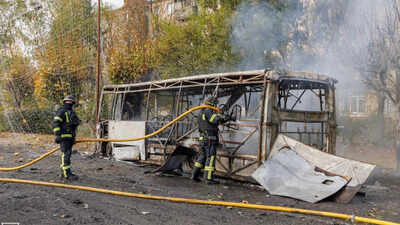
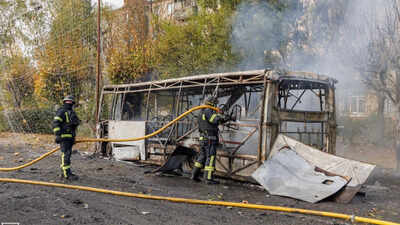
Over 30 people were killed and at least 18 others injured after Russia launched a glide bomb attack on two civilian buses in the frontline Ukrainian city of Kramatorsk on Thursday, according to Ukrainian authorities.The strike came a day after a major Russian aerial assault killed dozens across Ukraine, with much of the attack focused on the country’s power grid.Donetsk regional head Vadym Filashkin said Russian forces had targeted public transport in Kramatorsk, accusing Moscow of deliberately striking civilians. Police said the attack took place on a street where two city buses were operating, while Ukrainian President Volodymyr Zelenskyy described the location as a bus stop.“These are not ‘the consequences of war’, nor dry statistics. These are people killed by the Russian army,” Filashkin said. “Russia comes to Ukrainian land with death.”The attack came amid an intensifying Russian campaign of drone and guided-bomb strikes on cities in Donetsk’s so-called “fortress belt”, which Ukrainian officials regard as the backbone of the region’s defences. Russia has demanded that Ukraine surrender the remaining parts of the region under Kyiv’s control as a condition for ending the war, a demand Ukraine has rejected.
How Russia’s glide bombs are changing the war
The war has highlighted the growing importance of autonomous systems and stand-off weapons, with Russia making extensive use of glide bombs. Unlike conventional unguided bombs, glide bombs use aerodynamic surfaces, including deployable wings, to extend their range after being released from aircraft.Guidance systems combining satellite and inertial navigation allow the weapons to hit targets with tactical accuracy while aircraft such as Russia’s Su-34 and Su-35 fighters can release them from well inside Russian-controlled territory. This keeps Russian aircraft farther from Ukraine’s air-defence systems.Russia uses conversion kits such as the Unified Gliding and Correction Module, or UMPK, to turn Soviet-era FAB-500 and FAB-1500 bombs into precision glide weapons. It has also developed purpose-built weapons such as the UMPB, which has improved aerodynamics and a range approaching 90km. Their relatively low cost allows Russia to use them at scale while carrying large explosive warheads.