







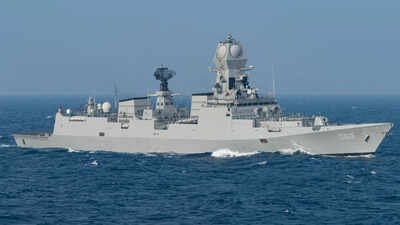
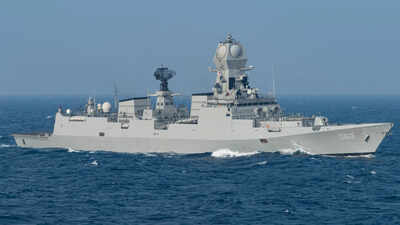
NEW DELHI: Chief of Naval Staff Admiral Krishna Swaminathan on Monday spoke on the collision that took place between a Pakistani Navy vessel and an Indian warship in September. He stated that the Pakistani vessel suffered significantly more damage than the Indian warship.Speaking at the ANI National Security Summit 3.0 in New Delhi, Swaminathan said the collision involved Indian Navy‘s INS Kolkata and Pakistan Navy’s PNS Hunain. He attributed the incident to unsafe manoeuvring by the Pakistani vessel, saying it had come so close that it reached a “point of no return”.“It’s not unusual for ships to come close to each other at sea, and of course you manoeuvre in a little bit of competition, not so friendly. That ship was manoeuvring and I suppose it came dangerously close,” he said.The Navy chief said the Pakistani vessel appeared to have tried to move away at the last moment but ended up striking the Indian ship.“When two ships are closing each other, the ship tried to manoeuvre away from our ship, I suppose, but it touched our ship. Luckily, it touched our ship in a position where we had no damage, but that ship had a lot more damage,” he said.Swaminathan said the Indian vessel was not significantly affected by the impact, while the Pakistani ship sustained greater damage and subsequently returned to its port. He declined to comment on reports that PNS Hunain was still undergoing repairs more than two months after the collision.What happened during the September collisionThe incident took place on the evening of September 15, when PNS Hunain approached an Indian Navy frontline warship operating in the North Arabian Sea. Sources had earlier told TOI that the Pakistani vessel was moving at high speed and manoeuvring in an unsafe manner when the collision occurred.The Indian warship was on a routine surveillance mission, according to the earlier account. Sources had said that PNS Hunain returned to harbour after suffering severe damage, while the Indian vessel reported no damage.The ministry of external affairs had summoned Pakistan’s charge d’affaires and lodged a strong protest over what it described as the “unacceptable and unprofessional conduct” of Pakistani naval units.New Delhi had also said the incident violated Article 10 of the April 1991 bilateral agreement on advance notice of military exercises. The provision requires naval vessels of the two countries to maintain a minimum distance of three nautical miles, according to the Indian government’s position.The MEA had asked the Pakistani diplomat to convey to the authorities concerned the need for military units to exercise due care and comply with bilateral agreements to prevent a recurrence.Navy chief on US sinking of Iranian warshipSwaminathan also addressed the sinking of an Iranian warship by a US submarine in March, days after the Iranian vessel had participated in India’s International Fleet Review in Visakhapatnam in February 2026.Describing the episode as an awkward situation for India, he said the fleet review was intended to promote friendship, cooperation and solidarity among participating countries. The Iranian vessel was returning home when it was attacked amid the US-Iran conflict.However, he said the US submarine’s action was not illegal under international maritime law, as the two countries were already at war and the Iranian vessel was in international waters, outside India’s territorial jurisdiction.“Because there are two belligerents. They had already gotten into a conflict. There are two nations at war,” he said, adding that military engagements during wartime could take place across different oceans.Swaminathan cited the Second World War, when fighting took place in the Atlantic and Pacific oceans, to explain that belligerents could engage their adversaries beyond the immediate theatre of conflict.He, however, declined to judge whether the US action was appropriate, saying that was a matter for the US Navy to address.The Navy chief also clarified that India’s engagement with the Iranian vessel had ended after the fleet review. The ship was on its return journey and was no longer participating in the Indian exercise when it was attacked.Earlier India-Pakistan naval collisionThe September incident was not the first collision involving Indian and Pakistani naval vessels. In June 2011, Pakistan Navy ship PNS Babur brushed past Indian frigate INS Godavari in the Gulf of Aden, triggering a diplomatic row.PNS Babur was escorting the merchant vessel MV Suez, which had been released after being held by Somali pirates for several months. The incident damaged the helicopter net on INS Godavari after the Pakistani vessel approached it from behind.