




Air forces around the world have been shrinking in size since the end of the Cold War, although not necessarily in capability. The Indian Air Force (IAF), for instance, has a sanctioned strength of 42.5 squadrons but now operates fewer than 30. Its fleet peaked at around 40 squadrons in 1996, according to the New Delhi-based Council for Strategic and Defense Research.India is hardly an outlier. The United States, which has by far the world’s largest defence budget, had a tactical fighter fleet of around 4,500 aircraft at the end of the Cold War. That number has since fallen to less than half, according to the official publication Air & Space Forces Magazine. The Royal Air Force and most other air forces, particularly in the Western world, have experienced similar declines.China, however, has been the major exception, expanding its air force in both numbers and capability over the same period.One of the primary reasons for the decline is what came to be known as the “peace dividend”. With the threat of a major conventional war appearing to recede after the collapse of the Soviet Union, many countries cut defence spending and, consequently, reduced the size of their armed forces.Europe benefited from this peace dividend for decades, until Russia’s invasion of Ukraine fundamentally changed the continent’s security calculations. The war, coupled with US President Donald Trump’s pressure on European allies to shoulder more of the burden for their own defence, has pushed European countries to strengthen their military capabilities.Nato members have now committed to significantly higher defence spending, with the alliance setting a new target of up to 5% of GDP. Countries such as Latvia and Poland are already at or approaching that level, while others are working to rapidly rebuild their military capabilities in response to the perceived threat from Russia.There is, however, another factor behind the shrinking size of fighter fleets, and one that affects countries far more broadly: the rising cost of buying and maintaining modern combat aircraft, even after accounting for inflation.In most countries, procuring fighter aircraft — arguably the most expensive and technologically sophisticated machines in any military — is subject to intense political and financial scrutiny. Maintaining a modern fighter fleet is therefore as much a function of politics and economics as it is of military requirements.
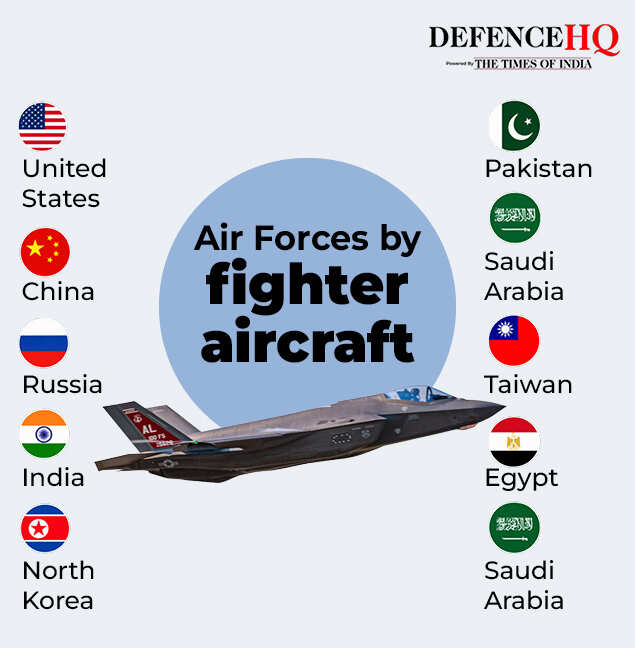
Of the countries listed here only Pakistan and North Korea have weak economies. Both these countries allocate a large share of their GDP on their armed forces.
The cost is difficult to avoid. Modern fighters are vastly more capable than their predecessors were in 1990. They can detect threats at greater distances, engage targets farther away, strike with far greater accuracy, operate as part of sophisticated networks and provide pilots with vastly greater situational awareness. But all of that capability comes at a price. As fighter aircraft become more capable, each individual aircraft also becomes dramatically more expensive to buy, operate and maintain.
Pakistan bucks the trend
Islamabad has gone to considerable lengths to maintain the numerical strength of its combat fleet, both by inducting new aircraft and by upgrading older airframes.Its Mirage fleet is perhaps the clearest example. The Mirage III and Mirage V, once among the world’s most widely used fighter aircraft, have long since been retired by virtually all their former operators. Pakistan, however, continues to operate them.The Pakistan Air Force (PAF) operates a diverse fighter fleet sourced from France, the United States and, increasingly, China.
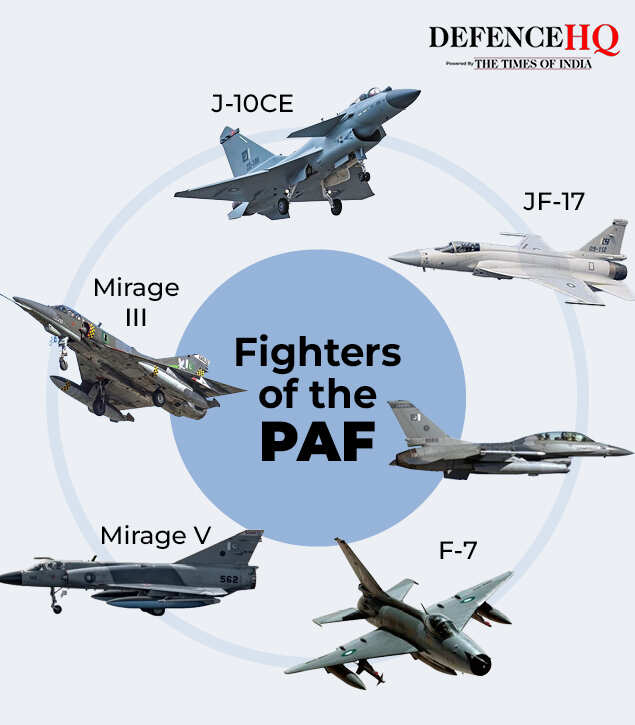
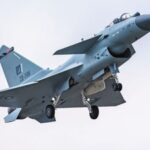
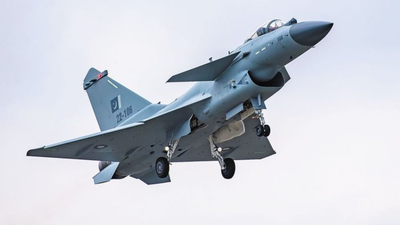
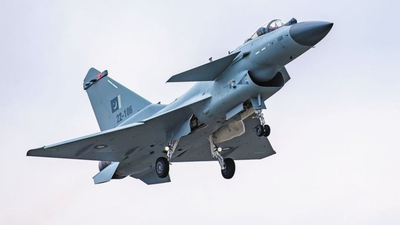
Pakistan flies a diverse set of single-engine fighter aircraft; most of these are of Chinese origin.
Its inventory includes the American F-16, the French-origin Mirage III and Mirage V, and a growing number of Chinese-origin aircraft. The latter include the F-7 and J-10, as well as the JF-17, which Pakistan assembles domestically in cooperation with China.The last PAF F-7 squadron is now transitioning to the JF-17 Block III. Once that transition is complete, the number of JF-17-equipped squadrons will rise from six to seven.The PAF also operates three F-16 squadrons. Two of these were inducted in the 1980s, while the third was inducted around 2010. In addition, there are four squadrons operating Mirage III and Mirage V fighters. Pakistan began inducting the Mirage in 1967, with some aircraft subsequently acquired from Saudi Arabia and others obtained second-hand from the Royal Australian Air Force.The newest addition to the fleet is the Chinese J-10CE, which Pakistan has recently acquired.This creates a significant challenge for the PAF. Six of its fighter squadrons (two F-16 squadrons and four Mirage squadrons) will need replacement over the coming years. In a force of around 15 frontline fighter squadrons, losing six represents roughly 40% of the fleet, making this a potentially significant capability gap.The PAF’s total fighter-related strength is larger when training and conversion units are included. It has a fighter squadron each of F-16s, JF-17s and Mirages at the Combat Commanders’ School (CCS), the PAF’s equivalent of the US Navy’s Top Gun school or the IAF’s Tactics and Combat Development Establishment. It also operates four operational conversion units flying F-16s and JF-17s.Taken together, these formations bring the number of PAF squadrons operating fighter aircraft to around 22. Beyond these are combat-support units performing critical missions, including airborne early warning, electronic warfare and other specialised roles.For decades, Pakistan has sought to maintain a degree of numerical parity with India, and it has gone to considerable lengths to preserve the size of its combat fleet. But it is now staring at what could be a significant gap.The problem is particularly acute because much of the older fleet is approaching the end of its Technical Total Life (TTL). Pakistan’s Mirage fleet is extremely old, while some of its F-16s are also approaching the limits of their service lives.The PAF’s last publicly announced major order for its “indigenous” fighter came in 2020, when it ordered 50 airframes of the advanced JF-17 Block III. Pakistan has also received the last of its 20 J-10 fighters, according to the International Institute for Strategic Studies.Based on publicly announced orders, therefore, the PAF appears to be facing a significant decline in numbers unless it secures another major fighter procurement programme.Pakistan has been seeking China’s fifth-generation J-35 fighter, but no formal deal has yet been announced. Pakistani Prime Minister Shehbaz Sharif had also posted a list of military equipment that Pakistan was expected to procure from China on social media, but the post was subsequently deleted, adding to speculation over a possible deal.Pakistan has already demonstrated its willingness to spend heavily on military hardware.It was the world’s fifth-largest recipient of major arms in 2021–25, up from 10th place in 2016–20, with its arms imports increasing by 66% between the two periods. Pakistan accounted for 4.2% of global arms imports during 2021–25, and 80% of those imports came from China, up from 73% in 2016–20.The bigger question is whether Pakistan can afford to maintain this pace.With a struggling economy and a substantial debt burden, financing an entirely new generation of fighters will be difficult. Pakistan has the world’s 40th-largest economy, according to the IMF, yet it maintains what is ranked as the world’s seventh-largest air force.The contrast with Bangladesh is revealing. Bangladesh is economically better placed than Pakistan but has a much smaller air force, ranked 65th by a major military tracker. The comparison illustrates the extraordinary importance Pakistan has placed on maintaining a large combat fleet.But there may be a limit to how long Islamabad can sustain that ambition.To paraphrase the original Top Gun, the PAF may be writing cheques that the Pakistani economy cannot cash.This is not entirely unprecedented. Pakistan’s former prime minister Zulfikar Ali Bhutto famously declared that the country would “eat grass” if necessary to acquire a nuclear weapon. Today, Islamabad faces a similar scenario: with an economy that is nosediving, how much is it willing to sacrifice to maintain the world’s seventh-largest air force?