






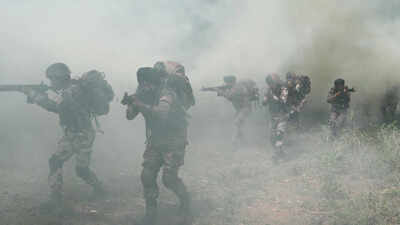
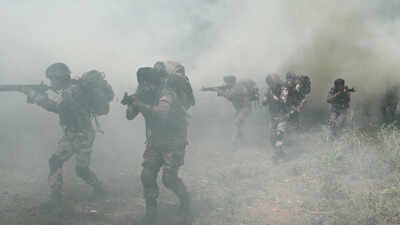
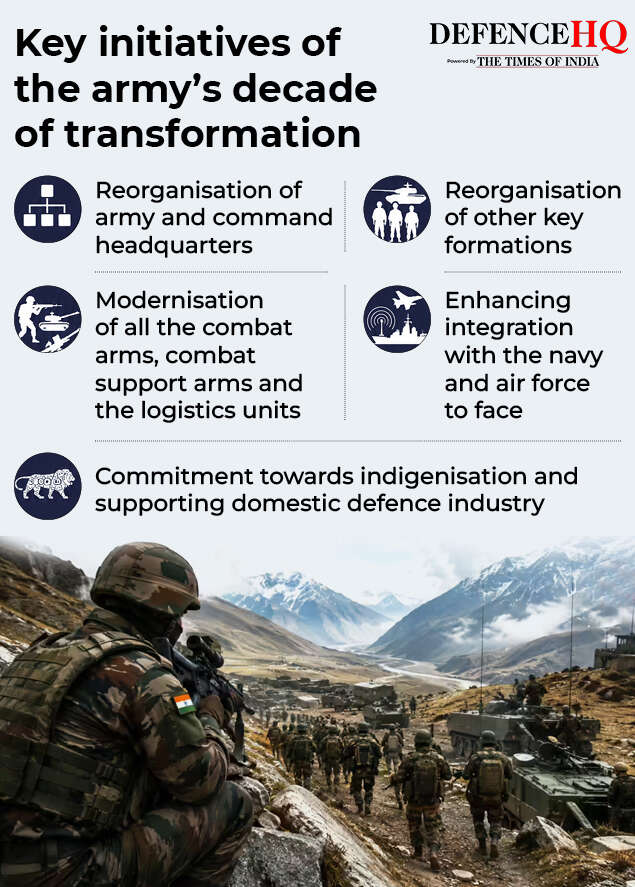
Army chief General Dhiraj Seth declared his “VIJAY” mantra soon after taking over as the Chief of the Army Staff (COAS).“Vijay” means “victory” in Hindi, and the army has fought two conflicts under this banner. The first was Operation Vijay in 1961, the liberation of Goa from Portugal, and then, more recently, the recapture of critical mountaintops during the Kargil War in 1999.General Seth’s “VIJAY”, however, is not a military operation to conquer lost territory. It is the direction he envisions for the army as it charts its future success. This “VIJAY” stands for Vigilance, Innovation, Jointness, Atmanirbharta and Yodha, or warrior, first.The move comes at a time when the army is already in the middle of what it calls the Decade of Transformation, a phase that runs from 2023 to 2032. The army had initially termed 2023 as the Year of Transformation and 2024 as the Year of Technology Absorption. In the same manner, 2025 was the Year of Reforms, and the current year is the Year of Networking and Data Centricity. All these steps are being taken at a time when the armed forces are looking at some of the biggest structural and doctrinal changes.
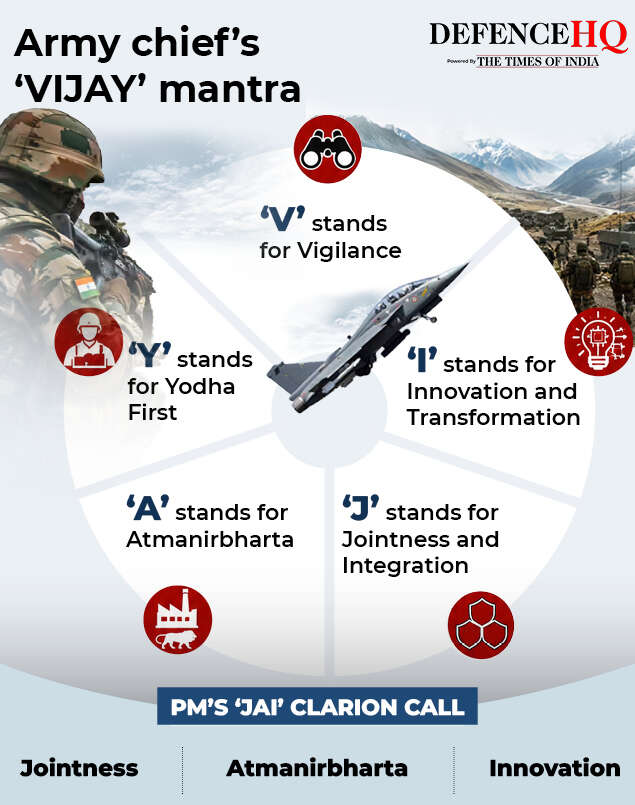
Many of these reforms, such as the operationalisation of Integrated Battle Groups (IBGs), have already taken shape, while more important changes, such as the implementation of Integrated Theatre Commands, are still pending. Most of the internal friction points within the armed forces have been resolved, and full implementation now awaits final approval from the Cabinet Committee on Security (CCS), chaired by the Prime Minister.In fact, General Seth’s “VIJAY” itself is derived from Prime Minister Narendra Modi’s “JAI” directive, which he gave at the 16th Combined Commanders’ Conference held in Kolkata in September last year. PM Modi’s thrust for the top leadership of the armed forces was on Jointness, Atmanirbharta and Innovation, with jointness and integration of the three services seen as the most important of these guiding principles.The position of the chief of defence staff, currently held by General N S Raja Subramani, was created to foster greater integration between the three services. The aim is to bring the forces together and get them to fight together in order to have a more decisive edge in combat.Although the army, like its sister services, the air force and the navy, is continuously modernising and keeping abreast of other changes, the current impetus on transformation started under General Manoj Pande, who took over as COAS on April 30, 2022, and relinquished command on June 30, 2024.It was General Pande who initiated the Year of Transformation in 2023 and the Year of Technology Absorption in 2024, putting the spotlight firmly on transformation.
The need for transformation
The rapid rate of technological change has altered society forever. In the last decade, there has been a sea change in how we shop, travel and interact with each other. The impact of these technological changes on conflict, too, has been profound.Many of these changes, such as the use of drones, stealth fighter technology, ballistic missiles in conflict and lasers, have made headlines over the last few years. Other changes, including cyber warfare, improvements in communication technology, AI-empowered networked systems and data centricity, have also seen considerable progress in the same time frame, even changing the way military leadership thinks and acts.For example, the term “kill chain”, a linear manner of orientation, thought and action, has now given way to “kill web”, a paradigm that is more resilient and accommodates different nodes for multiple combat solutions.
“Security is now multifaceted and multidimensional. It is relevant in war as well as in peace, including in the no war, no peace scenarios. The new security strategic continuum now extends from seabed to space. Fast-paced emerging and disruptive technologies are changing the way conflicts are being fought. The focus must be on capacity building and capability development to fight contemporary and futuristic conflicts. If you do not transform at a commensurate pace with respect to technology and allied developments, our ability to address futuristic threats and challenges may not be optimal. Hence, various facets of manpower, technology, and capability ought to be timely addressed to overcome potential challenges in the future. Doctrine and concepts at higher levels, as well as tactics, techniques, and procedures, need to be continuously revised to stay relevant in the modern battlefield. Capability development for complex threats necessitates a joint approach to multi-domain warfare capability for non-contact, contact, kinetic and non-kinetic facets”
Lt General PS Minhas (retired), who commanded the Jodhpur-based XII Corps
Armed forces across the world are scrambling to find solutions to many of these challenges. The Indian armed forces, too, are modernising with the confidence gained during Operation Sindoor. The foot is on the gas on reforms and modernisation, but this motion is grounded in sound operational experience.Systems such as the L-70 air defence gun, which was seen as obsolete equipment in other countries, have been modified and modernised domestically. This gun turned out to be very effective against drones, even as countries around the world are looking for effective ways to tackle this new scourge. At the same time, the armed forces are using newer domestically developed systems that work in the electromagnetic spectrum or with directed energy weapons.
Transformational milestones of the past
In 1986, General Krishnaswamy Sundarji took over as COAS. Under his leadership, the army formulated a plan to take the war to the enemy. This was in the mid-1980s, when the army was in a similar modernisation phase. The army was inducting equipment such as T-72 tanks, BMP-IIs, Bofors guns and a host of other systems that would greatly strengthen its offensive capabilities.The Sundarji Doctrine envisaged large-scale, high-intensity conventional warfare against Pakistan through deep armoured thrusts by powerful strike corps, supported by holding corps to fix and wear down enemy forces. Its premise was that rapid manoeuvre, combined with overwhelming firepower, could secure favourable outcomes.Conceptually, it refined post-1965 and 1971 offensive-defensive ideas, emphasising mechanisation, mobility, synchronised corps-level operations and major organisational changes. The scale, intensity and operational potential of this doctrine were demonstrated during the now-famous Exercise Brasstacks held in 1986-87.
Adapting to the situation: Cold Start after Sundarji
In the aftermath of Operation Parakram in 2001-02, the large-scale mobilisation after the attack on Parliament, the army had to adapt to form a new doctrine. This became necessary as the army took weeks to deploy. In this span of time, Pakistan was able to deploy its forces defensively and also internationalise the crisis between two nuclear-armed neighbours.The Cold Start Doctrine emerged from India’s experience with the limitations of earlier strategies. Its objective was to impose swift and punitive costs on Pakistan while staying below perceived nuclear thresholds. Unlike the Sundarji Doctrine’s deep armoured thrusts, Cold Start emphasised speed, surprise, flexibility and limited territorial objectives for bargaining leverage.Though the Cold Start Doctrine was officially denied for years, Pakistan treated such swift operations as a tactical reality.
It’s not just the Indian Army
Other armies, too, are looking at doctrinal shifts to change their orientation as they move forward. A clear example is “The US Army in Multi-Domain Operations 2028”. This paper lays out how the US Army will fight and win future wars against near-peer adversaries such as China and Russia.It recognises the tactics that are most likely to be employed by adversaries and how to counter them, as well as the technological advantages that need to be developed to counter these threats. The US Army, too, is looking at Multi-Domain Operations, where the army, as part of the joint force, penetrates and dis-integrates enemy defences, and exploits freedom of manoeuvre to achieve its objectives.This plan also represents a doctrinal shift from linear, domain-specific warfare to integrated, simultaneous operations across all domains.“Vijay ya veergati”, translated as “death or glory”, is, in some form or another, a common motto for combat units across the world. Now, in the context of a modernising Indian Army, Vigilance, Innovation, Jointness, Atmanirbharta and Yodha First form the bedrock of modernisation.The army has demonstrated its effectiveness in non-contact warfare and is currently strengthening itself in Multi-Domain Operations. This new phase of focused modernisation will usher in a new era of capabilities and, therefore, effectiveness for the Indian Army.