











More than $2 trillion in market value is set to be wiped from the tech-heavy Nasdaq 100 this month, as Big Tech earnings intensified investor scrutiny of whether the billions being poured into artificial intelligence can generate returns quickly enough.The wipeout would amount to slightly more than SpaceX’s entire market value. The index has fallen over 5.8% so far in Oct as the AI trade ran into turbulence, with hyperscalers Meta Platforms, Alphabet and Amazon.com raising spending forecasts further as they race to expand AI infrastructure.The prospect of ever-bigger AI outlays has unnerved investors, particularly as rising borrowing costs threaten to make debt-funded investment more expensive and harder to justify.Alphabet suffered its biggest one-day percentage drop on record on Thursday after disappointing results in the core business of search advertising and a massive acceleration in cash burn. Meta’s plans for a record $97.5 billion fund raise heightened concerns about shareholder dilution and whether mounting AI spending could force other Big Tech companies to increasingly tap capital markets.
Nasdaq 100 set to lose over $2 trillion in October as rising AI spending fuels investor concerns
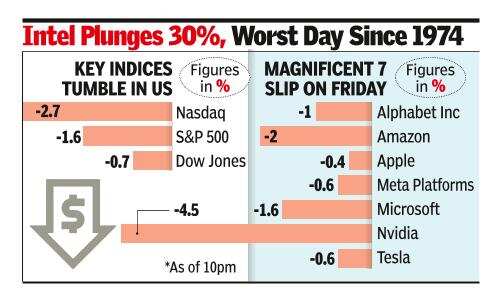
On Friday, Intel’s stock led the way lower and was flirting with its worst day since 1974 after tumbling 30%.Microsoft and SpaceX broke from the gloom, with results that showed AI spending starting to pay off.“It may be that we’ve overestimated how strong the growth might be, but they’re not going negative in aggregate,” said John Bilton, global head of strategic research at Multi-Asset Solutions.“We have an insatiable and growing demand for data.” Microsoft is reportedly planning to raise about $25 billion through its first US investment-grade bond sale in more than nine years. Among other hyperscalers, Meta, Amazon and Alphabet have issued hundreds of billions of dollars in bond sales over the past four years, worrying investors about overreliance on the medium for raising capital. Morgan Stanley forecast capital spending on AI infrastructure overall will surpass a trillion dollars next year. AI companies’ growing reliance on debt funding is emerging as a new risk for investors, challenging the view that the companies at the heart of the boom are insulated from macroeconomic pressures.The concern is spreading beyond stocks to credit markets, where investors are starting to price in the possibility that rising financing costs, combined with slower returns on AI spending, could squeeze companies previously viewed as relatively insulated. Revenue across the “Magnificent Seven” has remained strong since ChatGPT’s launch in 2022, showcasing insatiable demand and perhaps why investors were initially willing to back the spending, even as the timeline of payoffs remains uncertain.Amazon’s cloud computing cash cow, Amazon Web Services, continued to accelerate, while Meta offered better-than-expected revenue growth and an upbeat outlook. Microsoft also forecast strong cloud growth in its latest earnings report.Big Tech has historically spent heavily on infrastructure to build and expand businesses such as cloud computing, online advertising and e-commerce, but the AI boom has pushed capital expenditure to dizzying levels. JP Morgan expects global AI capex to reach $5.5 trillion by 2030, and sees $900 billion being spent in 2026 alone. Reuters