




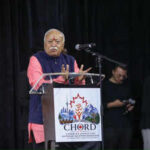


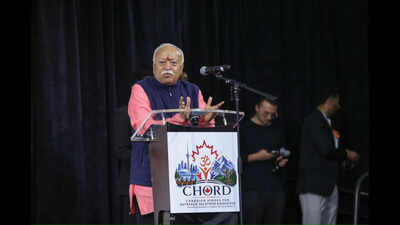
RSS chief Mohan Bhagwat said India became a “Vishwaguru” (world teacher) through its selfless service to humanity rather than by becoming a “Mahashakti” (superpower), highlighting the country’s civilisational tradition of friendship, refuge and respect for diversity.Addressing the “Hindu Vishwa Bandhu – Embrace the World in Friendship” gathering in Toronto, Bhagwat said India’s global influence had historically come from sharing knowledge and extending help, rather than seeking territorial or political dominance.“One may call Bharat a superpower, but it was not one. It served the world and by its own character, it became ‘Vishwaguru’, not Mahashakti,” he said.Bhagwat cited India’s history of providing refuge to people fleeing persecution and conflict. Recalling the Second World War, he referred to the Maharaja of Jamnagar offering shelter and protection to Polish refugees until they could return safely.“There are so many instances; it is still continuing,” Bhagwat said.He also referred to India’s evacuation efforts during conflicts in the Middle East, saying Indian military aircraft had rescued citizens of several countries alongside Indians.“When, some years back in the Middle East war, people were trapped, the military planes of Bharat went there and rescued not only Bharatiya citizens; citizens of seven countries were rescued from there by Bharatiya,” he said.Bhagwat said India had historically provided peaceful refuge to Muslims, Christians, Jews and Parsis, arguing that those facing persecution could find asylum in the country.“Anywhere in the world, if someone was persecuted, he got asylum in Bharat only,” Bhagwat said.‘This is the tradition. This is the DNA of Bharat’The RSS chief contrasted India’s civilisational outreach with imperial expansion, saying Indian travellers spread knowledge and values without conquering countries.“Our ancestors travelled from Mexico to Siberia… They crossed the Himalayas on foot, went to Southeast Asia through small boats, but they conquered no country. They gave knowledge, astronomy, ayurveda, imparted civilisational values… Even today, when an ordinary Bharatiya goes to any country, the people there offer Namaskara,” he added.He said helping people in distress was embedded in India’s civilisational character and that the country had extended assistance even when help was not explicitly sought.“This is the tradition. This is the DNA of Bharat,” he said.Bhagwat also explained his understanding of the term Hindu, saying it should not be confined to a particular language, form of worship or lifestyle.“When I say Hindu, the word Hindu cannot be defined by any specific language, through any specific worship, or through any living style,” he said, adding that Hindus “respect all” and “accept all”.He called for embracing diversity while recognising an underlying unity among humanity.“We have to serve, accept, respect this diversity because it is an expression of unity. It beautifies it. It is the decoration. We celebrate it,” he said.Bhagwat said India’s ancient ethos viewed diversity as a natural feature of existence while considering unity to be the fundamental reality.“There have been many castes, many creeds, many languages. Everything is many. Nothing”“Nature, expression of reality, is diverse. Diversity is natural. Unity is the reality. You have to tackle with natural, keeping in mind reality. That is the ancient ethos of Bharat,” he added.Invoking the philosophy of Vasudhaiva Kutumbakam, Bhagwat said an open-minded and knowledgeable person recognises the world as one family.“Those who are open-minded and knowledgeable embrace the concept of Vasudhaiva Kutumbakam–the belief that the entire earth is one family,” he said.He said that despite differences in people’s physical appearance, humanity was fundamentally united, making service to others a responsibility.“Therefore, serving others is our duty. We have gained this wisdom, which brings us enduring happiness and satisfaction,” Bhagwat said.
Share your thoughts in the comments
Be respectful · TOI community guidelines
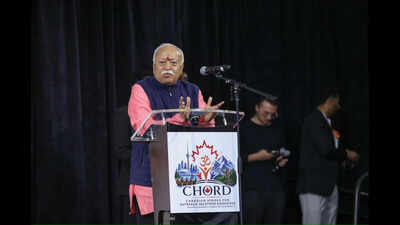
The address was delivered at the “Hindu Vishwa Bandhu – Embrace the World with Friendship” gathering, which brought together more than 2,000 members of Canada’s Hindu community from all 10 provinces.The event was organised by CHORD, Canadian Hindus for Outreach, Relations and Dialogue, with support from more than 175 organisations. It focused on friendship, dialogue, belonging and shared responsibility, drawing on the Hindu civilisational ideal of “Vasudhaiva Kutumbakam”.