







Weapons of war are becoming smarter, more autonomous and increasingly lethal. In a high-intensity conflict, one of the first objectives is often to degrade the adversary’s ability to retaliate by targeting airbases, missile launchers, radar stations, air-defence systems and command centres.The United States popularised the phrase “shock and awe” during the 2003 invasion of Iraq to describe the use of overwhelming force to paralyse an adversary’s military and political leadership. While military doctrines have evolved since then, the underlying principle remains relevant: strike critical targets quickly and create operational gaps before the adversary can effectively respond.
Operation Sindoor and the logic of opening strikes
India employed elements of this strategy during the military confrontation with Pakistan in May 2025. Operation Sindoor began with strikes on terror infrastructure in Pakistan and Pakistan-occupied Kashmir. After Pakistan attempted to target Indian military installations, India expanded its response to Pakistani military infrastructure.According to the Indian military, subsequent strikes targeted radar installations, air-defence systems, command facilities and airbases, including Rafiqui, Murid, Chaklala, Rahim Yar Khan, Sukkur and Sialkot. The fighting ended after the two countries agreed on May 10 to halt military action.Damaging an airbase or radar site does not necessarily put it out of action permanently. Runways can be repaired and mobile radars relocated. Even temporary disruption, however, can create gaps in surveillance and air defence that allow attacking aircraft and missiles to approach from less-protected sectors.Cratered runways can also slow fighter operations, while the loss of radar coverage or command facilities can make it more difficult to coordinate an effective response.
Why the number of launch platforms matters
A major element of such an offensive is the ability to deliver a large number of weapons within a short period. A concentrated missile salvo can overwhelm air-defence systems, force the adversary to expend interceptors and simultaneously threaten multiple targets.India can launch the BrahMos cruise missile from land-based batteries and naval platforms. Its ability to launch BrahMos from the air, however, is presently centred on a limited number of specially modified Su-30MKI fighters. The government had approved the integration of the air-launched BrahMos on more than 40 Su-30MKIs. The missile’s weight and dimensions require substantial structural, electrical and software modifications to the aircraft.The Indian Air Force also operates 36 Rafale fighters capable of carrying the SCALP long-range cruise missile.Fighter aircraft are highly capable launch platforms, but their numbers, maintenance requirements and sortie-generation rates place limits on how many cruise missiles can be launched at once. That has encouraged militaries to look at unconventional ways of increasing the number of available launch platforms.
Rapid Dragon : Turning cargo planes into missile carriers
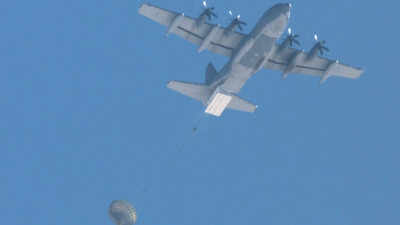
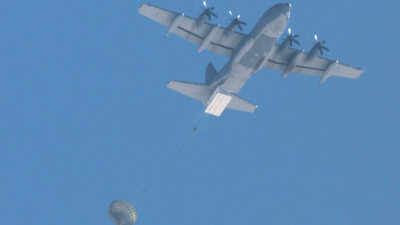
The United States has experimented with one such solution through Rapid Dragon, a programme designed to launch palletised cruise missiles from military transport aircraft such as the C-130 and C-17.Instead of permanently modifying the aircraft, missiles are loaded into a palletised deployment system that can be rolled into the cargo hold. During flight, the pallet is extracted through the rear ramp using standard airdrop procedures.A parachute stabilises the pallet after it leaves the aircraft. The missiles are then released, their wings and control surfaces deploy, and they proceed independently towards their assigned targets.Rapid Dragon completed system-level demonstrations using the C-17 and variants of the C-130 in 2021. Its first live-fire test, involving a JASSM-ER cruise missile released from an MC-130J, was also conducted in December 2021—not 2022. Further demonstrations followed in Europe in 2022.The attraction of the concept is that a transport aircraft can temporarily become a stand-off strike platform without undergoing the extensive modifications normally required to integrate a new missile.A single cargo aircraft can also carry several weapons, allowing a force to generate a larger missile salvo while keeping its limited fleet of fighter aircraft available for air-defence, escort or other strike missions.
From Rapid Dragon to Dragon Cart
Rapid Dragon was primarily an experimental programme intended to prove that palletised weapons could be safely deployed from existing airlifters.The US Air Force has since taken the idea forward through a programme called Dragon Cart. In April 2026, Dragon Cart formally became a programme of record, with the US Air Force aiming to begin fielding the capability in 2027.The system will combine standard airlift and airdrop equipment with a government-owned battle-management system. It is being designed to carry different kinetic and non-kinetic payloads rather than being tied to a single type of missile.Rapid Dragon and Dragon Cart, therefore, should not be used interchangeably. Rapid Dragon demonstrated the concept; Dragon Cart is the follow-on programme intended to turn the idea into an operational capability.
Could India adopt a similar system?
The Indian Air Force operates both the C-130J and the C-17, the two basic aircraft families used during Rapid Dragon trials. This does not mean that the American system can simply be fitted to Indian aircraft.A palletised strike system would require compatible missiles, safe-release trials, communication links, mission-planning software, targeting networks and certification for each aircraft and weapon combination.India would also need a cruise missile light enough to be deployed in significant numbers from a pallet. The air-launched BrahMos, weighing around 2.5 tonnes, is considerably heavier than weapons such as the JASSM-ER.Hindustan Aeronautics Limited has displayed the CATS Hunter as an air-launched stand-off weapon with a warhead capacity of about 250kg. Such a weapon could eventually fit into a broader massed-strike concept, although its final specifications, range and development status would determine whether it could be adapted for palletised deployment.
C-390 joins the palletised-missile race
Brazilian aircraft manufacturer Embraer and US defence company Anduril have now signed an agreement to explore integrating the Barracuda-500M stand-off missile with the C-390 Millennium transport aircraft.Under the proposed system, the Barracuda-500M would be carried and released through the C-390’s cargo ramp using palletised launch procedures. Anduril says the system could allow an airlifter to deploy dozens of relatively affordable missiles in a single mission.The first successful pallet-launched test of the Barracuda-500M was conducted in September 2024. Embraer and Anduril announced their C-390 integration agreement on July 21, 2026, but the project is still at the proposed integration stage and is not yet an operational system.The development is relevant to India because Embraer, in partnership with Mahindra, is pitching the C-390 for the Indian Air Force’s Medium Transport Aircraft programme. The companies have also proposed local manufacturing, maintenance and supply-chain participation if the aircraft is selected.
A missile truck, but not a bomber
Palletised weapons can turn cargo aircraft into temporary “missile trucks”, increasing the number of weapons that can be launched without requiring a corresponding increase in the fighter fleet.They could also complicate an adversary’s calculations. A transport aircraft that normally carries troops or equipment could potentially launch long-range weapons, making it more difficult to determine which aircraft pose an immediate strike threat.But the concept has limitations. Transport aircraft are large, comparatively slow and lack the survivability of specialised combat aircraft. They would have to remain well outside hostile airspace and depend on weapons with sufficient range to reach their targets.Palletised launch systems would therefore complement—not replace—fighters, bombers, ships and ground-based missile batteries. Their principal value lies in adding another launch option and enabling militaries to deliver larger, more dispersed missile salvos during the opening stages of a conflict.