






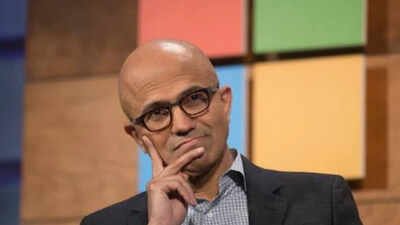
Microsoft CEO Satya Nadella has given his clearest explanation yet for why the company asked around 60,000 employees, more than a quarter of its workforce, to consider leaving. Speaking to Andrew Ross Sorkin at the NYT DealBook Summit on Wednesday, Nadella said the buyout was meant “to make sure that at least everyone felt like they had agency in making choices” as Microsoft rebuilds itself around AI. His comments come weeks after a group of Microsoft workers circulated an open letter. It accused the company of chasing AI with a “speed-at-all-costs” ethos and flagged “threats of AI job replacement and layoffs.”Nadella made it clear that the plan is not to swap engineers for AI.“Let’s take software engineering. We went from, ‘Well, we don’t buy that AI can ever do software.’ To suddenly, ‘Wow, it can do all software, and why do we need software engineers?’ To now rediscovering that software engineering is very much alive and, in fact, is going to thrive, except the way the team is organized and the work that a software engineer does has now got a new operating point,” he said.Some people, he admitted, find “that reorganization and change is sort of hard,” but “it has to be done.”
Nadella says every job at Microsoft will turn into managing AI agents
To show what that new operating point looks like, Nadella pointed to the team behind Cowork, the AI agent in Microsoft 365 apps. The team has just 11 developers, and they have learnt to let AI do most of the building. “They build a software factory that builds the product. They don’t build the product,” he said.He expects every employee to eventually direct AI agents instead of doing the work themselves. “That level of direction is what, by the way, is going to happen in all jobs,” Nadella said. He also admitted that a 51-year-old company was not born AI-first, and that the shift “is going to take a bit more time than anyone expects.”On a podcast with Gergely Orosz last week, he went a step further. He said the industry had “created enormous anxiety” among workers with talk of the singularity and of AI taking away all jobs.
Microsoft employees had already put their AI worries in writing
Before the buyouts were announced, current and former employees circulated a letter signed “Concerned Microsoft Workers.” It called working at the company “joyless and demoralizing.” According to the letter, staff were pushed to use AI in almost every area with little training, and were spending time “fixing AI slop” and reworking low-quality features.The letter asked Microsoft to involve workers in decisions on AI and to stop tying AI use to rewards, reprimands or layoffs. It also asked the company to treat AI as an assistive tool rather than “a complete labor replacement.”Six employees told the NYT that the buyout landed on a workforce already strained by AI targets and stagnant pay, with some merit raises this year below 1%. Gretchen Thomas, a design leader who left in September, had her stock award cut. According to a memo seen by the NYT, part of the reason was that she did “not consistently” show speed, urgency and willingness to experiment, including with AI.
Microsoft’s 60,000 buyout offer covers teams in India, US, Canada and UK
Microsoft confirmed the Voluntary Exit Offer on October 26. It covers employees at vice president level and below on select teams in the US, Canada, India and the UK. Xbox, Windows, Copilot and Finance are among the divisions involved.Employees have until December 9 to decide, and those who accept will leave on December 31 with at least eight weeks of base pay. Microsoft expects fewer than 5% to take it. This is its second buyout this year, after a retirement-age offer earlier in 2026. It also follows layoffs of 10,000 people in 2023, over 15,000 in 2025 and about 4,800 this summer.Chief people officer Amy Coleman told the NYT that the buyouts were not linked to how AI is changing work, and she did not rule out future layoffs. Two days after the offer, Microsoft reported quarterly profit of $36.6 billion, up 32%. Capital spending, mostly on data centres, rose 30% to $45.2 billion, and the company expects to spend roughly $170 billion this year.For those who stay, the worry is more immediate. Employees told the NYT they do not expect departing colleagues to be replaced, so their work will land on the people left behind. That is where Nadella’s new operating point will be tested first.