







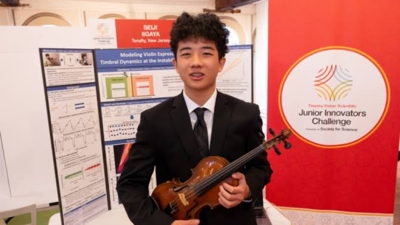
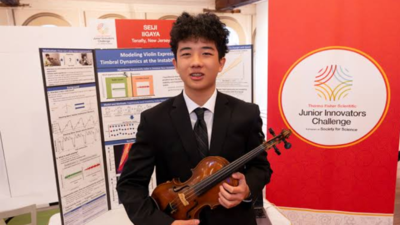
A 14-year-old violinist from New Jersey has used computer programming and the physics of strings to work out how a musician’s bow movement creates a rich tone. His work won a top national science prize in the United States. Seiji Iigaya, a student from Tenafly, won the First Place Science Award and a $3,500 educational stipend at the 2026 Thermo Fisher Scientific Junior Innovators Challenge in Washington, D.C. The Society for Science runs the contest every year. It is the top middle school science, technology, engineering and mathematics (STEM) event for young researchers across the country. His winning project was titled “Modeling Violin Expression: Timbral Dynamics at the Instability Boundary.” It looked at the exact physical factors that let string players make a warm, expressive tone without pushing the string into a harsh, cracked sound. Seiji wanted to improve his own playing. So he used software code to study how a bow hair and a vibrating string interact. “I was very happy I was able to prove this quantitatively,” Seiji said in an interview published by the Society for Science during the contest’s public project exhibition.
Simulating string dynamics with computer code
To study how tone is made, Seiji used the Python programming language to build a digital model of a vibrating violin string. His model split the virtual string into 100 separate points of contact. This let him track how changes in the bow’s position, speed and downward force changed the wave patterns. He ran many tests at different bow speeds and pressures. These tests mapped the line where smooth string vibration turns into chaotic noise. Data from his model showed a specific zone near the point of instability where the violin makes its most complex and expressive sound. According to research highlights on the Society for Science official blog, Seiji found a narrow safe zone. In this zone, musicians can get the most expression while keeping the sound clean. “Something else I found in my research was that there’s a slight buffer zone where you can play very expressively, but the sound is still not unstable,” Seiji noted during the showcase. “There’s a slight gap, and I found that this increases with bow speed, which was something very interesting since that means that violinists need to adapt dynamically in order to play with a lot of expression.”
National recognition in Washington
The Thermo Fisher Junior Innovators Challenge draws thousands of middle school entrants from connected regional science fairs across the United States. A panel of professional scientists, engineers and teachers chose 30 finalists from nearly 2,000 top applicants. They came from 47 states and five territories. During finals week in the American capital, the finalists took part in hands-on team challenges. They also gave individual talks about their own research. The Society for Science and sponsor Thermo Fisher Scientific gave out more than $100,000 in total prizes at a ceremony on October 27. Seiji’s first-place award of $3,500 honors excellent scientific method and promise in basic physics research. Besides the student awards, the Society for Science gave a $1,000 educational grant to Seiji’s school in New Jersey. It will support local STEM learning projects and lab equipment.
Bridging acoustic arts and modern data science
Seiji’s project shows how classical music can be studied with modern data tools. He calculated the mathematical limits of string friction. His model gives a theory that explains techniques master violinists usually learn through years of instinctive practice. The Society for Science noted that the 30 national finalists were picked for using strong scientific methods on real-world problems and personal interests. Senior leaders at Thermo Fisher Scientific stressed that the contest aims to inspire young students to pursue technical careers. It does this by applying coding, data modeling and experiment design to everyday questions. After the national awards ceremony, Seiji and the other finalists join the Society for Science alumni network. It supports young researchers as they continue their studies through high school and university.