




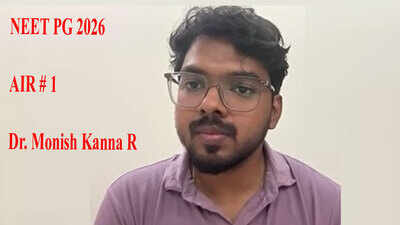
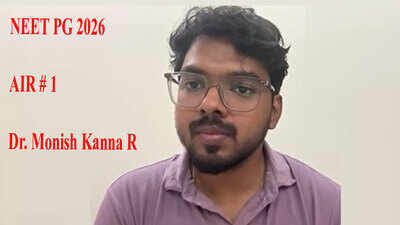
When Dr Monish Kanna R began preparing for NEET PG, he initially concentrated mainly on multiple-choice questions during his internship. Over time, he realised that solving questions alone was not enough and that he needed a structured approach to cover the vast medical syllabus.That change in preparation, combined with repeated revisions, daily practice and the ability to recover from setbacks, eventually culminated in a remarkable result. Dr Monish secured All India Rank 1 in NEET PG 2026, scoring 641 out of 720 marks. In a YouTube interview following the result, he discussed the study methods, personal struggles and family support that shaped his journey.
Who is Dr Monish Kanna R, NEET PG 2026 topper ?
Dr Monish Kanna R secured AIR 1 in NEET PG 2026, emerging as the top-ranked candidate in the postgraduate medical entrance examination.He described the result as an emotional and almost unbelievable moment. While acknowledging the role of his mentors and faculty members, he particularly credited his parents for supporting him during difficult phases of preparation.His journey was not defined by consistently high scores. Instead, he said, the ability to analyse mistakes, maintain discipline and bounce back after disappointing performances helped him stay on track.
10,425 MCQs, 445 leaderboards and 85 Rank 1 finishes
One of the most striking details of Monish’s preparation was the sheer volume of practice he completed. According to his interview, he attempted 445 leaderboards and 10,425 MCQs, securing Rank 1 in 85 of them.He did not always perform at the top immediately after a class. Describing himself as a slow learner, he said he would revise the day’s material and attempt the leaderboard the following morning, often finishing among the top 10–20 participants.This routine helped him reinforce concepts and identify gaps in his understanding.Monish also attempted around 100 MCQs daily and maintained a mistake notebook. Whenever he answered a question incorrectly, he analysed the reason and added relevant learning to his notes. Before major examinations, he would revisit these mistakes.
Why he revised his workbooks four to five times
Monish followed a structured revision schedule and said repeated workbook revision worked particularly well for him. By the time of the examination, he had revised his workbooks four to five times.During each revision cycle, he identified weak topics, bookmarked or annotated them and prioritised those areas before moving to subjects he understood better.He also tried to revise the day’s teaching on the same day, while maintaining regular contact with all 19 subjects.An important lesson from his experience was that studying faster was not always the same as learning effectively. During his early revisions, time-bound reading made him focus more on finishing pages than understanding and retaining information. He therefore prioritised thorough learning initially and introduced time-bound reading closer to the examination.
A disappointing result left him burnt out for weeks
Monish’s preparation also included a difficult phase. After an unexpectedly disappointing result, he experienced burnout for three to four weeks and found himself unable to study.Instead of forcing himself to continue at the same pace, he identified burnout as the problem and joined a library to create a better study environment.He gradually restarted his preparation, prioritising adequate sleep, walking, jogging and mental recovery. He also used meditation and his parents’ encouragement to regain confidence after poor performances.During the final two weeks, he increased his study intensity, but deliberately reduced it in the last few days, focusing on concise revision and rest.
What NEET PG aspirants can learn from his journey
Monish’s advice to junior medical graduates is to build the right mindset, stick to one reliable source, revise it repeatedly and practise MCQs consistently.He emphasised that not every day will be equally productive. What matters is how quickly candidates recover from setbacks and return to their preparation.His AIR 1 achievement, therefore, is not just about scoring 641 out of 720. It also reflects a preparation process built around repeated revision, thousands of practice questions, learning from mistakes and knowing when to take a step back.Disclaimer: This article is based on Dr Monish Kanna R’s YouTube interview and the information provided about his NEET PG 2026 result. TOI Education has not independently verified all details.