







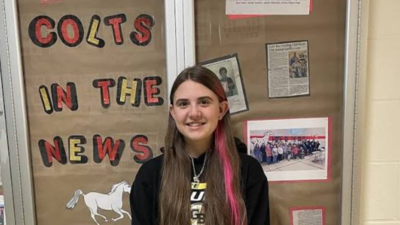
A teenager from Manitoulin Island, Ontario, is working to make science and technology more accessible to children who might otherwise miss out because of where they live or what their families can afford. Amara Wilson-Zegil, a Grade 11 student at Manitoulin Secondary School, has been named one of Canada’s Top 10 Youngest Changemakers of 2026 by Children First Canada for her efforts to expand access to science, technology, engineering and mathematics (STEM) education. According to Children First Canada’s announcement, also reported by ElliotLakeToday, the 17-year-old’s robotics outreach has reached six elementary schools serving more than 1,800 children. She has also helped deliver free and pay-what-you-can robotics camps that have reached more than 1,200 young people. Her work has now led her towards a broader initiative, Project RISE, short for the Rural Initiative for STEM Equity, which aims to address barriers to STEM learning in rural communities.
Turning limited opportunities into a larger mission
Growing up in a rural area has given Wilson-Zegil a close view of how a child’s location can influence access to educational opportunities. While robotics and technology programmes can introduce students to practical problem-solving and emerging careers, such activities may be harder to access in communities with fewer local resources.Wilson-Zegil’s outreach has focused on bringing those experiences directly to elementary school students. Through robotics activities and camps, children can explore technology in a hands-on setting rather than encountering it only through classroom theory. The model also recognises that cost can prevent families from enrolling their children in extracurricular programmes. Offering free and pay-what-you-can camps helps make participation possible for young people whose families might not be able to afford conventional fees. The reach of the initiative, spanning six elementary schools and more than 1,200 camp participants, highlights the scale the student has already achieved while continuing her own education.
Project RISE aims to widen access to STEM
Wilson-Zegil is now developing Project RISE to build on that experience and address the wider challenge of educational inequality in rural communities. The initiative’s focus is on making STEM opportunities less dependent on a student’s geographical location or household income. Its development marks a shift from individual outreach activities towards a broader effort to improve access to science and technology learning.The long-term significance of such programmes extends beyond robotics itself. Early exposure to STEM can help children develop analytical thinking, creativity and confidence in tackling unfamiliar problems. It can also introduce them to fields they may not otherwise consider pursuing. For rural students, these experiences can be particularly valuable when access to specialised clubs, equipment and extracurricular learning is limited.
Recognition beyond the classroom
Additional reporting by Around and About highlights another dimension of Wilson-Zegil’s work: she has captained an award-winning robotics programme involving approximately 100 students and authored a children’s book about robotics, with proceeds supporting STEM programmes in rural communities.Wilson-Zegil received the Together We Rise Award for Equitable Education and Opportunities at Children First Canada’s Future is NOW! Awards in Toronto on October 16. Each of the 10 young changemakers was set to receive $1,000 in funding, alongside mentorship, coaching and a year of support to help expand their initiatives. For Wilson-Zegil, the recognition brings national attention to a challenge that often receives less visibility: ensuring children in rural and Northern communities have opportunities to explore technology, develop new skills and imagine careers in fields that may seem distant from their everyday lives.Her next challenge is to turn that local impact into something larger through Project RISE, extending the possibility of hands-on STEM education to more young people across Northern Ontario.