



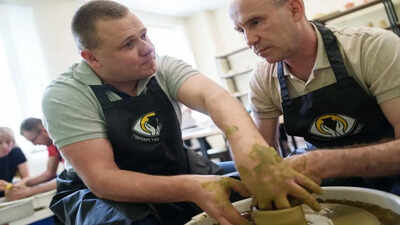
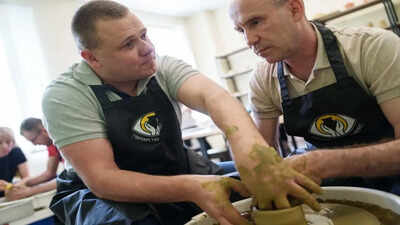
The two blury men stare straight ahead, hands intertwined on a pottery wheel, fingers buried in the clay. They sense each other’s presence through touch alone.One is a veteran who lost his sight in combat and now teaches other blind veterans. Slowly, a piece resembling a cup takes form.The instructor, Ivan Shostak, 37, said he has made more than 1,000 such pieces but has never seen a single one. The craft came into his life only after he lost his sight during one of Ukraine’s bloodiest and longest battles.Making plates, cups, mugs, candle holders and other objects helped him find new meaning in a life upended by trauma. What began as a rehabilitation exercise has grown into a business and a mentoring practice for veterans and others.“I have two kids I have to help through life and show by my own example that you have to fight for your life,” Shostak said.‘After the injury, there was no family’Shostak rejoined the army in the early years of Russia’s full-scale invasion, not joining right away since he wanted to be there for his second son’s birth. He previously fought in eastern Ukraine after the conflict broke out in 2014.His second tour lasted a few months. While fighting in the battle of Bakhmut in March 2023, a rocket-propelled grenade exploded just above his head. The blast destroyed his eyes.Besides blindness, he also had a concussion, a traumatic brain injury and displaced vertebrae in the neck.He said the real ordeal began at home. His wife at the time could not endure it. She left him alone with his new challenges.“There was a family, and after the injury there was no family,” Shostak said. But his parents stayed close, supporting him.‘You could live even in total darkness’He spent half a year bedridden, dulling the pain with medication. The despair was harder to manage. No pills could ease that.A fellow soldier home on leave came to his aid, taking him to a local rehabilitation center for people who had lost their sight. Within a month, staff taught him to use a phone and a cane and to handle daily life.“It turned out you could live even in total darkness,” Shostak said.One day, he and others from the center were invited to visit a pottery workshop, where he made his first plate. “And after that came the thrill that I could still do something,” he recalled.He began attending classes regularly and later sold his work. He became an instructor after the first “Pottery in the Dark” project, supported by Sweden and the U.N. Development Program, in Vinnytsia in central Ukraine. The program helps veterans who lost their sight, including in the war.Then he launched his business.Shostak has three others on his team who help him sell his pottery, mostly through his Instagram page. He keeps no strict schedule, working according to his mood in a workshop that his older brother, also a soldier, set up for him in his apartment.“Clay is that kind of material, and pottery is that kind of work, where if you feel bad, there’s nothing to do here. It won’t come out at all. Everything breaks, comes out crooked,” he said. “Only when you feel good, you sit down, you work, and it all turns out great.”The later stages happen in another workshop, where he gets help with firing and glazing. But he chooses every color himself, guided by his imagination.Each piece bears the emblem of the air assault forces he served in – a dome, wings and a sword – with the motto “Nobody but us” and his name on the side.‘It matters that a veteran teaches a veteran’Roman Shtohryn, director of the Podillia rehabilitation center in Vinnytsia, said six of the 11 project participants who completed the pottery training already earn an income from it. All but one are veterans.“We planned all this so it would turn into a business,” Shtohryn said.Pottery serves multiple functions, he said. The first is psychological: A person concentrates on something, stops thinking about problems and stays in a kind of flow, in the moment. Second, working with clay yields an immediate result.At the rehabilitation center, Shostak works with fellow veteran Viacheslav Sadovskyi, 47.“All good? Hands working?” Shostak asked, laughing, before reaching for Sadovskyi’s hands. He guided them toward the wheel.“There, I can feel it,” said Sadovskyi, who had served in the military since the start of Russia’s invasion. In 2024, a drone exploded near him, damaging the left side of his face and forcing him to undergo five surgeries.Shostak directed him, telling him how to press the clay and from which side, his hands never leaving Sadovskyi’s.“It matters that a veteran teaches a veteran,” the director Shtohryn said. “We’re equals. We understand and support each other.”