






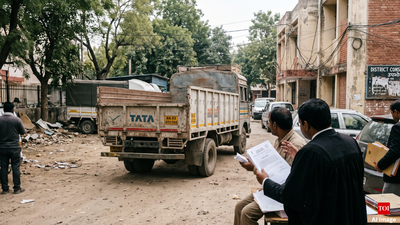
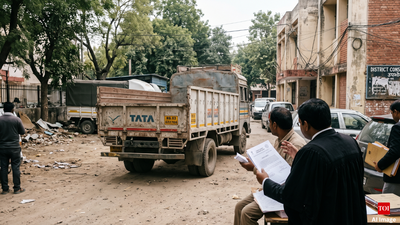
RAMPUR: A resident of Rampur district in UP had got a truck financed from IndusInd Bank in 2018. During the Covid-19 pandemic, he could not pay the EMIs, and the bank got his truck lifted and auctioned over an immediate default of Rs 43,000.The man contested the bank’s action from the district to the national commission and finally got relief. On November 17, the National Consumer Disputes Redressal Commission ruled in his favour and ordered the bank to pay him Rs 7.7 lakh — the insured declared value (IDV) of the truck — with interest within eight weeks.The NCDRC panel, presided over by Justice Sudip Ahluwalia and member Justice Anoop Kumar Mendiratta, was considering a revision petition filed by IndusInd Bank against the January 24, 2024, order of the State Consumer Disputes Redressal Commission, Uttar Pradesh.The state commission had held the bank deficient in service and directed it to pay compensation of Rs 20 lakh to the truck owner while setting aside the March 13, 2023, order of the District Consumer Disputes Redressal Commission, Rampur.The DCDRC had held that the bank was entitled to repossess and auction the vehicle in terms of the loan agreement upon default in repayment of instalments and that no deficiency in service was established.
Relief by the National Commission
While considering the revision petition filed by IndusInd Bank, the NCDRC said, “We are in agreement with the State Commission that seizure and sale of the vehicle on account of outstanding payment of only Rs 43,000/- was unconscionable on the part of the Financer.But for inexplicable reasons, the State Commission has awarded the Respondent a composite compensation of Rs.20.00 Lakhs which is far in excess of the Respondent’s own claim of actual IDV Rs 7,69,500.To that extent, the impugned Order would certainly appear to be unreasonable and uncalled for. The Revision Petition is, therefore, partly allowed after modifying the impugned Order to the extent that the Petitioner/Financer shall pay an amount of Rs 7,69,500/- alongwith interest @ 6% per annum from the date of filing of the Original Complaint,” the panel said.It added that if the payment was not made within eight weeks from the date of passing of the order, any outstanding amount would attract interest at 9% per annum.
The background of the loan and default
The case originated when Rampur man Istekhar Khan approached IndusInd Bank on November 29, 2018, to get a Tata truck financed for a loan of Rs 4,56,880.The loan was to be repaid in 36 monthly instalments. Khan had deposited Rs 3,86,796 till January 20, 2020. In February 2020, he suffered from jaundice, which disrupted the payment of instalments, and an outstanding amount of more than Rs 1 lakh became due.In March 2020, while returning from Bihar, his vehicle was seized by the bank, and Khan was directed to deposit Rs 43,000 immediately.The borrower offered to deposit Rs 20,000, but the bank did not accept the offer and refused to release the vehicle. The bank then auctioned the vehicle and informed Khan that the recovered amount had been deposited in the loan account and that there was still a shortfall of Rs 32,000, which he was supposed to clear.Khan paid the outstanding amount on March 23, 2021, and subsequently, the loan account was closed.
Loanee approaches the Consumer Commission
Aggrieved by the bank’s action, Khan filed an application with the District Consumer Disputes Redressal Commission, Rampur, seeking relief on account of ‘deficiency in service’ by the bank, which had auctioned his vehicle worth over Rs 7.7 lakh for a default of merely Rs 43,000.The district commission held that the bank had failed to establish that Khan was engaged in the business of purchasing and driving vehicles and, therefore, should be excluded from the definition of a ‘Consumer’.It further said that even the closure of the loan account would not affect the ‘Consumer’ status of the complainant. However, on the question of repossession and auction, it held that the bank was entitled to take possession of the vehicle and auction it in terms of the loan agreement upon default in payment of instalments.It also held that Khan had failed to establish, through expert evidence, that the vehicle had been auctioned at an inadequate price and concluded that the bank had acted in accordance with the terms of the loan agreement and that no deficiency in service was established.
Appeal filed before State Commission
Unhappy with the DCDRC’s order, Khan filed an appeal before the State Commission in Lucknow on June 7, 2023. State commission president Justice Ashok Kumar ruled in favour of the appellant and said, “I do not agree with the contention of the District Commission that even after taking the vehicle in its custody the Bank auctioned it due to non-deposit of the loan amount whereas it is clear from the records that due to illness and Corona, the financial condition of the Respondent had become miserable,” the commission said.It noted that Khan had deposited Rs 3,86,796 by January 20, 2020, and had outstanding dues of more than Rs 1 lakh when his vehicle was seized.“The Respondent was ready to deposit Rs.20 thousand but the Petitioner did not accept the request and thus a vehicle worth Rs.769500 was confiscated due to non-deposit of only Rs.43000.00 and the vehicle purchased for livelihood was auctioned which was deficiency in services,” the commission held, ordering the bank to pay compensation of Rs 20 lakh.
Bank approaches National Commission against SCDRC order
The bank approached the National Consumer Commission with a revision petition, seeking to quash the January 24, 2024, order of the state commission. In its written version, the bank took the stand that an amount of Rs 4,56,880 had been sanctioned to Khan for purchasing the vehicle in question.He was required to repay the amount of Rs 4,56,880 along with interest of Rs 1,14,860 and an insurance premium of Rs 75,000 in monthly instalments.“An amount of Rs.2,49,244/- was irregularly deposited till Jan 20, 2020 and as such there was an outstanding amount against him. Due to such default and lack of financial discipline in paying the installments, the vehicle was seized on March 17, 2020 and Khan was orally informed but he did not show any interest in paying the outstanding amount. Subsequently, the vehicle was auctioned for the purpose of recovery of the balance loan amount,” the bank’s counsel said.On the other hand, Khan’s counsel supported the order passed by the State Commission and submitted that the vehicle had been purchased for Rs 9,25,000 by his client for earning his livelihood, and an additional expenditure of Rs 2,15,000 had also been incurred on it.“The vehicle valued at more than Rs.9,00,000/- was auctioned for peanuts by the Bank thereby depriving my client of his livelihood and opportunity to pay back the instalments,” he said.Having heard both parties at length, the National Commission, on October 6, 2026, directed the parties to place on record a copy of the IDV depreciation table pertaining to motor vehicles issued by IRDA (Insurance Regulatory and Development Authority of India).“We find therefrom that in respect of vehicles having crossed the age of four years but not exceeding five years, there is a depreciation of 50%. The vehicle in question at the time of its seizure was already ten years old. So its value would certainly have fallen even below 50 percent. The Insurer had treated its value at Rs.7,69,500/- which is certainly less than 50% of the amount after applying the depreciation of 50%,” the commission observed.The commission calculated the vehicle’s value and revised the compensation of Rs 20 lakh awarded by the state commission to the actual IDV of the vehicle, directing the bank to pay Rs 7.7 lakh with interest.