







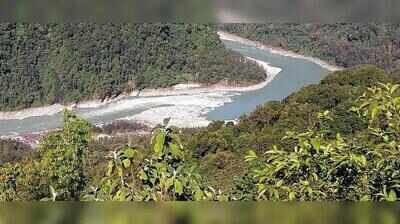
India’s biggest hydropower project, proposed across three districts of Arunachal Pradesh’s Siang valley, is being pitched as a strategic counter to China’s mega dam upstream. But the plan has triggered resistance from indigenous tribes who fear the reservoir could submerge villages and sever their deep-rooted ties with the river. The Siang, known as the Yarlung Tsangpo in Tibet, enters Arunachal Pradesh near Gelling and flows 294km before joining the Dibang and Lohit at Sadiya in Assam to form the Brahmaputra. Prabin Kalita examines the battle over the project.Where is the dam locatedThe 11,200 MW Siang Upper Multipurpose Project (SUMP) being implemented by NHPC will be spread across three districts in Siang belt — Upper Siang, Siang and East Siang. The idea goes back to 1983, and it was declared a national project in 2008. After the cabinet decided in Sept this year, to carry out a pre-feasibility survey, it has run into the Adi and Galo and other indigenous communities who live beside the river.Why does the Centre want itUpstream in Tibet, China is executing a 60,000 MW mega dam at Medog. The Arunachal Pradesh govt says SUMP would help regulate floods and “counter” the impact of the Chinese dam. The project aims to strengthen national water and energy security, regulate seasonal floods in the Siang-Brahmaputra basin and promote long-term socio-economic development. It also fits the state’s own ambitions. Arunachal holds about 40% of India’s untapped hydropower potential but has an installed capacity of only 2,115 MW, and it has declared 2025-2035 the “Decade of Hydropower.”How is the local govt in AP sayingArunachal Pradesh chief minister Pema Khandu has sought to address concerns over how the proposed 11,000 MW SUMP project could store more water than China’s reported 60,000 MW Medog project upstream, explaining that a dam’s storage capacity is not determined by its power generation potential.The Chinese project is estimated to have a storage capacity of around 5.5 billion cubic metres (BCM), while SUMP is designed to have 9.2 BCM of live storage, allowing it to hold back more water despite its lower power generation capacity. Khandu explained that electricity generation depends on the height from which water falls, with the steep drop at the Great Bend of the Yarlung Tsangpo enabling China’s project to generate significantly more power. However, a higher megawatt capacity does not necessarily mean greater water storage.Citing examples from Arunachal Pradesh’s Dibang Valley, he said the proposed Etalin project is expected to generate 3,097 MW with just 7.5 million cubic metres (MCM) of storage, while the Dibang project is designed to generate 2,880 MW with roughly 4 BCM of storage. Khandu said the state government would listen to people’s concerns and would not abandon them.The fears and protests on the riverbankThe proposed project has drawn strong opposition from several groups, including Adi Baane Kebang-United, the SUMP-Affected Youth Association, the Siang Indigenous Farmers Forum and the Adi Galo Welfare Society, which warn that the reservoir could submerge villages and fertile paddy fields along the river, threatening the traditional livelihood and food security of local tribes.The farmers’ forum estimates that 27 villages could be submerged and over 1.5 lakh people displaced. It has also warned of the loss of heritage sites such as Kekar Moying, associated with the Anglo-Abor battle. Alleging that surveys are being conducted without the consent of affected communities, the forum has criticised the deployment of central forces as militarisation.Former CM Gegong Apang has called for the project to be scrapped and questioned the utilisation of funds for preliminary work. Opponents maintain that their resistance is aimed at safeguarding ancestral land, cultural heritage and traditional livelihoods. Acknowledging the uncertainty surrounding the project, Khandu said the govt was committed to providing clarity, outlining a roadmap and extending support to affected people. He assured them that the state would not leave them in the lurch midway through the process and would remain open to hearing their concerns, addressing their doubts and working with them to find solutions.What the pre-feasibility report is all aboutKhandu said the pre-feasibility report (PFR) is an initial assessment of a dam project’s technical viability and potential implications, not a clearance to proceed with construction. If the project is found feasible, it will have to undergo further scrutiny through a Social Impact Assessment, an Environmental Impact Assessment and the preparation of a Detailed Project Report (DPR).Several villages have already signed agreements with the state government to facilitate survey work. Khandu said the preliminary assessment would help determine whether the project merits further investigation and guide informed decisions, adding that the process must be comprehensive, transparent and consider the concerns of local communities and the region’s geographical realities.