








In 2023, Rajeshwari, a 38-year-old woman from Wandoor village in South Andaman, had just five indigenous birds in her backyard. She had no experience in scientific poultry management and kept the birds mainly for household consumption. Today, she runs an organised poultry enterprise that produces around 2,000 chicks every month and generates an estimated monthly net profit of ₹1.91 lakh. According to the Indian Council of Agricultural Research (ICAR), Rajeshwari’s growth from a small backyard poultry keeper to a rural entrepreneur followed training, technical guidance and the adoption of scientific poultry farming practices. Her enterprise now supplies poultry meat, chicks and table eggs, creating a regular source of income.
From five backyard birds to a poultry enterprise
Rajeshwari holds an M.Sc. degree in Botany. In 2023, looking for a sustainable source of self-employment, she approached the ICAR-Central Island Agricultural Research Institute (ICAR-CIARI) in Sri Vijaya Puram for guidance on poultry farming. According to the official website of ICAR, she initially had only five indigenous birds and no prior experience in scientific poultry management. The institute enrolled her in a skill development programme that included practical training and continued technical support. She learnt about poultry housing, flock management, healthcare, vaccination, feed formulation and enterprise planning. As she gained experience, she gradually expanded her backyard unit and began treating poultry farming as a business rather than an activity meant mainly for household use.ICAR-CIARI continued to monitor her progress and provide guidance. She later received advanced training in brooder, grower and breeder management, hatchery operations, disease prevention and the scheduling of production activities. These practices helped her organise poultry rearing and chick production to support a more regular flow of income throughout the year.
How she produces around 2,000 chicks every month
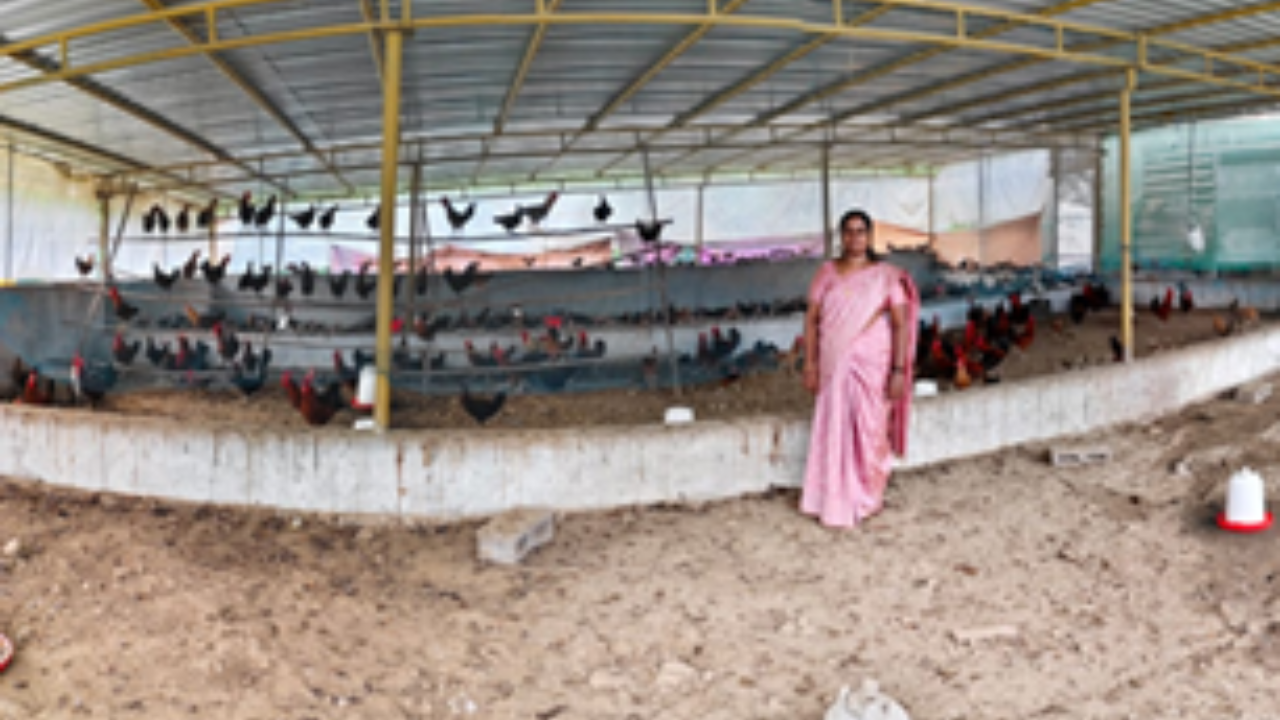
Photo credit: ICAR
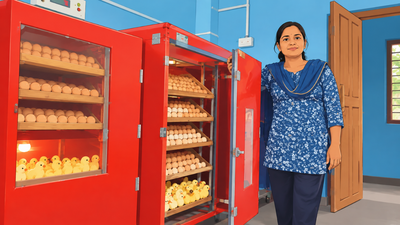
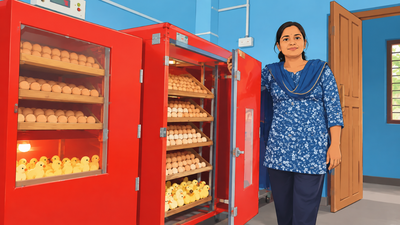
With technical support from ICAR-CIARI, Rajeshwari established a semi-intensive poultry unit with a mini-incubator that has a setter capacity of 2,500 eggs. According to ICAR, she initially reared 2,400 birds using scientific management practices. She gradually developed a breeder flock that could support continuous chick production. From the fifth month onwards, she maintained around 550 birds as parental stock for chick production. At the same time, she reared nearly 1,200 birds for meat production and sale.Her breeder flock now produces approximately 3,600 eggs a month. Of these, around 2,500 are used for hatching. With improved incubation techniques and scientific health management, she achieves a hatchability rate of nearly 80%, producing about 2,000 chicks every month. This production system allows her to manage different parts of the poultry business together, from maintaining breeding birds to producing chicks and raising birds for meat.
₹1.91 lakh estimated monthly net profit
The financial figures reported by ICAR-CIARI show the scale of Rajeshwari’s enterprise. According to the ICAR’s website, she currently markets approximately 600 kg of live poultry meat, 600 chicks and 1,100 table eggs every month. The integrated poultry unit generates an estimated monthly net profit of around ₹1.91 lakh. That makes it a benefit-cost ratio of 2.02 for the enterprise, indicating that the activity has been financially viable under the conditions in the Andaman Islands. These figures reflect the combined output of her poultry operation rather than income from chick sales alone. The business includes meat birds, chicks and table eggs, giving her multiple products to sell.
Scientific training helped her expand
Rajeshwari’s experience highlights the role of technical training in helping small-scale poultry keepers move towards organised production. Instead of relying only on traditional backyard rearing, she learnt how to manage poultry health, feeding, breeding and incubation as connected parts of a business. According to ICAR-CIARI, her progress has also encouraged rural youth and women in the Andaman and Nicobar Islands to consider scientific poultry farming as a possible source of self-employment. Her journey began with five birds kept mainly for household consumption. With training, continued guidance and a gradual expansion of operations, she has built a unit that produces thousands of chicks and supplies poultry products every month.