







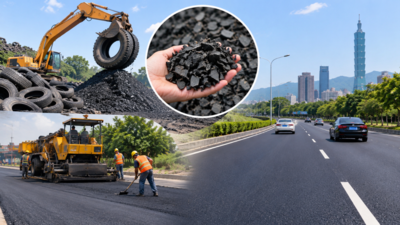
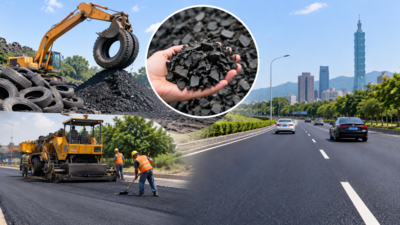
Taiwan built two experimental roads using recycled tyre rubber in asphalt in 2000 and 2001, testing whether discarded tyres could be turned into a material for better-performing pavements. Supported by the Taiwan Highway Bureau, the projects used ground tyre rubber in two different asphalt mixtures, with researchers monitoring their performance over four years. According to the study published in ScienceDirect, titled ‘Use of ground tire rubber in asphalt pavements: Field trial and evaluation in Taiwan’, the asphalt rubber mixtures performed better than conventional dense-graded asphalt mixes. The research also found that the recycled rubber mixtures could be successfully produced using locally sourced materials and existing paving techniques in Taiwan.
How Taiwan tested recycled tyre rubber in experimental asphalt roads
With support from the Taiwan Highway Bureau, two asphalt rubber (AR) pavement test sections were constructed as pilot projects. The first section, featuring a gap-graded design, was built in December 2000, while the second, using an open-graded design, was constructed in May 2001. Both projects were designed to examine the technical feasibility of incorporating ground tyre rubber obtained from local sources into asphalt pavement under Taiwanese conditions.The research used two different asphalt mixture designs for the demonstration projects. One employed a gap-graded mixture, while the other used an open-graded mixture. The researchers adopted Arizona Department of Transportation gradations and mix design specifications for the asphalt rubber mixtures. These were compared with a conventional dense-graded asphalt mixture designed according to Type IVb specifications of the Taiwan Highway Bureau, which had a nominal maximum aggregate size of 12.5 millimetres. The projects were intended to establish whether the recycled rubber mixtures could be successfully produced and laid using local materials and paving techniques.
Four-year study tested recycled tyre rubber asphalt using the wet process
Following construction, the research team carried out a four-year field evaluation to monitor the performance of the asphalt rubber pavement sections. The programme included field observations and measurements to assess how the mixtures performed under Taiwanese conditions. The researchers compared the demonstration pavements with conventional asphalt pavements to evaluate the technical suitability of incorporating ground tyre rubber into road construction.The study also examined the wet process, in which ground tyre rubber is blended with asphalt cement before the mixture is used for paving. The researchers implemented this method using #30-mesh ground tyre rubber, measuring approximately 0.6 millimetres. According to the paper’s conclusions, the wet process was successfully implemented and considered adequate for use in Taiwan. Laboratory testing further indicated that plant-mixed asphalt rubber met most ASTM specifications. The findings provided evidence that locally sourced ground tyre rubber and asphalt could be combined to produce mixtures suitable for pavement construction.
Taiwan’s recycled rubber roads showed better performance
The four-year evaluation found that the asphalt rubber test sections delivered satisfactory performance. The study’s abstract states that the field results demonstrated the potential of the mixtures to replace modified asphalt in domestic applications. It also reported that the test sections performed well based on the field monitoring data collected during the evaluation period.In its conclusion, the research paper stated that ground tyre rubber-modified asphalt concrete mixtures could be successfully constructed using Arizona Department of Transportation mix gradations and design properties, alongside local materials and paving techniques. The researchers reported that these mixtures performed better than conventional dense-graded asphalt mixes. The findings therefore established the technical feasibility of using locally processed waste tyre rubber in asphalt pavement construction in Taiwan. The paper, published in 2008, presented the results as evidence that recycled tyre rubber could serve as a material in road construction while offering an alternative application for the country’s discarded tyres.