







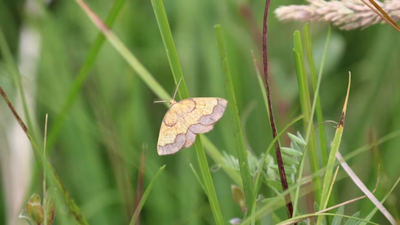
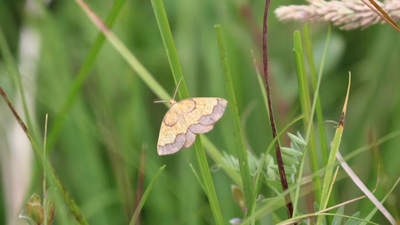
Conservationists restoring habitat at a historic estate in Northumberland have rediscovered a hidden population of one of England’s rarest insects, finding the species just 10 minutes into a survey at a site where it had not been recorded for more than 70 years. Dr Dave Wainwright, a senior conservation scientist with Butterfly Conservation, found a breeding colony of the dark bordered beauty moth (Epione vespertaria) at the National Trust’s Wallington Estate near Morpeth. The day-flying moth is known for its distinctive custard and chocolate-coloured wings. It was last recorded at Wallington in 1952 before disappearing from local records. As reported by ITV News in August 2026, the discovery could provide a vital boost for a species that was at serious risk of disappearing from England.
Decades of searching end in minutes
Dr Wainwright had spent many years looking for unknown populations of the rare moth across northern England. He first surveyed Wallington Estate in 2004 but found no sign of the species. Looking back at that survey, Wainwright said the land was not suitable for the moth at the time. “I looked at that site in 2004 and it was quite heavily grazed and wasn’t in the right condition for dark bordered beauty,” Dr Wainwright said. “This time the site looked a hell of a lot better – really lush vegetation with lots of wildflowers.” Even after preparing carefully for the latest survey, Wainwright did not expect to find the moth so quickly. “I was hopeful – I’m always hopeful – but I definitely didn’t expect it because I’ve been to so many sites to look for this species over the years, so my heart and my head were in two different places,” he told ITV News. Just 10 minutes after entering the restored area, the team spotted their first adult moth. Wainwright called the discovery “one of the highlights of my career”. “Overwhelmingly it was just a feeling of relief that we weren’t just fighting the fight at one site any more,” he added.
Crisis at the last known stronghold
Before the Wallington discovery, Strensall Common in North Yorkshire was thought to be the only remaining population of dark bordered beauty moths in England. Monitoring data from Butterfly Conservation shows that the Strensall Common population has fallen sharply over the past 20 years. Surveys that once found hundreds of moths have recently recorded numbers barely reaching double figures. The reserve, managed by the Yorkshire Wildlife Trust and the Ministry of Defence, is also facing growing pressure from changing weather patterns. Long summer droughts and a major wildfire that damaged parts of the habitat last year pushed the moth closer to local extinction. Small, isolated populations still survive in Scotland, including areas around Deeside and Speyside. But before the Northumberland discovery, the English population was almost entirely dependent on one vulnerable site.
Habitat restoration brings an unexpected return
The moth’s return to Wallington comes after major changes to the 13,000-acre estate. Through the “Wilder Wallington” nature recovery project, National Trust rangers have worked with tenant farmers to reduce livestock grazing in key areas, restore damaged peatlands and allow natural scrub and native young trees to grow. The work has helped encourage low-growing aspen suckers and creeping willow, which are the only two plants eaten by dark bordered beauty caterpillars. Emily Johnson, a National Trust ranger at Wallington Estate, said the team was delighted by the discovery. “We couldn’t be more excited to find that Wallington is a stronghold for such a rare species,” Johnson said in statements released to the press. “We have been working hard to manage the land better for nature, and it seems to be paying off.”
A new picture of suitable habitat
The discovery does more than protect the moth from disappearing in England. It has also changed what conservationists know about where the species can live. For years, efforts to protect the moth focused on the dry, open heathland found at Strensall Common. Wallington is very different, with damp grassland, mixed habitats and areas of regenerating woodland. Wainwright said the discovery could encourage conservationists to search for more hidden colonies across northern England. “The thing that’s kept me going all these years is I always felt there was a chance of finding Dark Bordered Beauty on the Northumberland/Cumbria border – now it feels like there could be other colonies out there waiting to be discovered which would be brilliant,” he added. Butterfly Conservation is now working with National Trust rangers to map the full Wallington population. The teams also plan to expand habitat corridors on nearby land, giving the newly discovered colony more space to grow and spread. The find shows how restoring damaged landscapes can bring back species that were thought to have disappeared, while also giving conservationists new places to search for other hidden populations.