








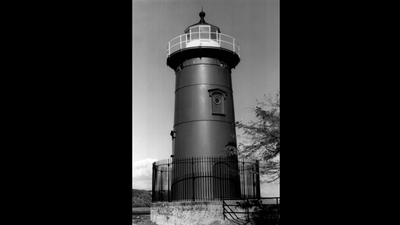
Beneath the enormous steel span of New York’s George Washington Bridge stands a small red lighthouse with a history that began far from Manhattan. Built in 1880, the cast-iron tower once served as the North Hook Beacon at Sandy Hook, New Jersey, before being dismantled and given a new life on the Hudson River. In 1921, it was moved to Jeffrey’s Hook, where it returned to service as a working navigational light. A decade later, the newly completed bridge towered above it, making the little lighthouse seem almost incidental. Its working life eventually ended, but its story did not. A 1942 children’s book turned the real lighthouse into a beloved literary landmark, and when plans emerged to sell it in 1951, children and adults rallied to save it. What followed transformed an obsolete navigation aid into one of New York’s most unusual landmarks.
Why New York moved the New Jersey lighthouse to the Hudson River
The tower now known as the Little Red Lighthouse was not originally built for Manhattan. The New York City Landmarks Preservation Commission records that the cast-iron structure was erected in 1880 and had served as the North Hook Beacon at Sandy Hook, New Jersey. It remained there until 1917, when it was dismantled after the construction of a new gun battery at nearby Fort Hancock placed the lighthouse in its line of fire. The iron tower was eventually given another purpose rather than being discarded.Its new home was Jeffrey’s Hook, a small projection of Manhattan into the Hudson River below what is now Washington Heights. The move took place in 1921 as part of a wider effort to modernise navigation on the river. According to the Landmarks Preservation Commission, the project responded to growing river traffic and developments including the New York State Barge Canal system, the deeper Hudson shipway and plans for the Port of Albany. Once rebuilt, the lighthouse received a flashing red light and a fog signal, becoming the southernmost fixed navigational light on the Hudson and the only lighthouse on Manhattan.
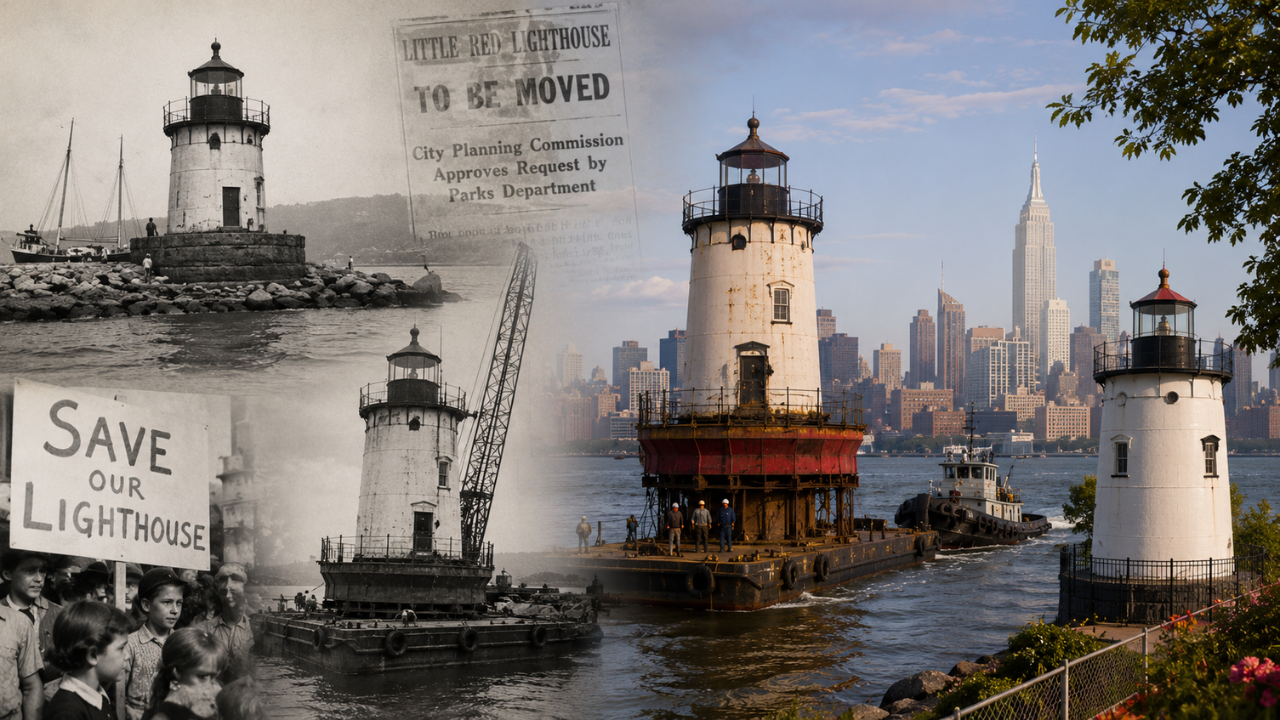
Image AI generated
How the George Washington Bridge overshadowed New York’s lighthouse
For a time, the lighthouse had a practical job. Its position at Jeffrey’s Hook was significant because the point reached into a deep section of the Hudson, where ships needed navigational markers. The new tower began operating in October 1921 with a red acetylene lamp that flashed every three seconds. A bell fog signal followed shortly afterwards. It was not simply a picturesque object beside the river; it was working equipment, maintained for vessels moving along one of New York’s busiest waterways.That changed rather quickly. Construction of the George Washington Bridge began above the lighthouse in the late 1920s, and the completed bridge eventually overshadowed the much smaller structure. The Landmarks Preservation Commission says the lighthouse’s prominence as a navigational aid was “soon diminished” by the bridge, which was built between 1927 and 1931. An aeronautical beacon was later installed on the bridge as well. The lighthouse itself continued operating until 1947, but its role had been steadily reduced by the enormous structure rising directly above it.
How a children’s book saved New York’s Little Red Lighthouse from demolition
The lighthouse might have faded into obscurity had it not become the setting for a children’s story. In 1942, Hildegarde H. Swift’s The Little Red Lighthouse and the Great Grey Bridge, illustrated by Lynd Ward, was published. The book imagined the lighthouse as a character struggling with its sense of importance after the huge bridge appeared above it. The story eventually gives the little lighthouse a purpose of its own, presenting the contrast between the small red tower and the immense bridge as a story about children and the adult world around them.The story had an effect beyond the pages of the book. Children around New York began recognising the real lighthouse beneath the bridge and treating it as something belonging to them. That connection became important in 1951, when the lighthouse, by then no longer required for navigation, was put up for sale as surplus property. The city had originally agreed that the structure would be removed once it was no longer in use. Instead, according to the commission’s report, children and adults began protesting its possible loss, with letters of support arriving from schoolchildren.
Children’s campaign saved the Little Red Lighthouse from removal
The response in 1951 was unusually broad for a small piece of obsolete infrastructure. Newspapers criticised the proposed sale, parents and children spoke up, and one four-year-old boy even offered to buy the lighthouse himself. The campaign helped turn the tower into what it called a “child’s landmark”. The affection surrounding the building was no longer connected to ships or fog signals. Its meaning had shifted towards memory, childhood and its unlikely place beneath one of New York’s largest bridges.The campaign succeeded. Parks Commissioner Robert Moses asked that the lighthouse be given to New York City, and on 23 July 1951 it was transferred to the city’s Department of Parks. The tower was therefore spared the removal that had once seemed likely. The commission later described its new role neatly: it had become a “beacon to children instead of to ships”. Decades later, the lighthouse was placed on the National Register of Historic Places in 1979 and underwent restoration during the 1980s. The children’s book remained in print, keeping the connection alive for new generations.Today, the Little Red Lighthouse occupies an odd but distinctive corner of New York. The cast-iron tower is only 40 feet high, while the George Washington Bridge rises dramatically above it. Yet the smaller structure has outlasted its original purpose because its history became intertwined with a story that children remembered. In its 1991 designation report, the Landmarks Preservation Commission said the lighthouse had become a symbol of “the significance of a small thing in a big world”.What began as a working lighthouse at Sandy Hook ended as something quite different on the Manhattan waterfront. The bridge appeared only years later, making that purpose increasingly marginal. Then a children’s book gave the little tower a place in the city’s cultural memory, just in time for the moment when it was facing removal. The result is a rare case in which a fictional lighthouse helped save a real one.