









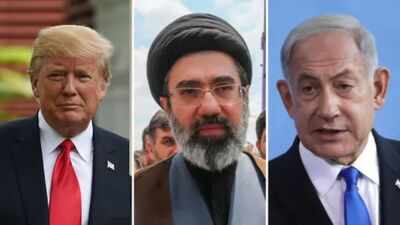
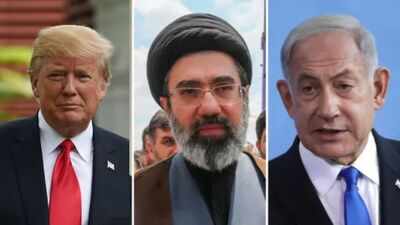
A fabricated quote attributed to Iran’s Revolutionary Guards commander spread from an Indian X account to Israeli media and US politicians, eventually featuring in Prime Minister Benjamin Netanyahu’s speech, according to a review by The New York Times.The false claim emerged on August 5, when an anonymous account on X in India posted that Brig. Gen. Ahmad Vahidi had said Iran would not abandon its nuclear weapons ambitions as long as Israel and the United States possessed such weapons.There is no evidence that Vahidi made the statement, or that Iran has developed nuclear weapons. Yet the claim quickly gained traction, with Israeli accounts and media outlets repeating it before it reached senior political figures in Israel and the United States.The episode, detailed by The New York Times, shows how an unverified social media post can acquire credibility as it is repeatedly cited by politicians, broadcasters and other accounts, even when its original source is unreliable.
False quote gains traction in Israel
The fabricated quotation was first known to have appeared on an Indian X account with around 175,000 followers. The account has previously faced criticism from fact-checkers and Pakistan’s government for allegedly spreading false and Islamophobic content, according to The New York Times.The post included a photograph of Vahidi alongside a cartoonish, AI-generated mushroom cloud. The English text also contained spelling and grammatical errors.Around two hours later, another Indian account with about 82,000 followers shared the same claim in Hindi. According to the Israeli fact-checking organisation Bodkim Project, that account had published another fabricated quote attributed to Vahidi a week earlier.The narrative gained wider attention after it was shared by Mossad Commentary, a prominent Israeli X account that has no known connection to Israel’s Mossad intelligence agency.“The regime is not preparing to abandon its nuclear ambitions. It is buying time. There will be no deal,” the account posted.The account is run by Gedaliah Blum, an entrepreneur who leads the Heartland Institute, which organises tours and promotional exchanges in Israel.Blum told The New York Times that he believed the quotation came from a radio interview with Vahidi, although he could not remember the source. He said he shared it because he believed Iran was determined to acquire a nuclear weapon, despite uncertainty over “whether those exact words were spoken.”About 30 minutes later, Israel’s Channel 14 shared the quotation in English and claimed it represented the first public acknowledgement by Iran that it was pursuing a nuclear bomb. The post was viewed more than 440,000 times, according to The New York Times.The claim then reached Yair Netanyahu, the son of Israeli Prime Minister Benjamin Netanyahu. Within hours, it appeared in the prime minister’s speech at Mount Herzl in Jerusalem.“We heard today the commander of the I.R.G.C., Vahidi, explicitly declaring Iran’s intention to keep developing nuclear weapons,” Netanyahu said.A spokesman for Netanyahu did not explain how the fabricated quotation came to be included in the speech, according to The New York Times, but defended the prime minister’s longstanding warnings about Iran’s nuclear programme.On Azriel, a co-founder of the Bodkim fact-checking organisation, said the quotation “gained credibility every time an outlet or a politician repeated it,” helping drive its spread.
False claim reaches Washington
The claim soon crossed into the United States, where it was amplified by senior political figures and Fox News.Mike Waltz, the Trump administration’s ambassador to the United Nations, reposted the quotation and wrote that Iran was “finally admitting what’s been obvious for years”.Republican Senator Rick Scott of Florida also shared the claim on social media.Fox News host Bill Hemmer cited the purported statement during an interview with retired US Central Command commander Gen. Joseph L. Votel.“That’s as close to an admission as I have heard, and we’ve been watching this story for years,” Hemmer said.The narrative subsequently began to unravel. Waltz’s post was removed from X, although no explanation was given. Neither Waltz nor the White House responded to requests for comment from The New York Times.Fox News later acknowledged the problem. On Thursday, after inquiries from The New York Times, Hemmer read a statement on air saying Fox had learned that the quote was “unverified and inaccurate.”Scott’s post remained online, as did the original posts containing the fabricated quotation and thousands of responses treating it as genuine. Scott did not respond to a request for comment from The New York Times.
How the narrative gained credibility
Experts described the episode as an example of “narrative laundering”, in which an unverified or false claim is repeatedly passed between accounts and institutions until it appears to have multiple independent sources.“This quote was clearly crafted to drive a wedge into peace negotiations,” said Darren L. Linvill of Clemson University’s Media Forensics Hub, who tracks the spread of disinformation and propaganda on social media.“It is a simple campaign,” he added, “but simple campaigns can still be very effective, and this seems to have certainly had bang for the buck.”The sequence also illustrates how the apparent credibility of a claim can increase as it moves from social media accounts to television networks and political speeches, despite no new evidence being introduced.The New York Times found it unclear who fabricated the quotation. However, the claim appeared to reinforce an existing narrative promoted by Netanyahu that Iran was determined to develop nuclear weapons and that military action against Tehran was necessary.
What Iran has said about its nuclear programme
Iran’s nuclear programme has remained a major source of international concern and diplomatic negotiations for decades. Tehran has maintained that its nuclear activities have civilian purposes rather than a military objective, although the precise status of its nuclear development remains contested.Iranian Foreign Ministry spokesman Esmail Baghaei criticised the fabricated claim and described it as “an example of the flood of lies against the Islamic republic.”He blamed Israel for the narrative but did not provide evidence to support the allegation.“The allegations of a link to a nuclear bomb are based on the same thing, a lie they have been feeding the international community for 20 years to justify military aggression,” he told reporters on Sunday.Vahidi, who took command of the Revolutionary Guards in March, has issued numerous statements during the conflict but has not made the purported declaration about developing nuclear weapons.Last year, after a 12-day conflict with Israel that ended with US airstrikes, Vahidi discussed Iran’s nuclear position in an interview with state media. He said Iran would “do things it has not done previously” to defend itself, while adding that the country’s position on nuclear weapons “has been stated with complete clarity in the past.”The false quotation therefore did not represent a new declaration by Iran’s military leadership, despite being presented that way by several accounts and media outlets.The episode has underscored the risks of relying on viral social media claims during periods of heightened tensions, particularly when those claims concern nuclear weapons, military action and ongoing peace negotiations.