










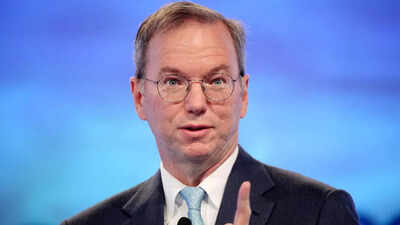
Eric Schmidt believes AI companies are underselling the technology’s benefits. After the November US midterms, the former Google CEO told Axios that the industry’s own messaging helps explain why Americans focus on the risks of artificial intelligence (AI). The interview came as proposed data centers, which house the computers that run AI services, faced opposition from communities concerned about electricity costs and environmental effects. Millions of people already use AI tools firsthand. Google’s parent company, Alphabet, reported 950 million monthly active users for its Gemini app in July, which shows how widely the app is being used. A user can find Gemini helpful for a task and still question how a proposed data center could affect their electricity bill.“Our industry does a terrible job of marketing our benefits,” Schmidt said. “We talk about all the negatives without talking the positives, and people are much more likely to index their minds on the negatives.”
Eric Schmidt wants large data centers away from population centers
Schmidt proposed building large data centers in sparsely populated areas and giving them their own power systems. “Let me state categorically that large data centers should not be near population centers,” Schmidt said. “Why would this be controversial? And they should have their own power systems. One of the great things about America is we have an awful lot of empty spaces. Put them there.”Concern about those facilities was already growing before the midterms. In September, Pew Research Center reported that more Americans saw data centers as having negative effects on home energy costs and the environment than earlier in the year. A separate June survey found that 71% of US adults expected AI to lead to fewer jobs in the country over the next 20 years, up from 64% in 2024. Pew data center survey,
Eric Schmidt sees a role for AI in scientific research
Schmidt pointed to scientific research as an area where AI could help. He said he expects professors, graduate students and postdoctoral researchers to work alongside AI agents, software that can carry out assigned tasks. He cited recent progress in mathematics and highlighted the role of human supervision in AI-assisted problem solving.