








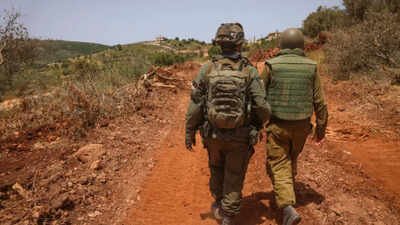
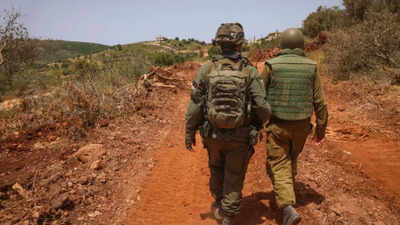
Israel moved into southern Lebanon to create a security buffer between its northern border and Hezbollah. It aims to keep the militant group and its weapons away from Israeli communities.But what was projected as a military measure to prevent cross-border attacks is increasingly raising fears of a prolonged occupation.With Israeli forces establishing fortified positions and preparing for an extended presence, questions are mounting over whether the security zone could become permanent, much like the Golan Heights, which Israel captured from Syria in 1967 and has controlled for nearly six decades.The concerns have gained fresh momentum after an Israeli military spokesperson visited a school in Debl, a Christian-majority village inside the Israeli-controlled zone in southern Lebanon.Lt Col Ella Waweya, also known as Captain Ella, shared footage of the visit on social media. The video showed her interacting with students inside the school, which lies within the Israeli-controlled security zone.Waweya reportedly praised the beauty of southern Lebanon’s villages while blaming Hezbollah for the destruction and suffering in the region.Lebanese Prime Minister Nawaf Salam strongly condemned the visit, accusing the Israeli military of exploiting schoolchildren for propaganda and attempting to legitimise its presence in southern Lebanon.“The use of students in a military and propaganda display constitutes a violation of the sanctity of schools and children’s rights,” Salam said in a statement carried by Lebanon’s National News Agency.“An occupying power has no right to exploit our children to embellish the image of its occupation or impose its dominance over our people in the south,” he added.The Debl municipality clarified that Waweya’s visit had taken place around a month earlier, without prior coordination with the school’s administration.Israeli forces currently occupy approximately 600 square kilometres of Lebanese territory, accounting for nearly 6 per cent of the country, according to a November 18 report by Defense News citing the UN peacekeeping force UNIFIL.The Israeli-controlled zone extends up to around 10 km inside Lebanon in some areas and includes military positions and fortified bases. UNIFIL has also reported continued Israeli construction of military positions and roads, demolitions and military operations inside Lebanese territory.Fears of another Golan HeightsThe Golan Heights offers a telling precedent for what could lie ahead for southern Lebanon.What began as an Israeli military capture of Syrian territory during the 1967 Six-Day War gradually turned into a decades-long occupation, with Israel extending its laws and administration to the territory in 1981.Nearly six decades later, Israel continues to control the strategic plateau despite international opposition. Now, as Israeli forces establish fortified positions and prepare for an extended presence in southern Lebanon, fears are growing that the declared security zone could follow a similar trajectory.Experts have warned that the distinction between a temporary security buffer and a prolonged occupation could become increasingly blurred.Gustav Meibauer, an assistant professor of international relations at Radboud University, told DW that the name given to such a zone matters less than what is happening on the ground.“What matters is not what something is called, but what is being done”, he said.Meibauer warned that if the Israeli military presence becomes a de facto permanent arrangement, with territory rendered uninhabitable and remaining under Israeli control, it could amount to an occupation under international law.HA Hellyer, a senior fellow at the Royal United Services Institute (RUSI), also raised concerns that Israel could be using the current situation to establish new territorial realities in southern Lebanon.“They’re using this particular period to draw some new lines in the sand, to create these sort of security zones,” Hellyer told DW.He pointed to the Golan Heights as an example of how Israeli security zones and territorial control could develop into long-term arrangements.The question of how long Israel intends to remain is also becoming a diplomatic flashpoint.Israeli Defence minister Israel Katz has said that Israeli forces will not withdraw until Hezbollah is disarmed and has ordered preparations for an extended military presence.Washington has pushed back, with a US state department official saying that a permanent Israeli military presence in southern Lebanon would not be consistent with the commitments made under the agreement between the two countries.For now, Israel has not announced any plan to annex southern Lebanon, and its stated objective remains the removal of Hezbollah’s threat along its northern border.However, its expanding military footprint, preparations for a prolonged presence and the destruction of border villages have raised questions about whether the security zone could outlast the current conflict.With the Golan Heights serving as a historical precedent, the central concern for Lebanon is whether a buffer zone created in the name of security could eventually become a decades-long Israeli occupation.