






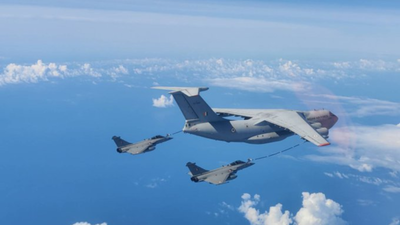
A recently released web series Operation Safed Sagar has reignited public interest in the Indian Air Force’s (IAF) role during the Kargil War. It captures the improvisation and courage of pilots who, in 1999, fought at altitudes above 15,000 feet with limited precision weapons and inadequate intelligence. The IAF was constrained by political orders not to cross the Line of Control, forcing crews to invent high‑altitude strike profiles never practised before. Despite these limitations, the destruction of Pakistan’s logistics base at Muntho Dhalo proved decisive. Yet the campaign exposed gaps in joint planning, shortages of guided munitions and the obsolescence of many systems.Then 26 years later in May 2025, Operation Sindoor demonstrated this transformation. In response to the cold-blooded Pahalgam terror attack, the IAF and the army struck nine terror sites in Pakistan and Pakistan Occupied Kashmir. Pakistan escalated with drone, missile and air attacks, prompting India to retaliate. During the 88-hour conflict, The air force hit air-defence infrastructure at Lahore, Karachi, Sialkot, Chunian, Pasrur and Arifwala were degraded or destroyed, while airbases including Nur Khan (Chaklala), Rafiqui (Shorkot), Murid (Chakwal), Sargodha, Rahim Yar Khan, Sukkur, Shahbaz (Jacobabad) and Bholari bore the brunt of Brahmos, SCALP and Rampage strikes. Unlike Kargil, this was not improvisation but deliberate, proportionate aggression, executed with precision stand‑off weapons and detailed joint planning with sister services.This capability evolution can be best viewed in four separate verticals. These are equipment, the induction of aircraft such as the Rafales armed with SCALP and Hammer, Su‑30MKIs integrated with BrahMos and layered air defences which include S‑400, Akash and MRSAM gave the IAF credible defensive and offensive capacity. This is in contrast to the use of very limited use of precision guided bombs by the IAF in Kargil. The conflict is known for the innovations used by the air force in terms of both tactics and deployment of equipment.Training is another key factor, simulators, night operations and international exercises ensured crews were better prepared for the conflict. Jointness is the third leg of this table, with the Chief of Defence Staff and the three service chiefs downwards were involved in the planning and execution from the outset. Political resolve, the deliberations and directions at the political level in 1999, ensured that the armed forces do not cross the Line of Control, while during Op Sindoor and the Balakot air strikes the aim was to strike terror targets deep inside Pakistan.From Safed Sagar’s improvised high‑altitude bombing runs to Sindoor’s precision strikes on airbases and radar sites deep inside Pakistan, the IAF has evolved into a force capable of shaping outcomes at strategic depth. The contrast is stark: in 1999, limited stocks of laser‑guided bombs and political restrictions defined the campaign; in 2025, deliberate planning, advanced munitions and jointness delivered decisive results. The journey from Muntho Dhalo to Masroor reflects not just technological progress but a doctrinal renaissance, positioning Indian air power as a mature instrument of national strategy.