








For decades, India’s industrial map has tilted west. Mumbai, Pune, Ahmedabad, the Delhi-Mumbai Industrial Corridor, the country’s manufacturing and export muscle has clustered along a belt that runs down the western seaboard, closer to the ports that move the bulk of the country’s trade. The Union Budget 2026-27 signalled an attempt to redraw that map. It announced the development of an integrated East Coast Industrial Corridor, anchored by a “well-connected node” at Durgapur in West Bengal, a single line in the Budget that carries the weight of a much larger ambition.Why India is looking EastThe Durgapur announcement doesn’t stand alone. It sits inside a bigger, already-running programme: the National Industrial Corridor Development Programme (NICDP), under which the Centre, working with state governments, is building out a network of planned industrial corridors coordinated under the PM GatiShakti framework. Eleven such corridors are currently under implementation across the country. Four projects are complete, four more are nearing completion. The Budget backed this pipeline with Rs 3,000 crore for 2026-27, routed through the National Industrial Corridor Development and Implementation Trust (NICDIT), the body responsible for executing it on the ground.
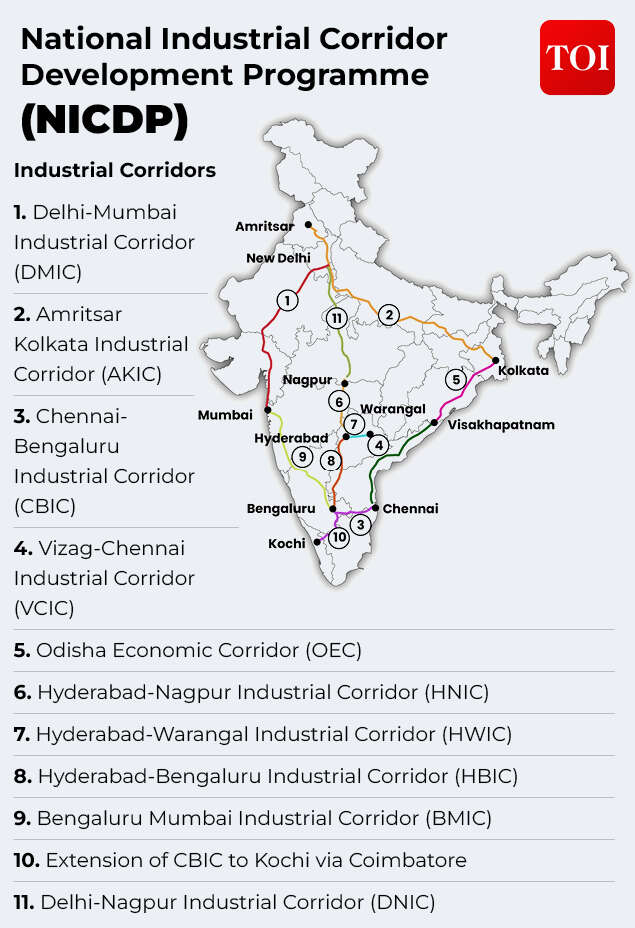
Industrial corridors in National Industrial Corridor Development Programme
The logic behind an industrial corridor is different from ordinary regional development spending. These are linear zones, built along major transport arteries, particularly rail trunk routes, that stitch together ports, airports and economic centres into one connected system, rather than leaving industrial growth to happen wherever land and labour are cheapest. The government’s own case for this model rests on a fairly simple chain of reasoning: better-connected infrastructure lowers the cost of production, lower production costs widen access to global markets, and wider market access pulls Indian manufacturing deeper into international supply chains it has historically sat on the margins of.There’s a practical layer to this too, one aimed less at economists and more at the businesses that actually have to set up shop. Corridors are meant to function as plug-and-play zones, land that comes with utilities, approvals and infrastructure already in place, cutting the time between a company breaking ground and a company actually producing something. Special Economic Zone incentives are folded in to help pull in the kind of foreign investment that greenfield industrial nodes need to get off the ground. And increasingly, the model comes with conditions attached: renewable energy adoption, waste recycling systems and green building norms built into these zones from the start, along with skill-development partnerships with local educational institutions meant to make sure the jobs these corridors create are filled by the workforce already living around them. Walk-to-work planning, shorter commutes, pedestrian-friendly layouts, more green space, is pitched as much a productivity argument as a liveability one.Put together, the case for going east isn’t that the region is an industrial blank slate waiting to be filled in. It’s that the east coast already has ports, trade volumes and manufacturing activity on the ground, what it has lacked, relative to the west, is the connective infrastructure and coordinated planning that corridors are designed to supply.Where the growth is happeningThe east coast’s raw material for this bet is already visible in the country’s export data. Among Indian seaports, Chennai handles close to $7.3 billion worth of exports, placing it third nationally behind only Nhava Sheva and Mundra on the west coast. Visakhapatnam follows at roughly $3.3 billion and Tuticorin at $3.2 billion, with Kolkata further down the list at around $2.8 billion. Together, these four ports — Chennai, Visakhapatnam, Tuticorin and Kolkata — represent the existing maritime backbone of the very corridor the Budget has now promised to formalise.
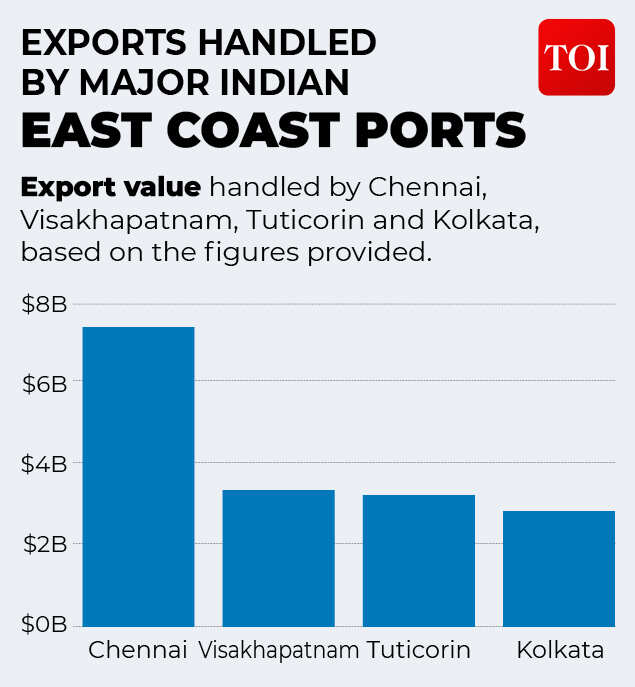
Where the growth is happening
The states behind these ports carry similar weight. Tamil Nadu, Andhra Pradesh, West Bengal and Odisha already have significant export bases, with all four featuring among India’s leading exporting states in recent official trade data. That’s not a coincidence of geography, it reflects decades of manufacturing and port activity that have quietly built up along this coastline even without the kind of dedicated corridor infrastructure the west has had access to since the Delhi-Mumbai Industrial Corridor took shape. The Durgapur node, and the broader East Coast Corridor it anchors, is being layered onto that existing base rather than built from scratch.What the numbers showThe scale gap, though, makes the case for investment becomes clearer. Nhava Sheva alone moves close to $29.3 billion in exports, roughly four times what Chennai, the leading east coast port, handles, and more than the combined exports of Chennai, Visakhapatnam, Tuticorin and Kolkata put together. Mundra, the second-largest port nationally at $12.8 billion, also outpaces every individual east coast port by a wide margin. The west coast’s dominance isn’t marginal; it’s structural, built up over years of concentrated infrastructure investment, deeper port capacity and the kind of corridor connectivity the east has only recently started to receive in similar form.That gap is precisely what the east coast Industrial Corridor is being pitched to close, not by inventing new economic activity on the coastline, but by giving existing activity the multimodal connectivity, plug-and-play industrial land and streamlined approvals that have helped the west pull ahead. Whether that closes the gap meaningfully will depend on how much of the Rs 3,000 crore allocation, and the broader NICDP pipeline behind it, actually converts into functioning ports, rail links and industrial parks on the ground, rather than remaining announcements on paper. It’s also worth noting that the government’s own trade data for 2026 shows sharp state-wise swings this year across the board, a reminder that any single year’s export numbers can move for reasons well beyond corridor infrastructure, from global demand cycles to shifts in specific export categories, and are worth reading alongside longer-term trends rather than in isolation.Can the East become India’s next industrial belt?The ingredients are, on paper, already in place: four working seaports handling billions of dollars in trade, four states with established export bases, a national programme with eleven corridors already under implementation and four of those already complete. What’s been missing is the thing corridors are specifically designed to provide, the connective tissue between ports, industrial land and transport networks that turns individual pockets of manufacturing into a coherent, competitive belt.
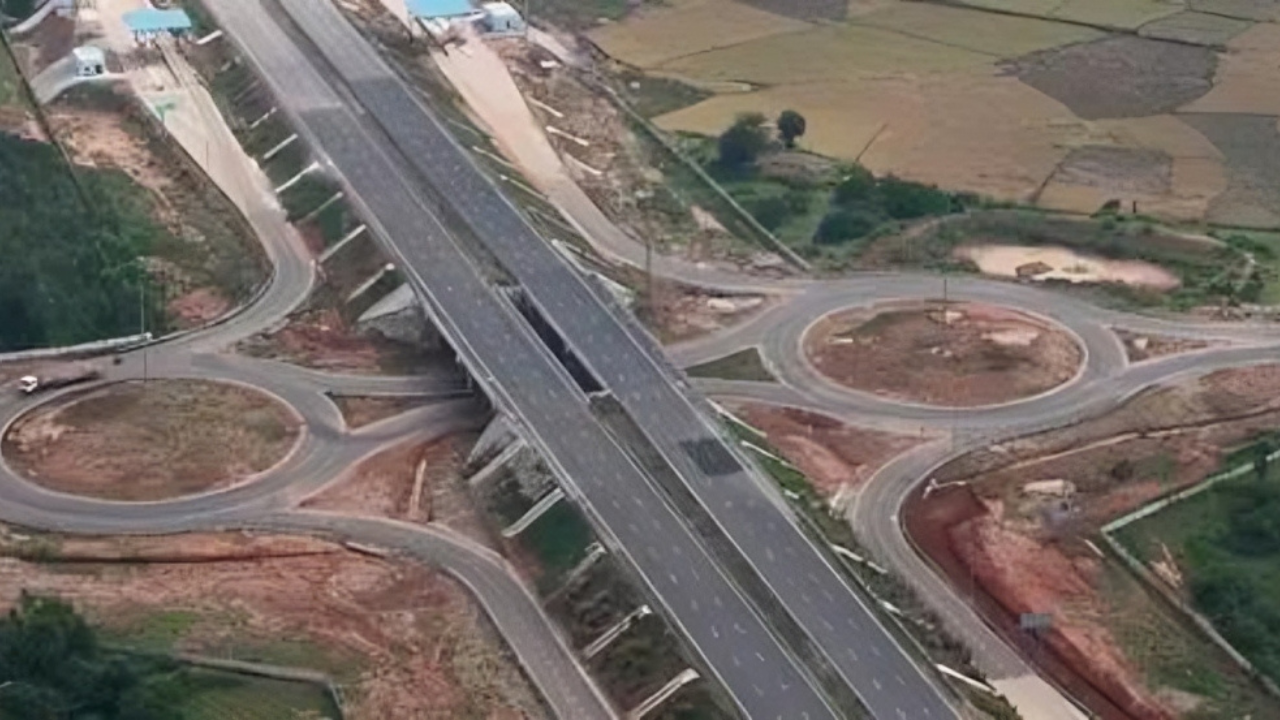
India’s next big industrial push is looking east, toward the Bay of Bengal, rather than west
The Durgapur node gives that ambition a physical anchor for the first time in this Budget cycle. But an anchor isn’t a corridor, and the distance between a Budget announcement and a functioning industrial belt has, in India’s own recent history, often been measured in years rather than budget cycles, the Delhi-Mumbai Industrial Corridor itself took over a decade to move from conception to operational nodes. Whether Durgapur and the ports around it can compress that timeline, and whether Odisha, Andhra Pradesh, Tamil Nadu and West Bengal can convert their existing trade base into the kind of globally competitive manufacturing hub the west coast has spent decades building, is the question the next few Budget cycles will have to answer. For now, the intent is formally on record: India’s next big industrial push is looking east, toward the Bay of Bengal, rather than west.