











BENGALURU: Karnataka has recorded the steepest fall in spousal violence, according to the National Family Health Survey (NFHS-6) fact-sheet, dropping from 44.4% to 14.1% of ever-married women reporting abuse between 2019-21 and 2023-24.The decline of over 30 percentage points dwarfs every other state. Nationally, India’s spousal violence rate fell from 29.2% to 22.3%. Karnataka topping the table of sharpest decline is in contrast with the state’s position in the previous survey.
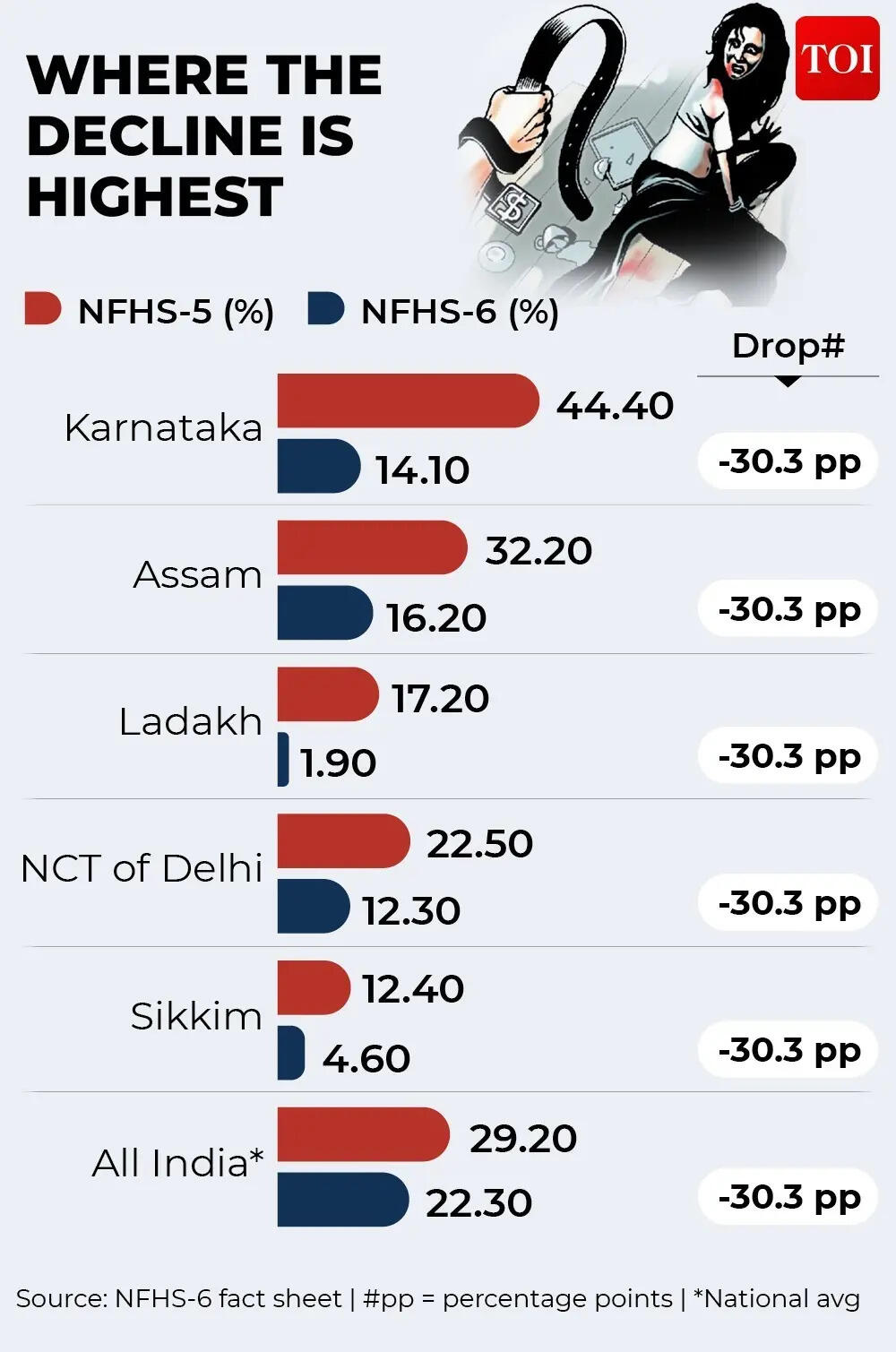
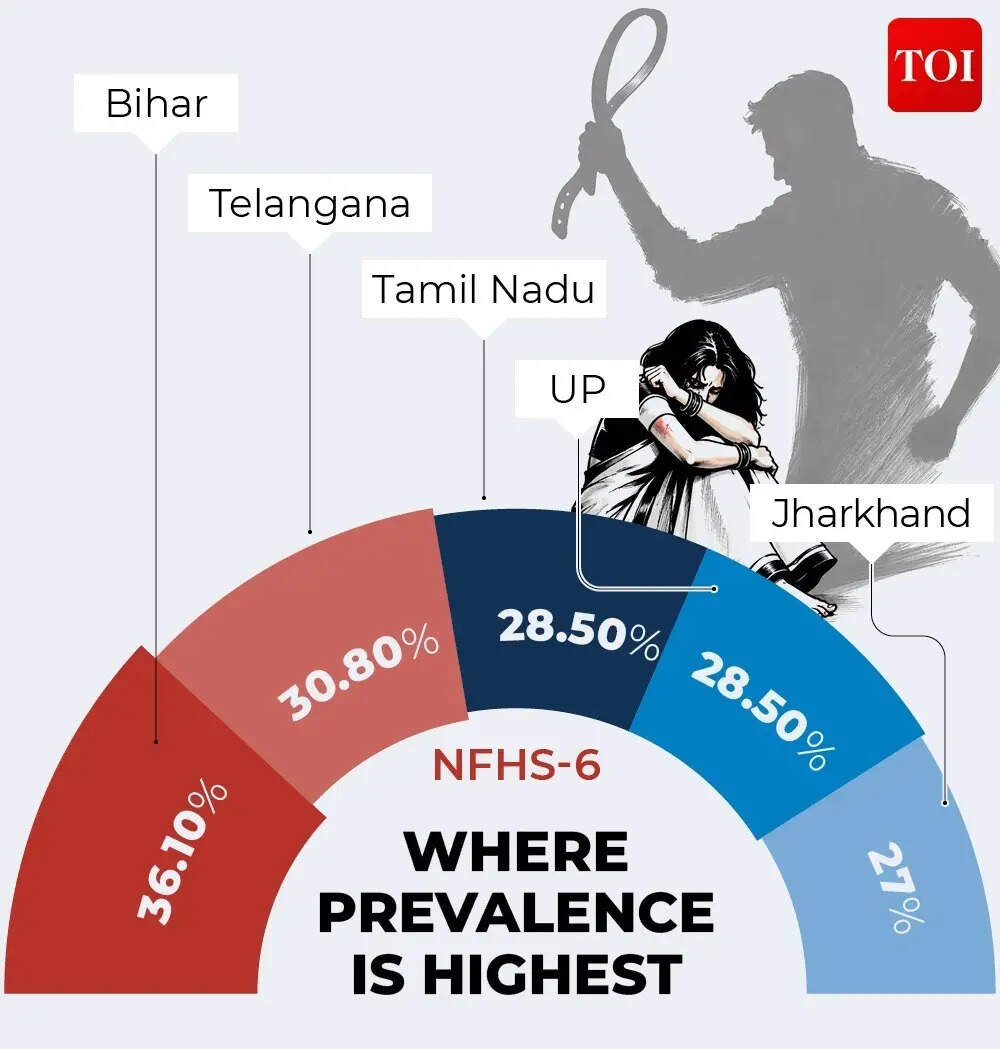
In NFHS-5, Karnataka was the worst-performing state in the country on spousal violence, followed by Bihar (40.1%), Tamil Nadu (38.1%), Telangana (37.2%) and Chhattisgarh (40.1%). In NFHS-6, Karnataka sits in the middle of the national distribution, comfortably below the likes of Bihar (36.1%), Telangana (30.8%), and Tamil Nadu (28.5%), which remain the states with the highest reported rates.Assam, the second-biggest mover, reduced its rate from 32.2% to 16.2%, a 16-point drop. Karnataka’s figure is nearly double that. A 30-point decline in a single cycle, while not impossible, is rare in survey data of this kind.To address concerns of whether such a massive improvement was a result of change in the questionnaire, which could have elicited different answers, TOI compared questionnaires of NFHS-5 and 6. The question structure, routing logic, and response options all appear identical between the two rounds.
Prof CM Lakshmana, head of Population Research Centre (PRC) at the Institute for Social and Economic Change (Isec), which conducted NFHS-6 in 15 districts in south Karnataka, told TOI: “I feel the decline reflects not one reform, but many — fewer child marriages, better education, greater financial inclusion, and women’s stronger voice in households. Empowerment, when structural and sustained, becomes the most powerful shield against domestic violence.”Explanations for the massive improvement may come once there’s a thorough review of interviewer selection and training.All these, however, are expected to become public only when the full report for the state is released by the ministry of health and family welfare.What is not in dispute is the national trend. Across India, spousal violence is falling.The full NFHS-6 state report for Karnataka, expected to contain disaggregated data and methodological notes, may hold some answers. Until then, the headline number is both a reason for hope and a prompt for harder questions.Spousal violence against married women drops in Bihar (2019-21)The latest National Family Health Survey (NFHS-6) data reveals a promising decline in spousal violence against married women (aged 18-49 years) in Bihar. However, despite this progress, the prevalence remains exceptionally high, positioning Bihar among the most challenging regions for women’s domestic safety in India.According to the latest NFHS-6 fact sheets released Friday, 36.1% of married women in Bihar reported experiencing spousal violence. This marks a notable improvement of 4 percentage points from the 40.1% recorded during the NFHS-5 (2019-21) survey. State authorities attribute this steady contraction to localised female empowerment schemes, education, increased digital inclusion, and stricter institutional vigilance.While the dip reflects a positive trajectory for Bihar, the state’s numbers paint a sobering picture when placed against the pan-India landscape. The NFHS-6 national average for married women experiencing partner-led abuse stands at 22.3% — a steep reduction from 29.2% in NFHS-5. Bihar’s prevalence rate of 36.1% sits a staggering 13.8 percentage points higher than the national baseline, highlighting a persistent regional crisis in gender-based safety.Social activists and health experts note that deep-rooted patriarchal structures, economic dependence, and substance abuse continue to block faster recovery.“The 4% reduction shows that our grassroots interventions and women’s self-help groups are creating an impact,” stated an official of the state’s social welfare department. “However, the massive gap between Bihar and the rest of India means we need aggressive social reform, better legal aid accessibility, and economic safeguards for rural housewives,” he said.Similarly, gender rights activists stress that the statistics might show only a fraction of the reality. “While a lower percentage is a step forward, under reporting remains an issue,” claimed Sunita Mishra, a researcher at a Darbhanga-based women’s rights organisation. “We must ensure that women who have survived spousal violence are not left to suffer in silence, but they should have the institutional backing to seek immediate help,” she added.Tamil Nadu: 38% women faced domestic violence (2019-2021)This is a distinction Tamil Nadu won’t be happy about. About 38.1% of women in the state in the 18-49 age group have experienced domestic violence by their spouses. Among southern states, only Karnataka is higher, with 44.4%, according to the National Family Health Survey – 5 (2019-2021)In Tamil Nadu, the survey was done among 27,929 households, 25,650 women and 3,372 men.Around 38.1% of women in the age group of 18-49 years experienced domestic violence by their spouses in Tamil Nadu, the survey said. In the previous survey, NFHS-4 (2015-16), 40.7% said they faced spousal violence.The survey data shows that about 44.4% of women in Karnataka, 36.9% in Telangana, 30% in Andhra Pradesh and 9% in Kerala suffered spousal physical and sexual violence. Whereas in Punjab it is 11.6%, Maharahstra 25.2%, Delhi 22.6% and West Bengal 27%.NGOs and activists have ascribed the high percentage of women suffering from domestic violence to high consumption of alcohol. The increase in domestic violence cannot be attributed to lockdown as the data was conducted from January 6, 2020, to March 21, 2020, and from December 21, 2020 to March 21, 2021, post lockdown by School of Public Health, SRM University.This shows that a pandemic of violence was prevalent much before Covid-19 and its ramifications unfolded.Advocate Sudha Ramalingam said it was good to see women exposing cruelty against themselves, due to awareness and with legal aid available. “It is unfortunate to see a man feel it is his right to beat a woman. They should feel spousal violence is wrong.”