









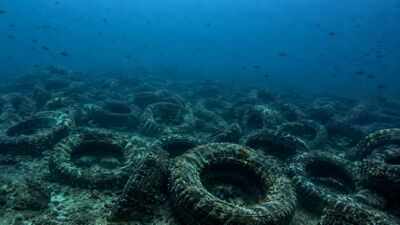
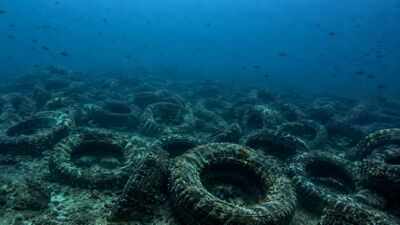
In the early 1970s, state officials and the US Army Corps of Engineers approved the dumping of vast numbers of used tyres into the Atlantic Ocean off Broward County, Florida. The idea was simple: create cheap, abundant artificial reef habitat to boost fish populations for anglers. Instead, the scheme left behind what is now known as the Osborne Tire Reef, a scattered underwater tyre field that has drifted far beyond its original footprint and damaged the very coral habitat it was meant to support. More than five decades on, Florida is still working to remove the tyres and repair the ecological harm.
Why millions of tyres were dumped off Florida in the 1970s
According to the Florida Department of Environmental Protection (DEP), the tyres were placed “predominantly between two coral reef tracts in the 1970s for fishery enhancement purposes.” At the time, reports from the 1960s and early 1970s recommended tyres for artificial reef construction because they were plentiful, cheap and easy to handle, while their use also offered a convenient solution to the growing problem of tyre disposal. State and federal permits were duly issued, and the material was deployed offshore of Fort Lauderdale, roughly three to four miles north of Port Everglades Inlet.Poor record-keeping at the time means nobody knows exactly how many tyres went into the water, with historical estimates ranging between 1 million and 2 million, according to the Restoration Plan. Whatever the true figure, the tyres did not stay where they were put. Decades of storms and hurricanes broke bundles apart and scattered loose tyres across a far wider area than intended, carrying them into contact with the reef complexes the project was originally meant to help.
2024 survey finds 521,000 tyres scattered across more than 6,000 acres
The true extent of the problem only became clear through recent survey work. A 2024 sonar and AI-assisted mapping exercise, referred to in the Restoration Plan as the 2024 Tire Survey, found tyres distributed across all four of the region’s reef complexes and sand habitats, covering more than 6,000 acres, compared with roughly 770 acres identified in an earlier 2019 survey. Combining data from both surveys, the DEP estimates that approximately 521,000 unburied and visible tyres remain in the surveyed area, of which around 429,000 sit in sand habitat and up to 92,000 are in contact with coral reef.A companion in-water assessment, the 2024 Recon Survey, sent divers to 30 sites to examine tyre condition and reef impact directly. Most sites had relatively few tyres actually on the reef itself, with the majority instead aggregated in sand patches and troughs nearby, representing what the Plan describes as ongoing potential for future damage as tyres continue to shift. Stony corals were found growing on tyres at 18 of the 30 sites, and four shallow-water sites contained the endangered staghorn coral species growing in proximity to mobile tyres, indicating a continuing risk to protected species.
Florida has been removing Osborne Tire Reef tyres since 2006
Efforts to retrieve the tyres date back to a NOAA-funded reconnaissance project in August 2006, according to the DEP’s project summary, which examined removal strategies and tested diver retrieval and disposal methods through a pilot programme. Removal work has continued since under state agency contracts, most recently Agency Contract SW348, renewed in February 2023 and running until February 2028, alongside a further Agency Contract SW349 executed in September 2025 and due to expire in September 2032.The 2023 Florida Legislature formalised the state’s obligations through the Restoration of Osborne Reef Act, which required the DEP to produce a status report on tyre removal, completed in December 2023, followed by this comprehensive Restoration Plan, due by 1 July 2024. The Plan sets out a lengthy timeline: removing tyres from sand and coral reef habitat and completing biological restoration is expected to take 14 fiscal years from July 2024, at an estimated annual cost of between $6 million and $13 million, and a total projected cost of around $137 million.
Osborne Tire Reef restoration aims to replace lost coral across 247 acres
According to the Florida Osborne Tire Reef Restoration Plan, a biological restoration programme intended to replace lost coral function in the worst-affected areas. Using benthic survey data collected by Broward County between 2003 and 2021, the DEP calculated a marked decline in stony coral density over that period and used this figure, applied across roughly 247 acres of identified impact area, to arrive at a target of 98,101 coral colonies to be grown and outplanted across ten priority grid cells in each of the region’s three main reef complexes.Before any tyres can be removed from reef habitat, divers must first relocate stony coral colonies growing on them, following requirements set out under a Florida Fish and Wildlife Conservation Commission Special Activity License. Contractors are also required to secure permits from several agencies, including Broward County, the DEP, the South Florida Water Management District and the US Army Corps of Engineers, before restoration work in coral reef habitat can begin. As of late May 2024, according to the Plan, around 1,400 corals had already been removed from tyres under the existing project, with more than 1,000 outplanted directly onto natural reefs.