









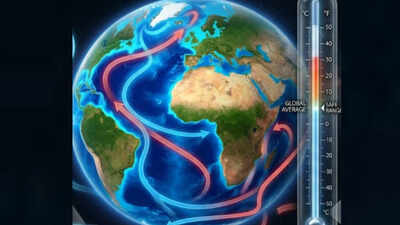
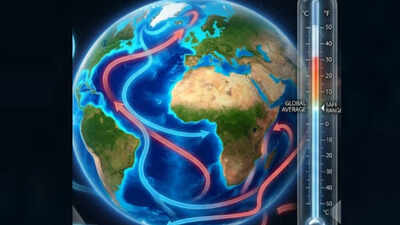
Earth has gone through many periods of warming and cooling over its long history. Despite these changes, the planet has remained capable of supporting life for hundreds of millions of years. Scientists have long believed that Earth has a natural system that helps keep its climate from becoming too hot or too cold over very long periods. However, how this system works exactly had remained unclear.A new study now has identified an important part of that natural climate control. According to it, changes in sea level influenced the amount of a key nutrient, phosphate, in the ocean which affected the amount of carbon dioxide in the atmosphere and has helped regulate Earth’s climate over the past 60 million years.The study published in the Proceedings of the National Academy of Sciences, was co-authored by Zunli Lu, professor of Earth and environmental sciences at Syracuse University, along with researchers from the University of Oxford and the University of Copenhagen.
Sea affected climate
To understand the findings, it is important to know that carbon dioxide is one of the main gases responsible for warming the planet. The more carbon dioxide in the atmosphere, the warmer Earth becomes.One way carbon dioxide is removed from the atmosphere is through the ocean. Tiny marine organisms absorb carbon as they grow. When they die, some of their remains sink to the seafloor and become buried in sediments. This locks away carbon for millions of years instead of allowing it to return to the atmosphere.Scientists have known that atmospheric carbon dioxide fell significantly as Earth gradually cooled over the last 60 million years. But they were not sure where much of that carbon had gone. The new research suggests that much more carbon was buried beneath the ocean floor than previously thought.“We know that atmospheric carbon dioxide decreased substantially as Earth cooled over the last 60 million years, but we have had remarkably little understanding of where that carbon ended up,” said lead author Ros Rickaby, professor of Earth sciences at the University of Oxford, as quoted by Science Daily.“Our results suggest that enhanced burial of organic carbon in marine sediments played a much more important role than was previously appreciated,” she added.
Role of phosphate
At the centre of the study is phosphate, a form of phosphorus that all living organisms need to grow. In the ocean, phosphate acts as a nutrient for microscopic marine life. The more phosphate is available, the more these tiny organisms can grow.Although scientists have studied carbon dioxide and ocean chemistry for years, the researchers say phosphate has largely remained an overlooked part of the climate system and the sea level directly influenced how much phosphate reached the open ocean.
When sea levels were high
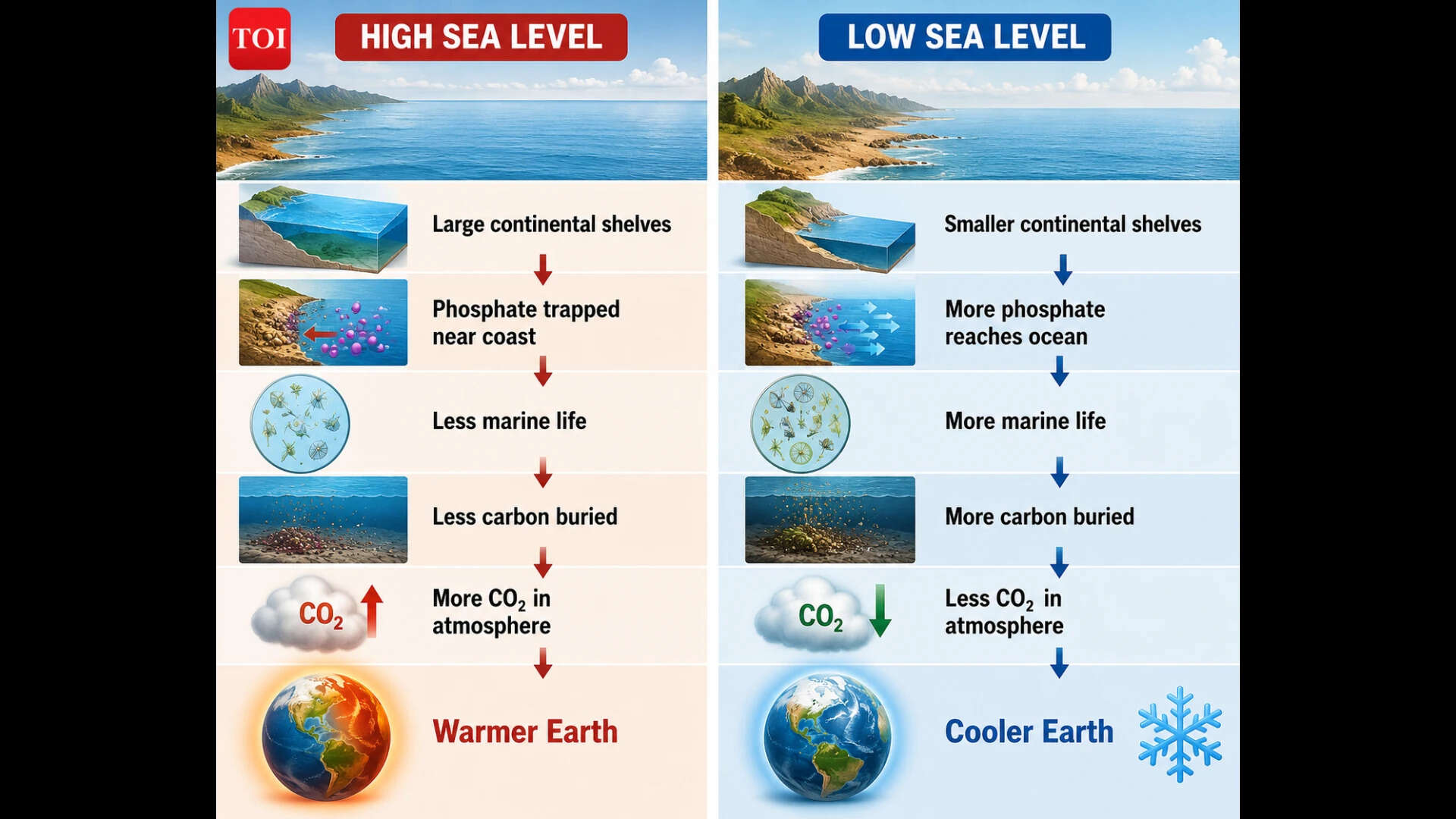
When Earth’s climate was warmer, polar ice sheets were smaller and sea levels rose. As sea levels increased, shallow coastal regions known as continental shelves became larger. These shelves trapped phosphate in coastal sediments instead of allowing it to spread into the open ocean.With less phosphate available, fewer marine organisms grew. As a result, less organic matter sank to the ocean floor, reducing the amount of carbon buried in sediments. More carbon dioxide therefore remained in the atmosphere.The oceans also contained more oxygen during these periods because there was less decomposing organic matter using up oxygen. Overall, these conditions supported a warmer climate.
.
Falling sea levels changed process
The opposite happened when Earth cooled and sea levels dropped. Lower sea levels reduced the size of continental shelves, allowing more phosphate to enter the open ocean.The additional phosphate helped marine life grow in greater numbers. When these organisms died, they sank to the seafloor. As they decomposed, they used up oxygen in the surrounding water.Over time, some parts of the ocean became low in oxygen. These low-oxygen conditions triggered another important process. Sediments on continental shelves released even more phosphate into the water.That extra phosphate supported even more marine life, creating a cycle that increased the burial of carbon on the seafloor. As more carbon became locked away in sediments, less carbon dioxide remained in the atmosphere, helping cool the planet.“Our co-author, Christian Bjerrum, studied the connection among sea level, ocean oxygen and phosphate with a computer model two decades ago. We finally pieced together the geologic records necessary to test this hypothesis,” Lu said.
‘Sweet spot’ for carbon
The researchers found that this natural feedback system worked best when sea levels were around 10 to 40 metres higher than they are today. At those levels, low-oxygen waters overlapped with carbon-rich sediments found on continental shelves.This combination allowed especially large amounts of carbon to be buried beneath the seafloor over millions of years. According to the researchers, this acted like a natural brake on Earth’s climate by removing carbon dioxide from the atmosphere.
Looking back 60 million years
To test their idea, the scientists compared their model with geological records covering the last 60 million years. They examined carbon isotope records, measurements showing how phosphorus accumulated in deep-sea sediments and a newer method that estimates oxygen levels in ancient oceans.This method looks at the ratio of iodine to calcium in fossils of tiny marine organisms called foraminifera. These microscopic organisms lived in the ocean millions of years ago. After they died, their shells settled on the seafloor.By studying the chemical composition of these fossils, scientists can estimate how much oxygen was present in the seawater when the organisms were alive.
Why Eocene remained warm
The study also helps explain why Earth stayed unusually warm during the Eocene epoch, which lasted from about 56 million to 34 million years ago.During that time, sea levels were much higher than today. Large continental shelves were covered by seawater, trapping phosphate in shallow coastal sediments.Because less phosphate reached the open ocean, marine productivity remained relatively low. With fewer organisms carrying carbon to the seafloor, less carbon became buried.As a result, more carbon dioxide stayed in the atmosphere and Earth’s climate stayed warm for millions of years.
A stable climate
Researchers also say that this carbon burial system changed gradually over Earth’s history. They believe the low-oxygen zones where carbon burial happens slowly, moved into deeper waters over millions of years.This may have made Earth’s climate more stable by reducing large swings in atmospheric oxygen and carbon dioxide. In other words, the planet’s natural climate regulation system became more resistant to major disruptions over geological time.The researchers say the findings improve scientists’ understanding of how Earth’s carbon cycle has worked over millions of years.The study also adds to earlier work from Lu’s laboratory using the iodine-to-calcium method to reconstruct oxygen levels in ancient oceans. An earlier study published in Nature Geoscience used the same technique to show that tropical oceans during the Proterozoic Eon were rich in oxygen, the opposite of what is seen today.