











As Europe reels under increasingly intense heat waves with temperatures crossing 40 degrees, one question continues to puzzle visitors from warmer parts of the world — Why are so many homes, schools and even hospitals still without air conditioning?A report by The Wall Street Journal explores the continent’s long-standing aversion to ACs, tracing it to everything from climate goals and heritage preservation to noise complaints and urban planning.The question has gained urgency as the latest heatwave pushes European infrastructure to its limits. Roads have melted, tram tracks have buckled, train services have been disrupted, power grids have come under strain and hospitals have struggled to cope, while record-breaking temperatures have swept across several countries. Yet, despite the worsening climate, Europe’s relationship with air conditioning remains deeply complicated.
‘Don’t want to look like America’
For many European planners, rows of outdoor AC units are seen as visually unappealing and incompatible with historic neighbourhoods.“The goal isn’t to be like some Italian, Brazilian, or American cities where you have entire rows, entire walls of convectors outside buildings that make an unbearable racket, releasing heat and toxic fumes,” the Wall Street Journal quoted Audrey Pulvar, deputy mayor of Paris saying.In cities such as Paris, visible air-conditioning units can be rejected if they spoil the iconic limestone façades of Haussmann-era buildings.
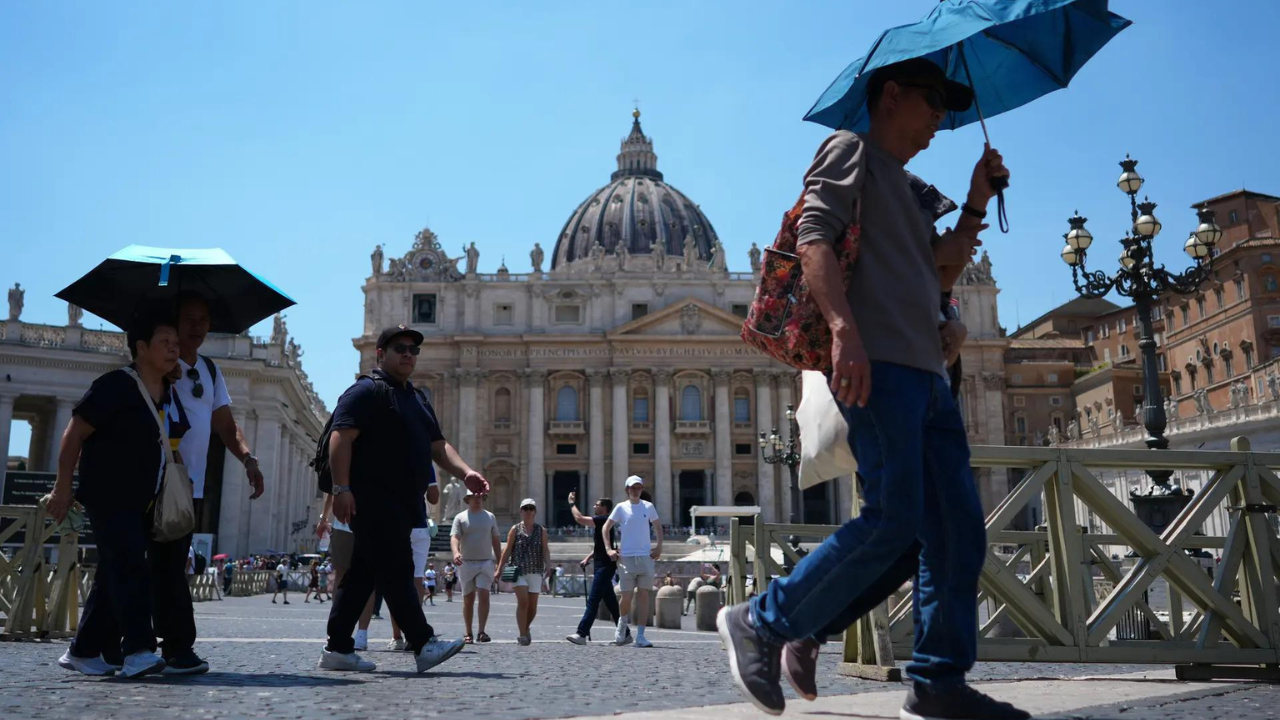
People shade from the sun under umbrellas as they walk through St Peter’s Square at the Vatican (AP)
‘Too noisy’
In parts of Europe, installing an air conditioner isn’t simply a homeowner’s decision.Apartment residents may need approval from neighbours, while local authorities can also intervene over planning rules, energy targets or noise concerns.According to the report, French law allows building associations to object if an AC unit exceeds strict noise limits, roughly equivalent to the sound of a light breeze. Lawyer Christophe Sanson, who specialises in noise disputes, told the newspaper his firm now handles more than 100 cases involving air-conditioning systems.“It’s a sound that can penetrate concrete, that is extremely powerful and can be deeply disturbing,” he said.32-year-old Luca Funaro, who has a rare genetic illness, has spent the past two years trying to get permission to install an air-conditioning unit in the courtyard of his apartment building in Paris’s Marais district. His neighbours have repeatedly objected, saying the unit would be too noisy.
Climate concerns
Europe has long viewed air conditioners as energy-intensive machines that could undermine its climate ambitions.Authorities have instead promoted alternatives such as better insulation, natural ventilation, shutters, tree cover and urban greening.However, the report notes that the intergovernmental panel on climate change considers air conditioning a highly effective way to protect people during extreme heat, while rating measures such as urban greenery and mechanical ventilation as less effective during prolonged heat waves.Oxford University climate scientist Radhika Khosla said that countries should combine better building design with air conditioning rather than relying exclusively on either.“You want to use it for what it’s really needed as opposed to making it your go-to solution,” she said.Moreover, French climate minister Monqiue Barbut said that ACs can’t be put everywhere.“I am horrified by people who say, ‘We only have to put air conditioning everywhere. Do you think that’s going to prevent forest fires? Do you think that’s going to prevent a crop from dying?” Barbut said.

A man on a train wipes sweat from his face on a hot day in London (AP)
Europe wasn’t built for 40 degrees
Much of Europe’s infrastructure was designed for a cooler climate, when temperatures above 40 degrees Celsius were rare.The report said that only around 25% of homes in France and about 5% in the United Kingdom have air conditioning, compared with roughly 56% in Italy.During the latest heat wave, thousands of schools shut down, businesses reduced operations and rail services were disrupted. Economists at ING said the conditions “brought back memories of the pandemic lockdowns.”Paris also crossed 40°C last week for only the fourth time since official records began in the 19th century.“We’ve always worked on the assumption that this scenario was possible starting in 2030… Now we realize that we are already there,” Pulvar said.
ACs become political flashpoint
As temperatures climb, air conditioning has become an unlikely political issue.Far-right leader Marine Le Pen has called for a nationwide expansion of AC systems, saying, “These heat waves kill; we must implement a major air conditioning plan!”Despite the resistance, attitudes are beginning to shift. The report noted that portable AC units are becoming increasingly common in England, while London Mayor Sadiq Khan recently argued that schools, hospitals and offices should be equipped with cooling systems.