

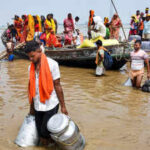





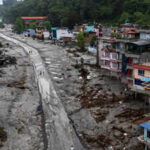

Nepal will collect and preserve DNA samples and other identifying information from victims whose bodies cannot be immediately identified before their remains are buried by the state, Prime Minister Balendra Shah said on Saturday.The measure comes as authorities continue to search for nearly 3,000 people missing after a devastating flood in the Himalayan region bordering Tibet. The disaster has killed more than 680 people in Nepal and Tibet.Nearly 3,000 people remain missing, including about 2,426 in Nepal and 546 in Tibet’s Gyirong County. At least 540 foreign nationals are among those missing.Triggered by a glacier collapse, a torrent of rock, ice, mud and debris swept through mountain river systems on Wednesday, engulfing villages and destroying buildings, bridges and power infrastructure.
DNA samples before burial
Some of the bodies recovered by rescuers have decomposed beyond recognition, making immediate identification difficult. Authorities have said such remains will be buried after completing the required legal formalities because of health risks and concerns over possible disease outbreaks.In a social media update on rescue and relief operations, Shah said bodies that could not be identified immediately would be handled under government guidelines governing unidentified and unclaimed remains.However, authorities will first preserve DNA samples and other information that could help establish the victims’ identities later.“DNA samples will be collected, and the bodies will be buried in an open space,” the Chitwan district administration said in a notice.Bodies that have been identified by families are being handed over to them.The process is intended to preserve an identification trail even when the condition of recovered remains makes visual identification impossible.
Families await news
In Kathmandu, relatives of missing people gathered outside Maharajgunj Medical Campus, where some recovered bodies were taken. Some searched through photographs displayed on gates and boundary walls in the hope of identifying loved ones.The scale of the disaster has also left families abroad waiting for information. In Malaysia, relatives of 91 citizens listed as “uncontactable” across Nepal and Tibet were awaiting updates.Manivannan Rethinam, a representative for some of the families, urged Malaysia’s foreign ministry to establish a communication channel to provide faster information, describing the wait as “profoundly painful”.Malaysia’s foreign ministry said search, rescue and verification efforts were continuing, while India’s Ministry of External Affairs said 275 Indian nationals were missing.
Rescue effort resumes
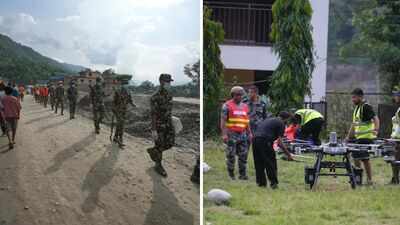
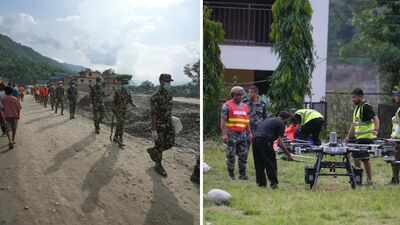
Search and rescue operations resumed on Saturday afternoon after rain and fog had temporarily halted efforts in Nepal.“Helicopters are flying and the operation resumed following some improvement in weather,” a police officer in the worst-hit Rasuwa district said, speaking on condition of anonymity because he was not authorised to speak to the media.Rescue operations had also been suspended on Friday after a lake formed across the Nepal-China border began overflowing into the Lhende Khola and Trishuli rivers.By Saturday, the immediate risk had eased, with Chinese authorities and state broadcaster CCTV reporting that parts of the lake bed had become visible. Satellite imagery indicated that the lake was gradually shrinking as water drained away.Nepal is monitoring two upstream lakes, with officials warning that flood risks will continue until both have fully drained.
Nepal seeks specialist help
Nepal has appealed for specialist international assistance as it confronts the challenges of rescue, recovery and identification.Foreign Minister Shisir Khanal said the country needed technical support to rescue people trapped in tunnels, restore transport and communication links damaged by destroyed bridges, identify bodies, conduct DNA testing and preserve remains for longer periods.A team of Indian tunnel experts arrived in Nepal on Saturday, while China has also dispatched tunnel specialists to assist with rescue operations.India has sent three flights carrying 60 tonnes of relief supplies, including food, medicines and blankets. It has also offered disaster-response personnel, prefabricated bridges and technical teams to help restore connectivity.In Tibet, Chinese authorities are continuing efforts to locate more than 500 people still missing. Rescuers reached the badly damaged Gyirong border crossing complex on Friday, using ropes to navigate forests and cliffs after roads were destroyed.More than 50 rescue workers searched through rubble, boulders and mud on Saturday morning, calling out for survivors, CCTV reported.The disaster has also left Nepal facing a massive reconstruction challenge. Finance Minister Swarnim Wagle told Reuters that the government’s preliminary estimate for rebuilding was between $4 billion and $5 billion, while stressing that the full scale of the damage was still being assessed.