









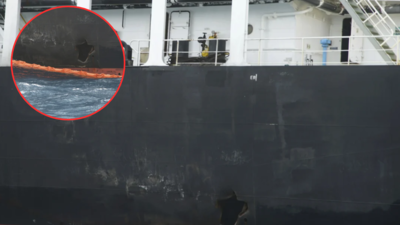
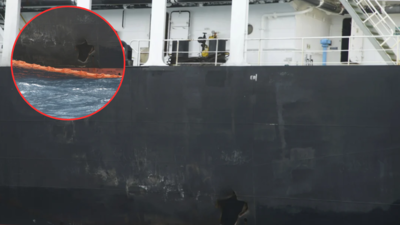
A Panama-flagged oil tanker carrying 27 Indian seafarers was targeted with limpet mines in the Strait of Hormuz, raising fresh concerns over the safety of commercial shipping in the strategic waterway. The explosives, reportedly attached to the vessel’s hull by a small craft, damaged its engine room and temporarily disabled the tanker before the fire was brought under control.The attack on MT Louise 1 on October 30 was described by maritime security sources as the first known successful use of limpet mines against a vessel in the region since the US-Iran conflict began in February. The incident came a day after another tanker, Liberia-flagged MT Arzanah, carrying two Indian nationals, was targeted in a separate projectile attack.Union minister for ports, shipping and waterways Sarbananda Sonowal said all 29 Indian seafarers aboard the two vessels were safe, with no injuries reported. “All 29 Indian seafarers across both vessels are completely safe with no injuries. We are continuously monitoring the situations & coordinating with the ship management companies to ensure the ongoing security and wellbeing of our crew,” he said.
What are limpet mines and how do they work?
Limpet mines are small explosive devices designed to attach themselves to the hull of a ship, usually with the help of magnets. They are named after limpets, a type of shellfish that clings tightly to rocks and is difficult to remove.According to The New York Times, the explosives are generally placed manually by swimmers, divers or frogmen. Unlike conventional naval mines, which may be anchored underwater or float near the surface, limpet mines are specifically designed to stick to their targets.They typically contain relatively small explosive charges and use a fuze, a mechanism that triggers detonation, often through a time-delay system. Some versions also have anti-removal mechanisms that can trigger an explosion if someone attempts to detach them.Their primary purpose is not necessarily to sink a vessel but to cause what naval experts call a ‘mission kill’, damaging critical components and rendering a ship unable to operate.According to Naval Technology, the MILA is a smart limpet mine featuring a computer-controlled detonation system. It can be attached to a ship’s hull by divers and can also be used as a demolition charge. Its conical shape and low underwater weight reduce hydrodynamic resistance, making it easier for divers to carry and deploy.
Why are they difficult to detect?
Limpet mines pose a particular threat because small boats can approach commercial vessels without immediately attracting suspicion. Tankers routinely operate alongside smaller craft in busy shipping lanes, potentially allowing attackers to get close enough to attach explosives.The New York Times noted that placing such devices on moving vessels is considerably more difficult than targeting ships at anchor or moored at ports.Their underwater placement also makes them particularly destructive. Water surrounding the explosive helps direct the force of the blast towards the ship’s hull, potentially creating significant damage even with a relatively small charge.The latest incident has highlighted the vulnerability of commercial vessels transiting the Strait of Hormuz, one of the world’s most important oil-export routes. Greece-based maritime risk management group Marisks described the tactic as “cheap, low tech and very efficient”.While maritime security sources have attributed the attack to limpet mines, responsibility for the incident remains unclear.