








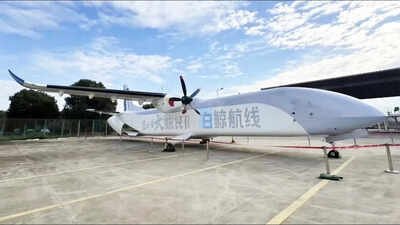
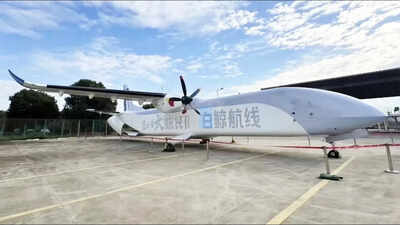
Unmanned aircraft now play an essential role in modern warfare, carrying out missions ranging from reconnaissance and surveillance to target identification and strikes.But their role on the battlefield is expanding beyond combat operations. Militaries are exploring their use in logistics, from transporting ammunition and medical supplies to delivering food and equipment to troops in remote and contested areas.China’s unveiling of an eight-tonne cargo drone marks another step in this shift, as countries look to integrate unmanned aircraft into military supply operations.The W8000, developed by Chinese aviation company Air White Whale, was unveiled in Zhuhai ahead of the China International Aviation & Aerospace Exhibition, scheduled to open on December 7, defence publication The War Zone reported.The twin-turboprop aircraft is designed to carry up to eight metric tonnes of cargo and features a rear loading ramp for transporting bulky equipment and palletised freight.However, the W8000 remains a developmental concept, and its proposed payload capacity has not yet been demonstrated in flight. Its range and maximum takeoff weight have also not been disclosed, TWZ reported.The W8000 follows the company’s smaller W5000 cargo drone, which completed its maiden flight on November 14 in Inner Mongolia. The W5000 is designed to carry up to five tonnes of cargo, has a reported maximum range of 2,600 km and a maximum takeoff weight of 10.8 tonnes.Chinese sources have reported that Air White Whale has received 835 orders or prospective commitments for the W5000, with commercial operations targeted for the end of 2027, subject to testing and certification.Why is China developing larger cargo drones?China’s push to develop heavy-lift cargo drones is linked to the challenge of supplying troops and maintaining military operations across remote and contested areas.The aircraft could provide the People’s Liberation Army (PLA) with another means of transporting ammunition, medical supplies, food, spare parts and equipment to military installations, particularly in remote locations and island outposts in the South China Sea.Their potential value becomes more significant during a conflict, when military bases, ports and conventional supply routes could come under attack. Uncrewed cargo aircraft could help maintain supply operations without exposing pilots to the risks associated with flying into contested areas.They could also support China’s military presence across the Indo-Pacific by providing supplies to locations where maintaining regular transport links is difficult.However, their ability to operate in a conflict would depend on their range, payload, survivability and resistance to electronic warfare, including GPS jamming and disruption of communications.China is not alone in the raceThe United States is also developing autonomous cargo aircraft, with military planners looking at their potential to transport supplies to troops operating across remote islands and forward bases in the Indo-Pacific.The US military’s interest is driven by the need to maintain supply lines during a conflict, when conventional transport aircraft, ships and logistics infrastructure could face attacks.US aviation company Textron Aviation and autonomy specialist Merlin are developing the Cessna SkyCourier UX, an uncrewed version of the twin-engine SkyCourier. The aircraft is designed to carry around 6,000 pounds (2.7 tonnes) of cargo.The US air force has also explored autonomous Cessna Caravan aircraft for logistics operations in the Pacific, including demonstrations involving Joby Aviation’s former Xwing autonomy team.China, meanwhile, is pursuing several cargo drone programmes, including the W5000, W8000, HH-100 and CH-YH1000. The W8000’s proposed eight-tonne payload would exceed the stated capacities of the US aircraft discussed above, although it remains a developmental concept.Why cargo drones matter in modern warfareMilitary operations depend on the ability to move ammunition, food, fuel, medical supplies and equipment to troops. In a conflict, these supply lines can become targets, particularly when forces operate across remote islands, forward bases and areas exposed to enemy attacks.Cargo drones could provide another means of maintaining these supply lines. Unlike conventional transport aircraft, uncrewed aircraft do not put pilots at risk during cargo missions. They could also operate alongside crewed aircraft and ships to deliver supplies to locations where conventional transportation is restricted.The US military has identified this challenge as contested logistics. US air force Lieutenant General Kenyon K Bell, deputy chief of staff for logistics, engineering and force protection, said that “the era of uncontested logistics is over”.Bell said the US military would need to sustain its forces while operating under threat, highlighting the need to rethink how supplies are transported during a conflict.US air force chief of staff General Kenneth Wilsbach has also acknowledged the potential of autonomous cargo aircraft in the Pacific, saying the service was evaluating different aircraft demonstrators, although it did not have a programme of record for their procurement at the time.The development of heavy-lift cargo drones could therefore add another component to military airlift capabilities. However, their operational value would depend on payload, range, reliability and their ability to function when communications and satellite navigation systems are disrupted.